25 Years of China’s Advantage and America’s Amnesia


China versus the United States: a permanent normalized trade regret
Welcome back Friday. This is our weekly summary of current news on the economy, the current collapse of expert authority, and the historic policy mistakes made by our nation’s leaders and the public intellectuals who support them.
Twenty-five years after our markets opened to China, Beijing celebrated the anniversary by closing its own markets. Economists are still hiding from their massive inability to predict the results of trade with China and are now trying to put a number on them. why tariffs work when they weren’t supposed to. And in the nation’s capital, Republicans continue to explain why they plan to shake up the middle class to fund Obamacare. Progress, in its own way.
Happy twenty-fifth Chinaversary!
This week marks the twenty-fifth anniversary of the granting to China Permanent normalized trade relations with the United Statespaving the way for China’s entry into the World Trade Organization the following year. While Breitbart marked the quadricentennial with a guest essay by Sen. Jim Banks (R-IN), the occasion received almost no attention in mainstream media or academia.
We believe that one reason for this is that any memory would clearly indicate that Granting normalized trade relations to China was one of the worst public policy mistakes in the history of the United States. At the time, the consensus among American political leaders and intellectuals was that deeper trade ties would benefit the American economy and American workers, lead to political liberalization and promote individual rights in China, and open a huge new market for American companies.
Here is a brief excerpt from President Bill Clinton’s remarks after the US Senate approved the PNTR for China:
In exchange for normal trade relations, the same terms of trade we currently offer to more than 130 other countries, China will open its markets to American products, from wheat to automobiles to consulting services. And we will be much more capable of selling goods in China without moving our factories there…
The more China opens its markets to our products, the more it will open its doors to economic freedom and the more it will fully unlock the potential of its people.
When China completes its negotiations and joins the WTO, our high-tech companies will help accelerate the information revolution in this country. External competition will accelerate the demise of China’s huge state-owned industries and boost private sector involvement. They will reduce the role of government in people’s daily lives. This will strengthen those in China who are fighting for higher labor standards, a cleaner environment, human rights and the rule of law. And we will discover, I believe, that America has more influence in China with an outstretched hand than with a clenched fist.
The reality was almost the photographic negative. American companies were not only required to manufacture goods in China in exchange for access to its market, they also had to reach out to Chinese partners. This arrangement made technology theft easier. U.S. exports to China have not grown at the rate of the Chinese economy.so that today China’s export-to-GDP ratio is about two-thirds of what it was before the turn of the century. Chinese exports to the United States have taken a reverse direction. In 1999, U.S. exports to China accounted for about 1.2 percent of China’s GDP. Today, that share is around 0.8 percent. During the same period, Chinese exports to the United States increased from about 0.9 percent of U.S. GDP to 1.5 percent. In other words, we have changed positions and more.
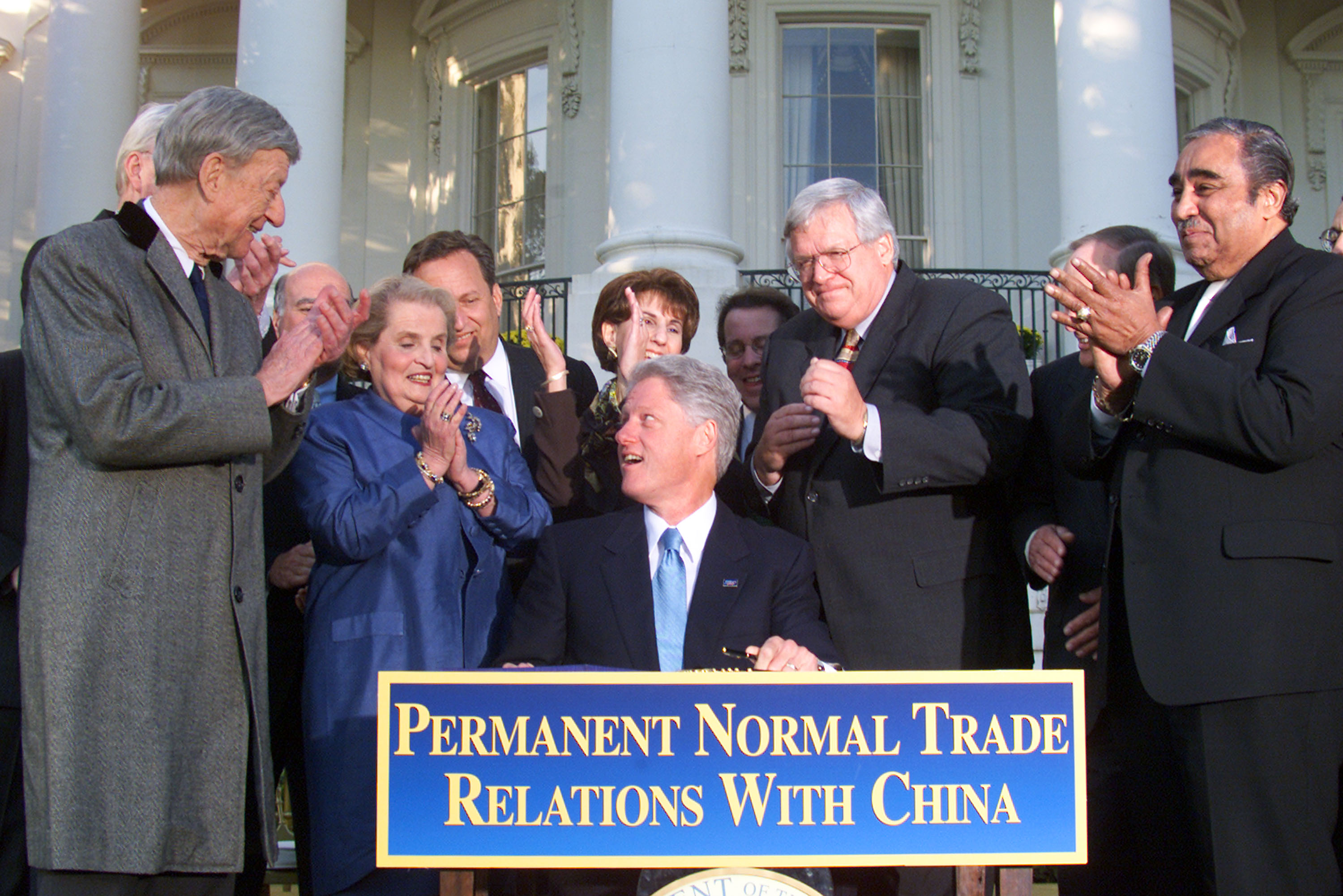
President Bill Clinton is surrounded by Secretary of State Madeleine Albright, Treasury Secretary Lawrence Summers, Trade Representative Charlene Barshefsky, Speaker of the House Dennis Hastert and members of Congress as he signs a bill on permanent normal trade relations with China October 10, 2000, in Washington, DC. (Mark Wilson/Actors via Getty Images)
China is still dominated by state-owned industries, state-adjacent businesses, and a ruling party clique. The main political reform was the consolidation of authority around a single dictator, Xi Jinping. The role of the Chinese government in the daily lives of its citizens has increased rather than diminished. The leaders of those in China fighting for human rights, the rule of law, the environment and higher labor standards have been eliminated. We have less influence in China than we used to.
It should not have been missed that this episode would be a fiasco for the field of economics if knowledge had a wider diffusion. At the time, American economists almost universally agreed that access to American markets would liberalize China, promote individual freedom, take power away from central planners, lower China’s trade barriers, and be an unqualified boon to the American economy.
In 2000, more than 150 of the era’s most prominent economists – including 13 Nobel laureates – signed an “Open Letter to the American People” urging the United States to support China’s entry into the WTO. It was undoubtedly the most elite intellectual support for globalization since Bretton Woods. Two and a half decades later, the historical record gives us a clear verdict: almost every major prediction contained in that letter has been proven wrong. Worse still, there has never been any public awareness of this catastrophic failure of foresight and the erratically deployed expert authority.
Birthday present from China: rare earth retaliation
China has chosen to celebrate the anniversary by ensuring that it conducts global trade with “Chinese characteristics” – in other words, by weaponizing its dominance in rare earth minerals. Beijing announced Radical and strict export controls and new licensing rules covering any product containing even traces of rare earths processed in China. The move reverses the conciliatory tone China took during trade talks earlier this year in Geneva, London and Stockholm.
No one should be surprised. State-led economic aggression is the perfect way for China to celebrate a quarter century of exploiting Western opening-up.
President Trump responded with cancel plans to meet with Xi Jinping later this month in Korea and threatening “massive” new tariffs. It’s a good start. But the deeper lesson is that America’s dependence on Chinese supply chains remains a strategic vulnerability. If this episode accelerates decoupling, Beijing may have done us an involuntary service.
Economists: still making business mistakes after all these years
Even the Washington Post begins to admit what we have been saying for years: the consensus among economists was seriously wrong on tariffs. In a remarkable column this week, Matthew Lynn wrote that the profession’s predictions of recession and runaway inflation have collapsed under the weight of reality: growth approaching 4%, inflation below 3% and tariff revenues soaring. This article marks a turning point: after decades of anti-tariff dogma, public debate is shifting toward a populist view that markets adapt, foreign producers absorb costs, and the United States can use trade policy to strengthen its own economy.
Will the Republican Party become Obamacare’s tax collector?
Take away the theatrical shutdown measures and you’re left with the real question: Should we lock in the Affordable Care Act’s (ACA) pandemic-era subsidies as a permanent entitlement?
Obamacare was initially sold as a way to lower health care costs without increasing public spending – a self-financing reform which would even reduce the deficit, according to its supporters. It did none of that. Premiums have increased and the program will now cost hundreds of billions of dollars over the next decade.
This created pressure to increase subsidies. When COVID hit, the pressure became unbearable. THE enhanced credits were sold on a temporary basis relief. Democrats now want them permanent, transforming Obamacare from a regulated market with targeted aid into an unlimited entitlement that automatically increases with premiums and enrollment.
Republicans oppose it on cost – and on principle. But politically, these are losing arguments. They are led to act as Democratic health state tax collectors. Democrats are shutting down the government to cut premiums, while Republicans are pushing for higher household costs. This is not a winning framework.
There is an exit ramp, although it is not cheap. Republicans could support maintaining increased subsidies for working-class and middle-class Americans, while ensuring illegal aliens…including DACA recipients and Biden parolees— remain ineligible. They could also reinstate small bonuses for “Zeros”, those who pay nothing under the current formula. Even $30 a month – a typical phone bill – would seem fair to most voters and would restore the principle that recipients should contribute something.


