50 years ago, a single keystroke changed Apple and the world forever


One of the most substantial developments in the history of computer science occurred 50 years ago. He put Apple on the right track to become one of the most precious companies on the planet and changed the face of computer science unfathomablely. However, you have probably never heard of what happened. It is an often overlooked moment that has had incredible consequences for the years to come.
Handling on a computer is something we all want for granted. One of Apple’s main philosophies has long been to remove the technology from your path – Steve Job and Jony Ive have been lyrical on this idea – so day by day, we never really think of how writing on a computer really works.
We can debate the advantages and disadvantages of various screens and even build our own personalized mechanical keyboards to adjust the experience to our taste. But the fundamental concept of typing on a keyboard and seeing the characters appear on your screen in front of you is something that is rarely questioned.
It was not always that way. In the early 1970s, the idea that a person could sit in their own house with an affordable computer that adapts to their office and tapping characters who were reflected on a connected display felt almost incomprehensible for most people.
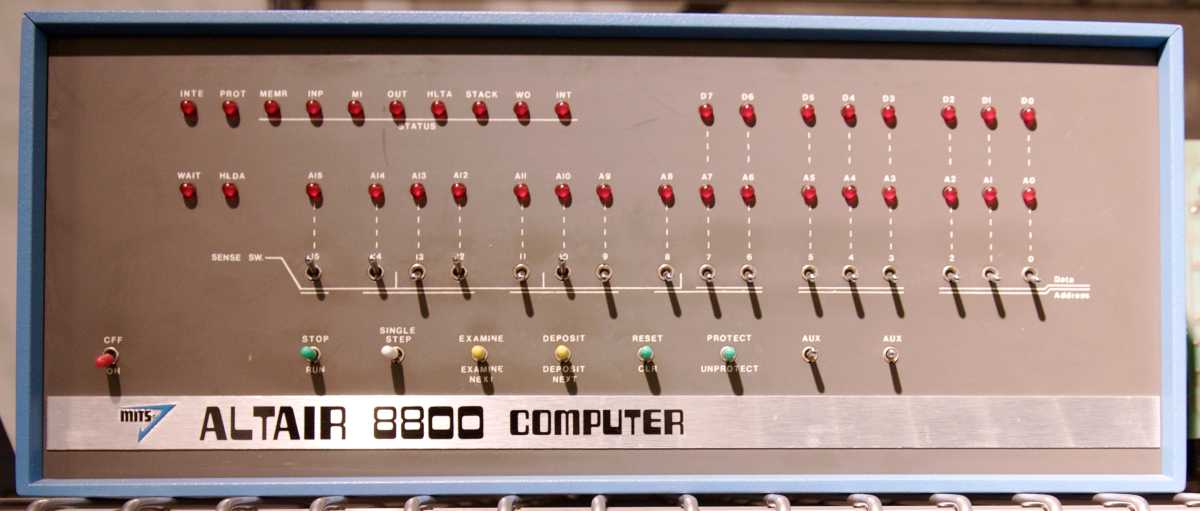
The Altair 8800 is recognized to be the first personal computer, but its user interface was anything but “personal”.
Todd Daily / Wikipedia
At the time, most computers were several orders of magnitude larger than the Macs of today, the majority of them confined to research laboratories and secure facilities. A handful of “personal computers” had been created, such as the Altair 8800 in 1974, but their Byzantine operations were eccentric to use (Altair, for its part, required reversal switches and then interpreting the confused light patterns produced by the device). You had to weld everything yourself, and even when you had finished, you still couldn’t do much.
But at the same time as Altair made waves in the IT community, two people worked on something much more revolutionary. They would continue to create the first real personal computer, upset the IT industry and change the world in the process.
Innovation at reduced prices
These people were Steve Jobs and Steve Wozniak, the founders of Apple. In the mid -1975, they had worked for a few months on their own personal computer, which would become Apple I.
At the time, Wozniak was employed at HP, and he spent his evenings after work at his office finding the design of the Apple I. After a few months, he had a functional prototype ready to be tested.
I typed a few keys on the keyboard and I was shocked! The letters were displayed on the screen.
Steve Wozniak
It was the big moment. “I hit a few keys on the keyboard and I was shocked! The letters were displayed on the screen,” said Wozniak. “It was the first time in the story that anyone tapped a character on a keyboard and saw him appear on the screen of his own computer right in front of them.”
For the context, many computers at the time required a terminal to display the characters. You would enter your characters in the terminal, which would feed them on the computer, then display the result on its screen. The thing you are lurking was not to be treatment itself, where Wozniak’s creation differs.
Instead, Wozniak’s design included the entire package: a computer that could be interacted directly. And not only that, but he also managed to do it at an incredibly affordable price compared to alternatives.
For example, although a computer costs you only a few hundred dollars in 1975, a terminal could cost you $ 1,000, or about $ 6,000 today. Wozniak, however, managed to create a computer with budgetary parts. The processor he chosen only cost him $ 20, for example, which was a flight compared to the Altair 8800 chip which said that Wozniak cost “almost more than my monthly rent”.
Not only did Wozniak managed to create a computer the size of an office, but they did it at a low cost that could be transmitted to all those who wanted to buy their own model. This combination of portability and price was the key ingredient to launch the personal computer revolution.
Change the world
Wozniak was convinced that he and Jobs should give their computer for free. They were members of the Homebrew Computer Club based in Menlo Park, whose guiding principle was to “give help to others”. The jobs, however, saw things differently and finally convinced Wozniak that they should sell the aircraft and train a business around him.
Unlike the computer world at the time, their goal was to make a computer that was available by everyday people. After all, a computer is hardly “personal” if no ordinary people can afford it. Jobs and Wozniak were convinced that as many people as possible should have a computer.
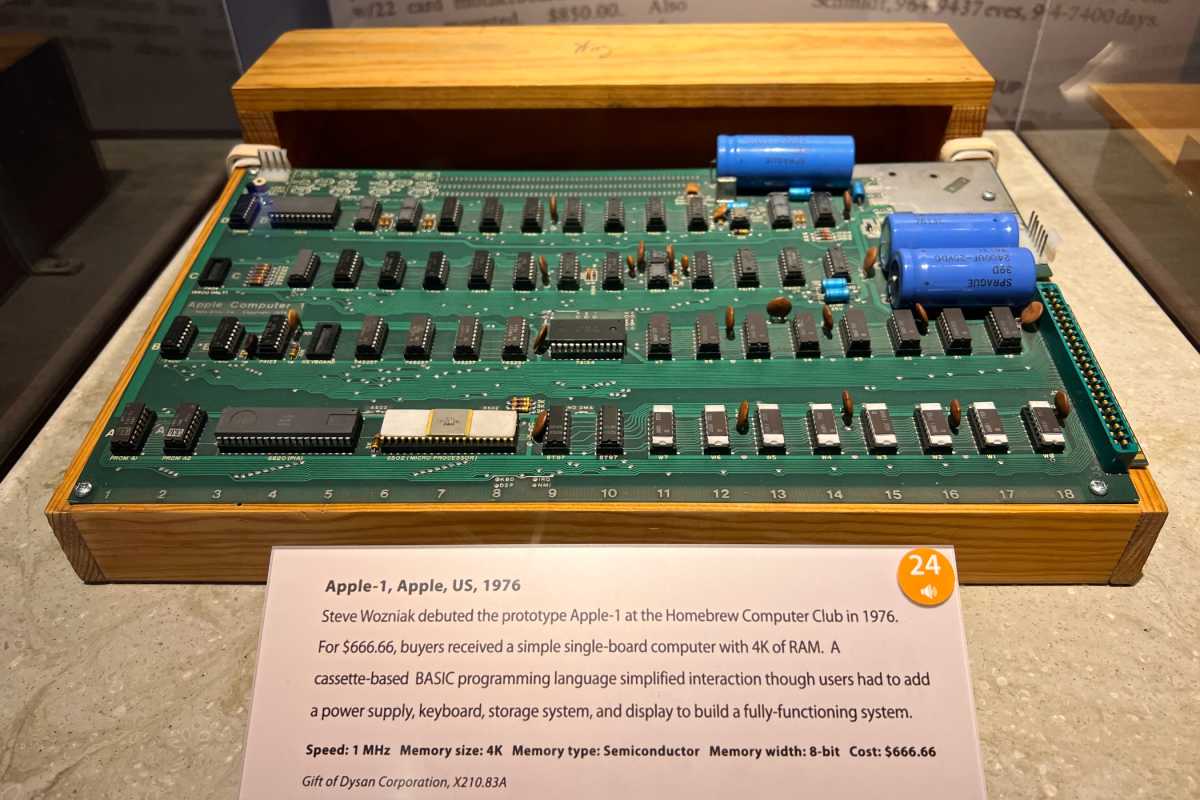
To this end, they evaluated the apple I at $ 666.66, chosen because Wozniak loved repetitive numbers (rather than for satanic purposes). The computer would become one of the first accessible computers designed for personal use.
Foundry
Nowadays, it might not look much like. He lacked a keyboard, a mouse and a display, and he had not even come with a case. But compared to his rivals, he was revolutionary. It was small enough to hold on your desktop, could be connected to a television and devices that you already had, and did not require an esoteric operating procedure, paper cards, a flashing light interpretation or one of the other huts confused which tormented its ancestors.
And perhaps the most exciting of all, there was this innate ability to combine typing and treatment power. The result was that without the need for a large and expensive terminal, the apple that I could be a more acceptable living room presence than any previous computer. This has forever changed the appearance of computers and the way they worked.
Without Wozniak’s radiance of engineering, the apple that I would never have been born. Without the conviction of Jobs that it was something that should be sold to the masses, Apple himself would never have succeeded. And none of this would have happened was not for these few fateful strikes than on June 1975. Find out more about Apple’s story.


