780,000-Year-Old Charcoal Reveals How Early Humans Mastered Fire


Hominids at the Acheulian site of Gesher Benot Ya’aqov in Israel relied on driftwood collected from a lake to fuel their homes, according to new research by archaeologists at the Institut Català de Paleoecologia Humana i Evolució Social and Bar-Ilan University; Fragments of 780,000-year-old charcoal from the site show that survival was not about finding the perfect wood, but rather understanding the landscape well enough to let it stand.

The ancient inhabitants of the Gesher Benot Ya’aqov site in Israel likely used some sort of earthen oven that maintained a temperature below 500 degrees Celsius to cook their fish. Image credit: Ella Maru / Tel Aviv University.
“Charcoal rarely survives at such ancient prehistoric sites, making an unusually large assemblage from Gesher Benot Ya’aqov a unique window into the daily practices of early fire users,” said Professor Naama Goren-Inbar of the Hebrew University of Jerusalem and colleagues.
“While many ancient sites preserve only fragmentary or ambiguous traces of burning, this Acheulian site provides a remarkably detailed record of the repeated use of fire over tens of thousands of years.”
“Gesher Benot Ya’aqov preserves a multi-layered history of human occupation along the shores of Paleolake Hula, with more than 20 archaeological horizons documenting generations of Acheule hunter-gatherers returning to the same location.”
At Gesher Benot Ya’aqov, researchers discovered a vibrant landscape of activity: stone tools made from flint, limestone, and basalt; the remains of hunted animals; and a wide range of plant foods, including fruits, nuts and seeds harvested from the lakeshore.
“One particularly striking layer captures a dramatic moment: alongside stone tools and plant remains, researchers discovered the skull and bones of an elephant with straight tusks, evidence of large-scale hunting and butchery,” they said.
“The spatial arrangement of the remains suggests that the animal was treated on site.”
“In the heart of this ancient camp, life was fire. »
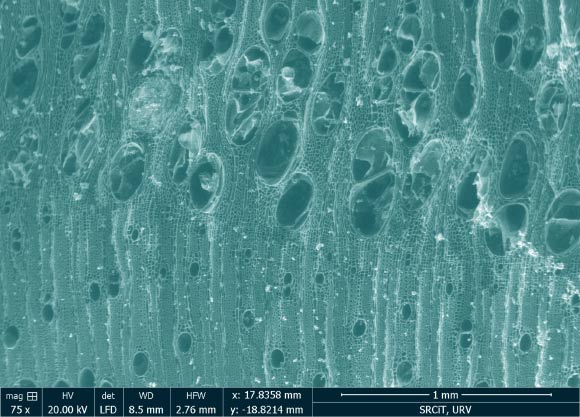
A fragment of charcoal observed under an ESEM microscope. Image credit: M. Moncusil, PHES.
In their current research, the scientists focused on a single occupation layer dating to around 780,000 years ago.
They analyzed 266 charcoal fragments, using microscopic techniques to identify the internal structure of the wood and determine its botanical origin.
The results revealed a surprisingly diverse mix of plant species, including ash, willow, vine, oleander, olive, oak, pistachio and even pomegranate, providing the first known evidence of this fruit tree in the Levant.
Unexpectedly, the charcoal assemblage showed greater plant diversity than other botanical remains at the site, such as seeds, fruits, or unburned wood.
This suggests that firewood collection captured a broader cross-section of the environment than other forms of plant use.
Together, these species paint a vivid picture of the ancient landscape: a mosaic of moist lakeside vegetation and open Mediterranean forests.
But more importantly, they reveal how early humans interacted with this landscape.
Rather than selectively collecting specific types of wood, Gesher Benot Ya’aqov hominins appear to have relied primarily on driftwood that naturally accumulated along the lake shores.
Fallen branches and logs, carried by the water and deposited along the shoreline, would have created a readily available supply of fuel.
The composition of the charcoal closely reflects the wood available in that environment, suggesting a practical and efficient strategy, using what the landscape offers.
This idea leads to a broader conclusion: Access to firewood may have been a deciding factor in where these early humans chose to live.
The shores of the lake offered not only fresh water, edible plants, animals, and raw materials for tools, but also a constant supply of fuel, essential for sustaining the fire.
The team’s spatial analysis shows that dense clumps of charcoal overlap with concentrations of fish remains, primarily the distinctive teeth of large carp.
This co-occurrence adds compelling evidence that fish was cooked at the site nearly 800,000 years ago, likely using a carefully controlled fire.
These findings reinforce the idea that hominids possessed advanced cognitive abilities.
They were able to control fire, organize the space around it and integrate it into complex subsistence strategies.
Interestingly, although hunting and tool making required elaborate planning, firewood collection itself appears to have been a more routine activity, based largely on availability rather than careful selection of specific tree species.
Together, these behaviors paint a picture of a community that was both highly skilled and deeply in tune with its environment, repeatedly returning to a place that offered everything it needed to survive and thrive.
“The Gesher Benot Ya’aqov charcoal assemblage provides a unique dataset for examining the intersection of fire use, environmental context, and hominid behavior,” the authors said.
“The results refine current models of early fire-related practices and highlight the importance of local resource availability in shaping occupation and subsistence patterns during the Middle Pleistocene.”
Their article appears in the journal Scientific reviews of the Quaternary.
_____
Ethel Allué and others. 2026. Paleoenvironmental and behavioral insights into firewood selection by early Middle Pleistocene hominids. Scientific reviews of the Quaternary 38:109973; doi: 10.1016/j.quascirev.2026.109973