95 million-year-old ‘tiny, tiny skull’ from never-before-seen crocodile-like creature discovered in Montana


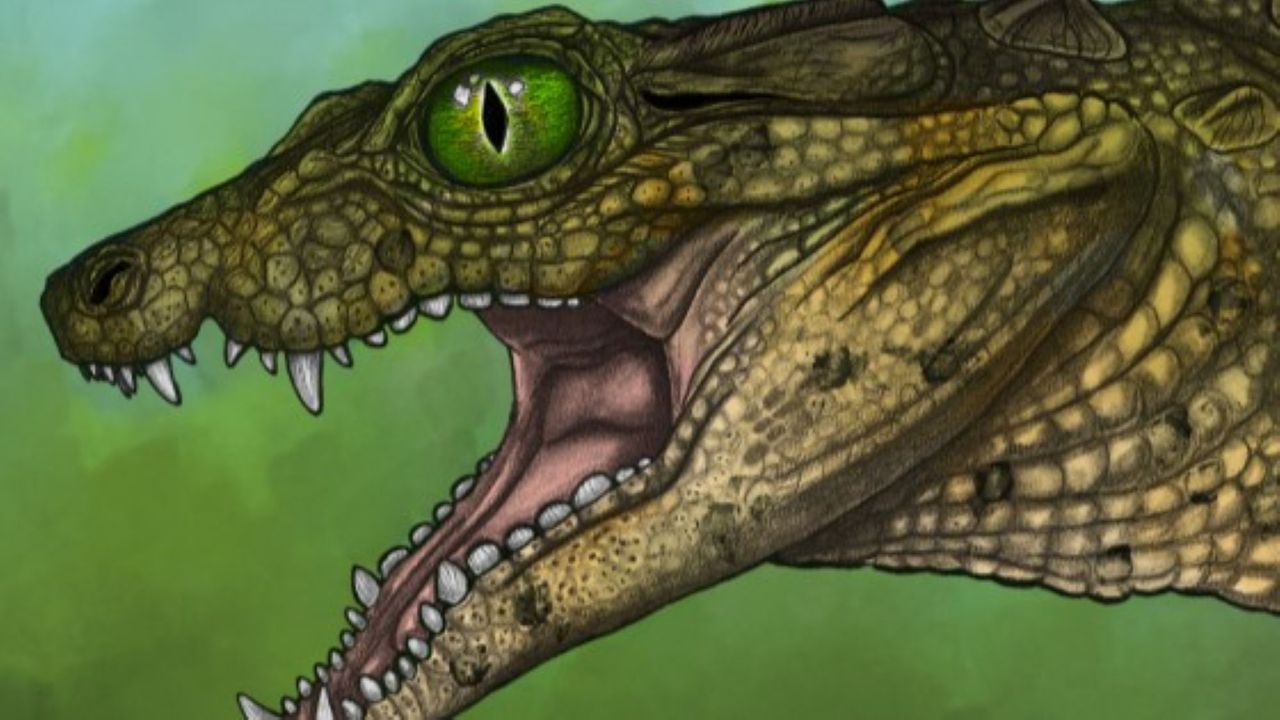
About 95 million years ago, small crocodile creatures with strange and sheathed teeth searched along the banks of the Western interior maritime path in what is now the southwest of Montana, suggests a new study.
The new research describes the first creature of this type never discovered – an adolescent hook nicknamed Elton who was measuring about 2 feet (60 centimeters) from the nose to the tip of the tail. Elton fossilized remains were discovered in 2021 during a excavation organized in the geological training of black heads, which dates from the middle of the Cretaceous (145 million to 66 million years old).
The first fossil that Allen noticed was the skull of Elton, which was only 2 inches (5 cm) long and integrated into the rock, according to the press release. Allen showed the miniature skull for David VarricchioProfessor of paleobiology, taphomy and ichnology at the Montana State University, which immediately understood the importance of the fossil.
“After the excavation, Dr. Varricchio explained to me why he was so excited the day I found the initial specimen,” said Allen. “He has so much anatomy visible to explore, and he could see that it was a tiny croche in croc, entirely articulated and preserved – it was a special thing.”
It turns out that Elton belonged to a now extinct family of creatures of the crocodile type, or crocodyliforms, that the researchers did not know before. This family, called Wannchampsidae, is in the Neosuchia line, which includes all modern crocodilians and their nearest parents. Its members lived in North America during the Cretaceous, and they were much smaller than the other Neosuchiian fangs; If Elton had survived until adulthood, he would have reached only 3 feet (90 cm) long, according to the press release.
Neosuches are generally semi -aquatic or marine carnivores with simple and conical teeth – but not Elton. He and his colleagues from the new species, named Thikarisuchus xenodenthad an assortment of teeth of different shape, including shelled fangs and other specialized fangs, which they used to devour plants and insects, according to the press release.
Elton and his genre also lived on earth, and they probably made grounds in the ground, depending on the way in which Elton’s bones were densely packed when Allen and his colleagues analyzed them, according to the press release.
Shortly after finding Elton’s skull, Allen returned to collect surrounding sediment bags to search for more clues on the animal. He spent hours spending through dirt, extracting bone fragments and rebuilding the Thikarisuchus Skeleton little by little. He worked with his classmate Dane JohnsonNow a paleontology laboratory and a field specialist at the Museum of the Rockies in Montana – often up to Elton John’s song in 1972 “Crocodile Rock”, which inspired the name Elton.
To obtain a clear image of the fossils, Allen then made CT scans, which helped him to distinguish between the bones and the pieces of rock which were always stuck in the remains of Elton. “Harrison has worked very hard to digitally rebuild the animal, and it came out beautifully,” said Varricchio, who is co-author of the new study, in the press release.
A detailed description and photos of T. Xenodedentas well as a discussion on the position of the new species in the evolutionary tree, are included in the study, published on September 22 in the Journal of Vertebrate Paleontology. In particular, researchers highlight a family of old crocodyliforms called atopasauridae that is previously found in Eurasia and looks like Elton, with a small body size and similar dental characteristics.
“This suggests that during the same period, we see a convergent development between two distant groups due to similar environmental conditions, the availability of prey and who knows what prompted the fangs on the opposite sides of the planet to develop similar characteristics,” said Allen.


