Slavs Originated in Ukraine and Southern Belarus, DNA Study Finds


The second half of the first millennium in central and eastern Europe was accompanied by fundamental cultural and political transformations. This period of change is generally associated with the appearance of Slavs, which is supported by textual evidence and coincides with the emergence of similar archaeological horizons. However, so far, there has been no consensus that this archaeological horizon has spread by migration, “Slaviization” or a combination of the two. The genetic data remains rare, in particular due to the generalized practice of cremation at the start of the Slavic colony. In new research, scientists have sequered genomes from 555 ancient people, including 359 samples of Slavic contexts from the 7th century of the ECT. The new data demonstrates a large -scale population movement from Eastern Europe to the 6th century, replacing more than 80% of the local genes in eastern Germany, Poland and Croatia.
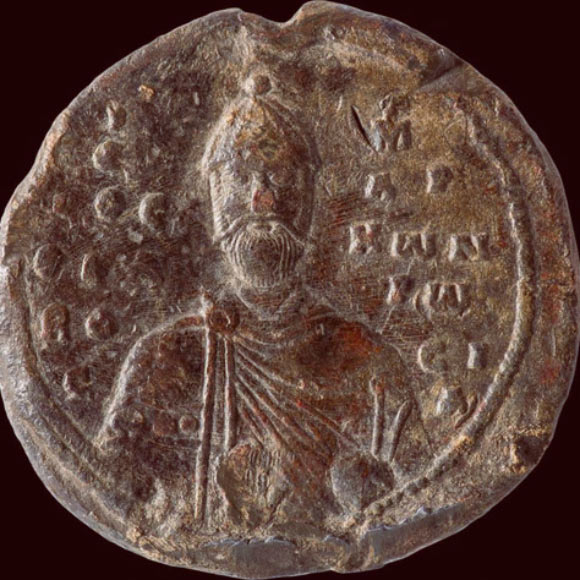
Seal of Yaroslav the Sage, the great prince of kyiv from 1019 to 1054 and the father of Anna Yaroslavna, the Queen of France. Image credit: Sheremetievs Museum.
The term Slavs appeared for the first time as an ethnonym during the 6th century in Constantinople and later in the West.
Written sources initially locate them north of the lower Danube, and later in the Carpathian basin, the Balkans and the Eastern Alps.
Many are noted from the Avar Steppe rule empires along the Middle Danube (567 CE at around 800 CE).
In the 7th century, there was evidence of the presence of Slavs in a large part of the center-east and southeast of Europe.
When the Slavs lived, the Roman, Germanic infrastructure and other pre-Slavic infrastructures were generally replaced by fairly simple lifestyles, archaeologically characterized by small colonies of pitfid houses, burials of cremation, non-decorated and modest pottery and low-metal material culture, known as Prague-Korchak group.
More complex social systems and regional leaders developed later in the contact areas with Byzantium and the Christian West.
How Slavs transformed Europe
The first former complete DNA study of medieval Slavic populations shows that the rise of Slavs was, at the base, a history of people in movement.
Their genetic signatures underline an origin in the region which extends from southern Belarus to the center of Ukraine – a geographic area which corresponds to what many linguistic and archaeological reconstructions had long suggested.
“Although the direct evidence of the first Slavic nucleus regions are still rare, our genetic results offer the first concrete clues to the Slavic ancestry formation – pointing to a probable origin somewhere between the Dniester and Don rivers,” said Dr. Joscha Gretzinger, a geneticist at Max Planck Institute for Evolutionary.
In the study, Dr. Gretzinger and his colleagues obtained data at the genome scale of 555 unique ancient individuals from 26 different sites from central and eastern Europe, creating, in combination with data previously published, a dense sampling transect for three regions: (i) Elbe-Saal in the east of Germany as the main area of study, (ii) in the North-West (III) Polar-Northwester.
The new data show that, from the 6th century AD, large -scale migrations transported the ancestry of Eastern Europe in large regions of central and eastern Europe, which caused the displacement of the genetic composition of regions like East Germany and Poland.
However, the expansion did not follow the model of conquest and empire: instead of sweeping armies and rigid hierarchies, the migrants have built their new societies on flexible communities, often organized around extended families and links of patrilineal kinship.
In addition, it was not a uniform and uniform model in all regions.
In eastern Germany, the change was deep: large multi-generational pedigrees have become the backbone of society, with more extensive and structured kinship networks than small nuclear families observed during the previous migration period.
On the other hand, in fields like Croatia, the arrival of Eastern Europe groups has brought much less disturbances to existing social models.
Here, social organization has often preserved many characteristics of previous periods, resulting in communities where new and old traditions mixed or persisted side by side.
This regional diversity in the social structure underlines how the propagation of Slavic groups was not a unique process, but rather a dynamic transformation which adapted to local contexts and stories.
“Rather than one people moving like one, the Slavic expansion was not a monolithic event but a mosaic of different groups, each adapting and mixing in their own way – suggesting that there was never a single identity ” Slave ”, but many,” said Dr. Zuzana Hofmanová, a researcher at Max Planck University.
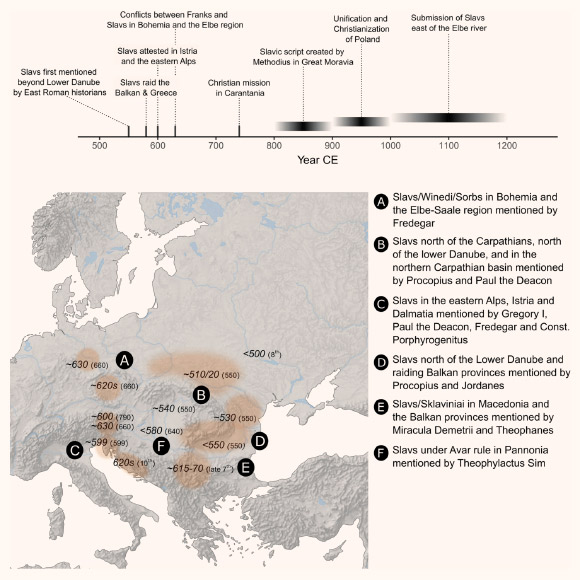
Historical overview of Slavs in Europe: the calendar lists the main historical events associated with Slavs in Central Europe; The map has historical certificates schematized for the appearance of Slavs (Sklavenoi – Slavi – Winedi); The italic numbers indicate the date of the attested event, with the date of the respective report in parentheses. Image credit: Gretzinger and al., DOI: 10.1038 / S41586-025-09437-6.
Eastern Germany
In eastern Germany in particular, genetic data show a particularly striking story.
After the decline of the Thurinian kingdom, more than 85% of the regional ancestors can be allocated to new arrivals from the East.
This marks a change in the previous migration period, when the population was a cosmopolitan mixture as the best illustrated by the Brücken site.
With the propagation of Slavs, this diversity has given way to a population profile almost identical to modern Slavic groups in Eastern Europe.
These new communities have organized around large expanded families and patrilineal descents – while women of marrying age generally left their villages of origin to join new households elsewhere.
In particular, the genetic heritage of these first settlers from Eastern Europe today continues among the songs, a Slavic Slavic minority in eastern Germany.
Despite centuries of surrounding cultural and linguistic change, the sorbs have preserved a genetic profile closely linked to the early medieval populations that adjusted the region more than 1000 years ago.
Poland
In Poland in particular, research reverses the previous ideas of long -term continuity of the population.
The genetic results show that from the 6th and 7th centuries, the previous inhabitants of the region – the descendants of populations with strong links with Northern Europe and Scandinavia in particular – have almost entirely disappeared and were successively replaced by the new arrivals of the East, who are closely linked to modern posts, the Ukrainians and the Belausians.
Although the change of population is overwhelming, genetic evidence also reveals minor traces of mixing with local populations.
These results underline both the extent of the change of population and the complex dynamics that has shaped the roots of the linguistic landscape of today’s central and eastern Europe.
Croatia
The Balkans of the North specifically present a different diagram compared to the northern immigration zone – a history of change and continuity.
The old DNA of Croatia and neighboring regions reveals an important influx of ancestry linked to Eastern Europe, but not a complete genetic replacement.
Instead, migrants from Eastern Europe have mixed with various local populations in the region, creating new hybrid communities.
Genetic analyzes indicate that in the populations of the current Balkan, the proportion of this ancestry of entrant oriental Europe varies considerably but often represents about half or even less of the modern genetic pool, highlighting the complex demographic history of the region.
Here, the Slavic migration was not a wave of conquest but a long marriage process mixingly and adaptation, resulting in the cultural, linguistic and genetic diversity that still characterizes the Balkan peninsula today.
New chapter in European history
Especially when the first Slavic groups are found in the archaeological and historical archives, their genetic traces correspond: an ancestral common origin, but regional differences shaped by the degree of mixing with local populations.
In the north, the Germanic peoples earlier had moved away, leaving room to the Slavic colony.
In the south, new arrivals from Eastern Europe merged with established communities.
This patchwork process explains the remarkable diversity found in cultures, languages and even the genetics of Central and Eastern Europe today.
“The propagation of Slavs was probably the last demographic event of the continental scale to permanently and fundamentally reshaping the genetic and linguistic landscape of Europe,” said Dr. Johannes Krause, director of Max Planck Institute for Evolutionary Anthropology.
The results were published on September 3 in the journal Nature.
_____
J. Gretzinger and al. Ancient DNA links large -scale migration to the spread of Slavs. HarmE, published online on September 3, 2025; DOI: 10.1038 / S41586-025-09437-6
This article was adapted from an original version of the Max Planck Institute for Evolutionary Anthropology.


