The White House Is Being Destroyed Because Corruption Doesn’t Matter Anymore


Policy
/
October 23, 2025
The demolition of the East Wing is a symbol of a system that has long since stopped caring about the kind of blatant corruption that Trump adores.
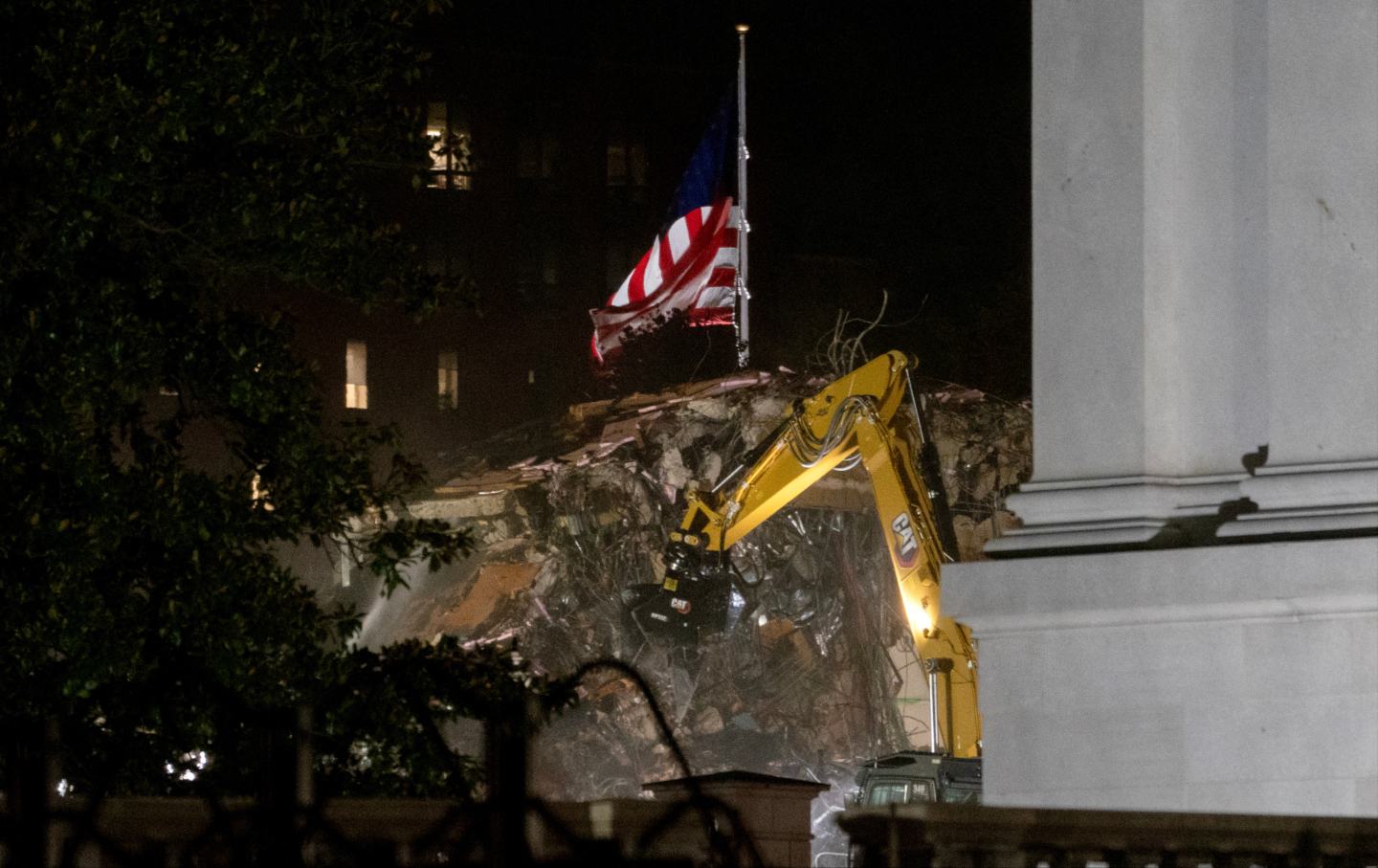
Demolition of the East Wing of the White House on Wednesday, October 22, 2025.
(Stefani Reynolds/Bloomberg via Getty Images)
It’s long been obvious that MAGA’s siege on American governance is a glorified demolition job, but this week’s episode was just a little too pointed: After pledging not to molest the White House in the process of building an additional $250 million ballroom apparently built in the loudest parts of Versailles, President Donald Trump has now approved the demolition of the entire wing is structure.
This reckless lurch toward gilded ruins sparked a chorus of denunciations ranging from the National Trust for Historic Preservation to defenses of Never Trump’s “People’s House” (a characterization significantly weakened by the use of forced labor to build it) to a display of civic dudgeon by former East Wing occupant Hillary Clinton (which provoked outbursts equally predictable indignation from the right).
It is true that, even by Trump’s standards, the literal destruction of the White House is an unusually brazen display of Caligulan impunity. Yet, as has so often been the case over the past decade of MAGA brand plundering of our public sphere, critics in and around the house of liberalism find themselves gasping and panting at the specter of Trump simply being Trump — that is, leveraging every resource at his disposal to further his own crude and venal self-interest. In other words, Trump continues to devalue constitutional governance in favor of a system of back-sheesh enforcement, because our political order no longer supports any viable theory that corruption is an outgrowth of executive power.
Not so long ago, such a blind spot in the American body politic would have been unthinkable. The Watergate scandal and the arguably more damning findings of the Church Committee investigation into abuses in the U.S. intelligence community, as well as the corrosive legacy of the Vietnam War, sparked a healthy public backlash against what Arthur Schlesinger Jr. called the imperial presidency. But today, many of the era’s most important pillars of reining in the executive branch and fighting corruption, such as the Immoundment Control Act of 1974 and the War Powers Resolution of 1973, have become virtually useless as the American republic is reduced to an autocratic toy. And don’t get me started on the abuses of American intelligence services.
This change is not solely due to Trumpism. A central factor has been the agitprop jurisprudence of the Roberts court, which, long before Trump’s ascension, had wanted the concept of corruption abandoned in landmark decisions such as those of 2010. Citizens United v. Federal Election Commission. Consistent with established standards, the court proceeded to deregulate virtually any financial attack on good government, provided that the recipient of a payment does not loudly announce in a bank deposit line that “I am transferring the proceeds of my bribe today.”
This is largely the backstory to Trump’s hostile takeover of the Republican Party, and then our government as a whole — and it’s also what lies behind the grim saga of the demolition of the White House. Trump funds ballroom construction with massive contributions from major corporate donors; on October 15, a fundraising dinner at the White House brought together companies such as Blackstone, OpenAI, Microsoft, Coinbase, Palantir, Lockheed Martin, Microsoft, Amazon and Google, as well as a group of reliable and corrupt NFL owners. Alphabet, Google’s parent company, also initiated a $22 million settlement in Trump’s frivolous lawsuit against YouTube (which Alphabet also owns) for banning him from the platform following the Jan. 6 coup attempt. “I view this huge ballroom as an ethical nightmare,” Richard Painter, a former ethics lawyer in George W. Bush’s White House, told the BBC. “It’s about using access to the White House to raise money… These companies all want something from the government.” That’s right: The scale and volume of executive branch corruption has accelerated to the point of scandalizing a White House ethics veteran who launched a baseless illegal invasion, authorized torture, and selected John Roberts to be chief justice of the Supreme Court.
Current number
Meanwhile, Democratic Party leaders have been particularly slow to connect the relevant dots in scandals like this. This is not very surprising when you consider that the opposition party in Washington enjoys enormous support from the same corrupt corporate oligarchy as Trump. That’s the bracing object lesson that any return to the donor list provides for Kamala Harris’ 2024 campaign and her heavy-handed economic agenda. Indeed, at a delicate moment, on the same day that the demolition of Trump’s East Wing began, news broke that the Democratic National Committee had retired an additional $1.6 million in debt following Harris’ record $1.5 billion campaign failure, bringing to $20 million the total post-campaign cleanup expenses the party is effectively sacrificing for more productive use over the course of of the 2026 midterm cycle. The MAGA GOP’s financial crusade of civic ruin happens to be more blatant and executed at a higher level of symbolic outrage.
Hence the bombastic rhetoric about Trump’s crude personal attack on “the people’s house”; the interests that arise from this particular demolition work are not forces that either major party can afford to alienate. This is also why each new MAGA fence of the civic commons is treated like a freshly perpetrated outrage, rather than part of an all-too-obvious extension of a corrupt ideology. So, in the same cursed news cycle this week, Trump also reportedly demanded an additional $230 million (he’s clearly in favor of nice 12-figure sums) from the Justice Department as “damages” for harm caused by legal investigations into his transfer of classified documents to Mar-a-Lago and possible Russian influence on his 2016 campaign. barely offering a remotely plausible explanation, pardoned expelled New York congressman and convicted fraudster George Santos. And he extended his high-seas assassination campaign to a ship in the Pacific, once again suspected of being involved in drug trafficking, without any credible public evidence of the accusation (although such a crime would not, in any event, justify a campaign of extrajudicial assassinations carried out by the US military).
The same fundamental vision is at the origin of all these self-dealings and this shipwreck; indeed, even Trump’s reckless physical assault on the White House is mirrored by his long-ago ransacking of the Bonwit Teller Building and his destruction of the art deco murals he had pledged to protect, in order to erect Trump Tower, the first great ugly monument to his insatiable ego. This is not a difficult mentality to dissect; all you need is a political system that can call it by its real name.


