Oregon built to silence Iowa, Kinnick Stadium amid road success under Dan Lanning


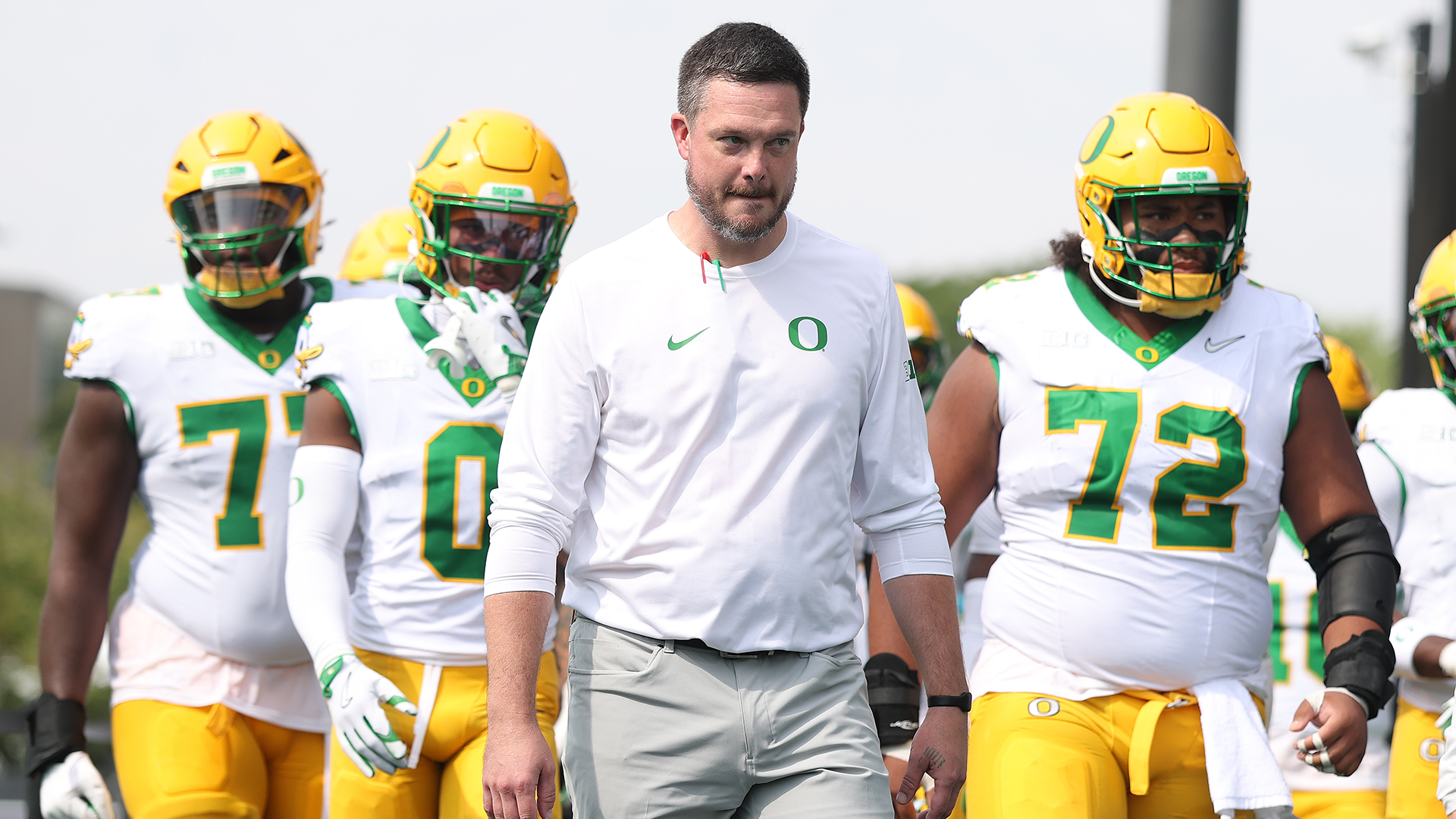
Kinnick Stadium has been something of a nightmare for top-10 teams, a place where rankings often melt away to the roar of the crowd. This Saturday, No. 9 from Oregon faces a dangerous No. 20 from Iowa (3:30 p.m. ET on CBS and streaming on Paramount+ Premium) in a game with College Football Playoff implications. But the Ducks don’t necessarily fit the mold of the previous 10 teams that have stumbled in Iowa City, and they appear poised to turn one of college football’s toughest environments into just another venue.
Oregon’s resume under coach Dan Lanning reinforces that confidence. The Ducks own the longest active road winning streak in the FBS at 10 games – double the second-best streak (Ohio State, 5). And since Lanning took over ahead of the 2022 season, Oregon is tied with the Buckeyes for the best road winning percentage in the FBS at 15-2 (.882). It’s also 12-4-1 (.750) ATS in those games, the best mark among Power Four programs over that span.
Simply put, the Ducks have repeatedly shown they can handle hostile environments, giving them a plan to silence the Kinnick crowd while putting pressure on Iowa’s weaknesses.
While Kinnick’s capacity is just over 69,000 — the 24th largest in college football — its design and the intensity of Iowa fans amplify the noise well beyond its size, creating one of the most intimidating atmospheres in sports. Lanning personally knows the stadium’s potential to turn a game around. As a graduate assistant at Pittsburgh in 2011, he watched Iowa erase a 24-3 deficit in the third quarter to beat the Panthers 31-27.
Even 14 years later, Lanning still remembers the intensity of that crowd.
“He’s one of those players that you’re excited to have the opportunity to play up front against,” Lanning said Monday. “A lot of their plays – pink locker rooms. There’s a vibe in this one and it means a lot to the Iowa people. They’re doing really well for this game. I’m expecting a great crowd.”
Iowa vs. AP, Top 10 Opponents Since 2016
|
2022 |
No. 4 Michigan |
Defeat (27-14) |
|
2021 |
No. 4 Penn State |
Win (23-20) |
|
2019 |
No. 8 Minnesota |
Win (23-19) |
|
2019 |
No. 10 Penn State |
Defeat (17-12) |
|
2017 |
No. 6 Ohio State |
Victory (55-24) |
|
2017 |
No. 4 Penn State |
Defeat (21-19) |
|
2016 |
No. 3 Michigan |
Win (14-13) |
|
2016 |
No. 10 Wisconsin |
Defeat 17-9 |
Overall, the Hawkeyes’ success at home against top-10 AP opponents extends beyond the last decade. Since 2003, Iowa is 8-7 (.533) in such games and has entered as a favorite in only four of those victories. Yet history offers limited guidance for a program as proven as Oregon’s, which performed well in hostile environments under Lanning.
Built for Kinnick: Why Oregon is well-equipped for Iowa City
Aside from recent trends showing Oregon’s consistency on the road, the Ducks bring a level of explosiveness and overall success running the ball that could exploit subtle weaknesses in the Hawkeyes’ defense.
Iowa excels at limiting explosive plays – ranking third nationally in defensive explosive play rate (6.61%) – and both defenses are built on a “keep everything in front” philosophy. But Oregon’s offense is much more dynamic than the Power Four teams Iowa has faced this season. That versatility could particularly stress the middle of Iowa’s defense, where the linebackers have struggled to make big plays consistently.
On Saturday, there will also be one of the most intriguing coordinator matchups in college football: Oregon offensive coordinator Will Stein versus Iowa defensive coordinator Phil Parker.
Oregon’s speed-and-motion system thrives on creating mismatches in space — precisely where Iowa’s linebackers have been tested the most. And while the Hawkeyes’ defense relies on discipline and strong tackling, the Ducks’ athleticism makes it difficult to keep everything under control for four quarters.
“It’s going to be tough to defend,” Parker said during the Hawkeyes’ bye week. “The guys he can throw it to are scary. You have to be fundamentally sound, you have to be prepared and you have to play hard, physical. We have to play with 11 guys and play their best at all times.”
That challenge begins with first-year starting quarterback Dante Moore, one of the most efficient young passers in the country. The sophomore completed 71.4 percent of his throws for 19 touchdowns with just four interceptions. Oregon’s offensive balance also keeps Iowa guessing, with 13 different players responsible for a touchdown this season. Freshman running back Jordon Davison has taken on a larger role since early October, while tight end Kenyon Sadiq continues to emerge as a versatile weapon capable of emphasizing multiple levels of the defense.
Even if Iowa can contain the explosiveness and efficiency of Oregon’s offense, the biggest concern might come on the other side of the ball. The Hawkeyes are near the bottom of the Power Four in generating explosive plays on offense (10.1%) with a lack of threats in the passing game, while no FBS team does a better job of preventing big plays (5.5%) than the Ducks.
That gap in playmaking ability — combined with Oregon’s highest rate of forcing three-and-outs on defense (53.1%) and best-for-fewest three-outs on offense (13.9%) — could undermine what is expected to be a rain-soaked Kinnick Stadium, limiting crowd impact while allowing the Ducks to play with their usual comfort on the road.