Blue Origin launches wheelchair-user and five others on sub-orbital trip to space


In a space age milestone, Jeff Bezos’ Blue Origin launched a wheelchair-bound engineer and disability advocate to the edge of space on Saturday, a 10-minute journey that allowed her to enjoy a few minutes of weightlessness more than 65 miles above Earth.
Michaela Benthaus, a German aerospace engineer who suffered a spinal cord injury in a mountain biking accident in 2018, joined a retired SpaceX manager and four contractors for the top-down flight to a point just above the so-called “edge” of space.
“It was the coolest experience!” she said after landing, joking about turning around in zero gravity. “I not only loved the view and the microgravity, but I also loved the climb. It was so cool, every step of the climb.”
Blue Origin Webcast 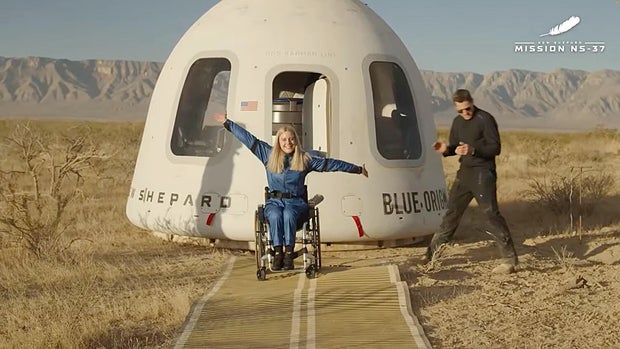
Benthaus was assisted during training and inside the Blue Origin capsule by Hans Koenigsmann, a former SpaceX executive and engineer who was instrumental in the development of that company’s Falcon family of rockets.
A German by birth and a naturalized U.S. citizen, Koenigsmann helped organize Benthaus’s robbery after meeting her last year.
“I first met Hans online,” Benthaus said in an interview with Blue Origin. “I just asked him, you know, you worked for SpaceX for so long, do you think people like me can be astronauts?
“Then he contacted Blue Origin and said, oh, Blue is actually really excited about this. Okay, I have my doubts about this, but let’s see. Luckily, it turned out we can do it. So Hans and I (ended up) flying as a team,” Benthaus continued.
Koenigsmann said that Benthaus “basically inspired me to do this. It was his motivation that convinced me that I should do this too, and just experience something that I’ve been seeing from the outside for a long time.”
Blue Origin Webcast 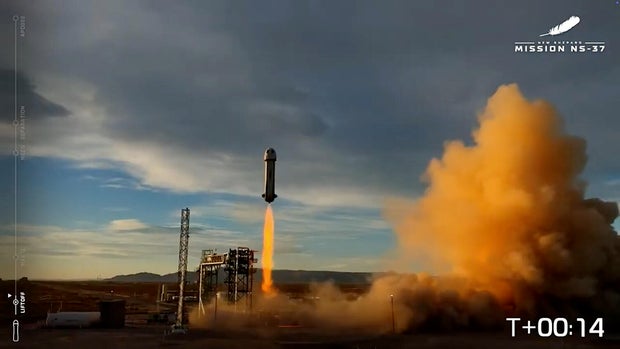
Benthaus was able to navigate his way from his wheelchair onto the New Shepard capsule before launch, moving along a bench extending from the hatch provided by Blue Origin. Koenigsmann was attached nearby to offer assistance during the flight if necessary.
Two days late due to last-minute technical issues, the countdown ran smoothly to zero on Saturday and the New Shepard lifted off from Blue Origin’s launch pad in West Texas at 9:15 a.m. EST.
Accelerating directly into mostly clear skies, the capsule’s single-stage booster reached a speed nearly three times the speed of sound before its hydrogen-fueled BE-3 engine shut down about two and a half minutes after liftoff.
At this point, the New Shepard capsule was released to continue ascending on its own, and the crew, now weightless, were free to briefly detach and float into the cabin.
Benthaus’s legs were strapped together to hold them in place, but she too was free to enjoy the thrill of weightlessness as the New Shepard reached a maximum altitude of just over 65 miles, well above the 62-mile high point where aerodynamic forces no longer have any effect.
At this altitude, the “sky” is deep black and the earth’s horizon is strongly curved. Passengers can admire the view through the largest windows ever deployed in space.
“Oh, my God,” a passenger could be heard exclaiming over the capsule’s radio.
“Amazing,” said another.
Falling back into the lower atmosphere, the crew was warned to return to their seats to strap in before atmospheric deceleration began. Maximum deceleration subjects New Shepard crews to approximately five times the force of normal gravity.
The booster, meanwhile, followed a similar trajectory, falling tail first toward the launch site. As it approached the ground, the BE-3 engine reignited, the landing legs deployed, and the rocket landed on target on a concrete slab near the launch gantry.
Blue Origin Webcast 
The New Shepard descended under three large parachutes, landing in a cloud of dust near the booster and its launch pad. Blue Origin support personnel quickly reached the spacecraft to help the crew get out.
Blue Origin Webcase 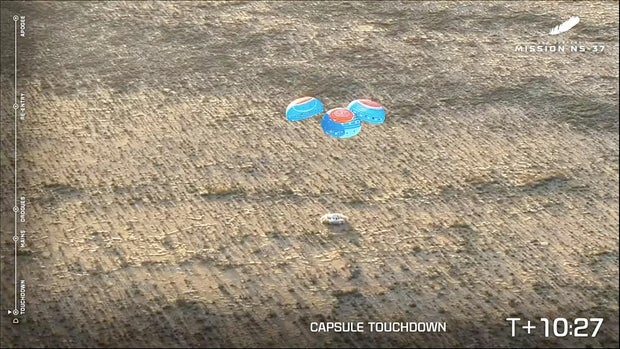
Alongside Benthaus and Koenigsmann aboard the New Shepard were physicist-investor Joey Hyde, entrepreneur Neal Milch, adventurer Jason Stansell and Adonis Pouroulis, a South African entrepreneur and mining engineer.
All six of them waved, smiling widely as they exited the pod one by one. Benthaus was the last to exit, carried from the spacecraft by Koenigsmann and a member of Blue Origin’s recovery team to a nearby wheelchair.
“You should never give up on your dreams, should you?” she said after landing. “I feel very lucky and am very grateful to Blue, Hans and everyone who said yes to this trip.”
Blue Origin doesn’t publicly disclose the cost of a New Shepard seat, but the price is reportedly upwards of $500,000 each. How the Benthaus headquarters was financed has not been revealed.
Blue origin 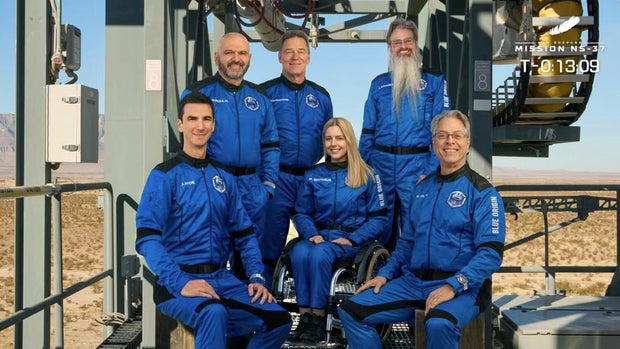
Saturday’s launch marked Blue Origin’s 16th New Shepard flight with passengers on board since Bezos, his brother and two others took off from first flight of this type in July 2021. Including Saturday’s flight, Blue Origin has now launched 92 men and women into space, including six who have flown twice.
While Benthaus was the first person with a significant physical disability to fly in space, European Space Agency astronaut John McFall, who wears a prosthetic leg, was cleared for selection for a future flight to the International Space Station.
Benthaus said before the launch that the reaction to her flight aboard the New Shepard had been mostly positive, saying she hoped more people with disabilities could go to space.
The big question for NASA and other space agencies and private companies is not so much whether disabled astronauts can perform their tasks in the weightless environment of space. It’s more about how they can handle an emergency that might require a rapid exit from their spacecraft, whether on the ground or in space.
In an interview with CNN, Benthaus said: “We are thinking more and more about long-duration space missions; some of us want to go to Mars in the future.”
“It’s a very long journey. And yes, people can become disabled along the way. People can have a stroke, break their leg or have a spinal cord injury.”
Ultimately, she says, “people with disabilities actually bring value to a crew. (…) We develop a very particular resilience.”

:max_bytes(150000):strip_icc()/Health-GettyImages-BestTimeToEatAnApple-1d25e922439942348abe280fc63b53f0.jpg?w=390&resize=390,220&ssl=1 "The Best Time to Eat an Apple for Digestion and Weight Loss")


