To ‘run’ Venezuela, Trump presses existing regime to kneel

WASHINGTON- Senior Trump administration officials have clarified their position on the “management” of Venezuela after arresting its president, Nicolás Maduro, over the weekend, putting pressure on the government that remains in power on Sunday to acquiesce to US demands for access to oil and the fight against drugs or face further military action.
Their goal appears to be the establishment of a docile vassal state in Caracas that keeps the current government – led by Maduro for more than a decade – largely in place, but ultimately defers to the whims of Washington after turning away from the United States for a quarter of a century.
That leaves little room for the rise of Venezuela’s democratic opposition, which won the country’s last national elections, according to the State Department, European capitals and international watchdogs.
President Trump and his top aides have said they will try to work with Maduro’s hand-picked vice president and current interim president, Delcy Rodríguez, to lead the country and its oil sector “until we can make a safe, appropriate, and wise transition,” with no timetable for the proposed elections.
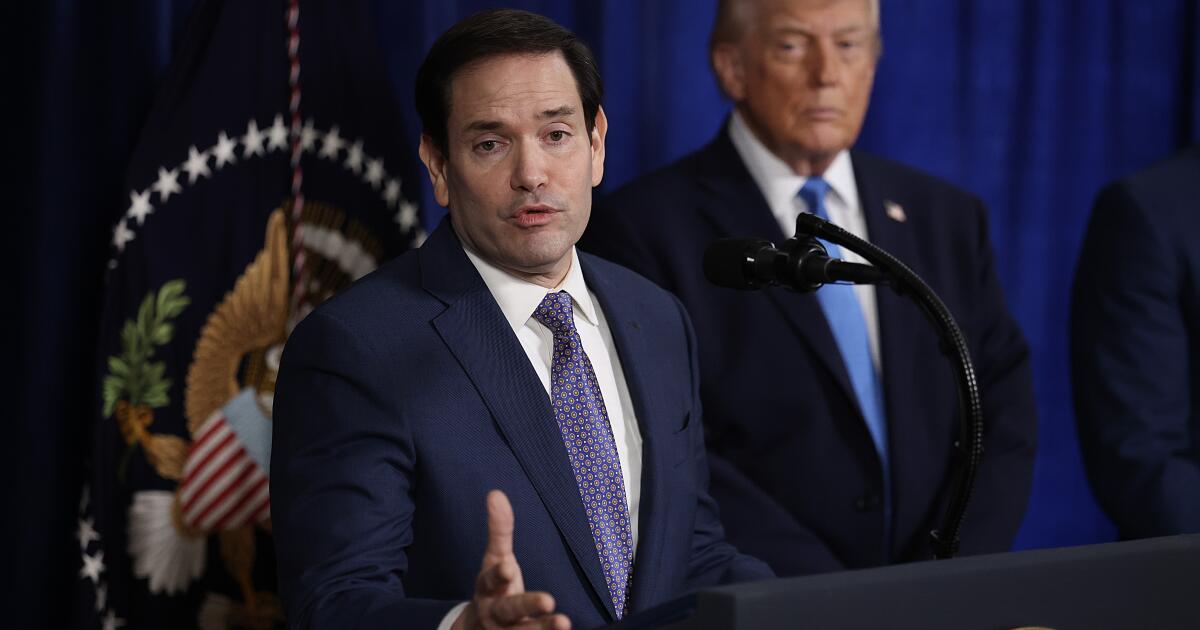
Trump, Secretary of State Marco Rubio and Homeland Security Secretary Kristi Noem outlined that strategy in a series of interviews Sunday morning.
“If she doesn’t do what’s right, she’s going to pay a very high price, probably higher than Maduro’s,” Trump told the Atlantic magazine, referring to Rodríguez. “Reconstruction and regime change, whatever you want to call it, is better than what you have now. It can’t be worse.”
Rubio said the U.S. naval quarantine of Venezuelan tankers would continue until Rodríguez begins cooperating with the U.S. administration, referring to the blockade — and the continued threat of additional military action from the fleet off Venezuela’s coast — as “leverage” over the remnants of Maduro’s government.
“This is the kind of control that the president is referring to when he says that,” Rubio told CBS News. “We are maintaining this quarantine and we hope to see changes – not only in the way the oil industry is managed for the benefit of the population, but also in putting an end to drug trafficking. »
Sen. Tom Cotton (R-Ark.), chairman of the Senate Select Committee on Intelligence, told CNN he has been in contact with the administration since the Saturday night operation that snatched Maduro and his wife from their bedroom, taking them to New York to face criminal charges.
Trump’s promise to “lead” the country, Cotton said, “means that Venezuela’s new leaders must meet our demands.”
“Delcy Rodríguez and other Venezuelan ministers now understand what the U.S. military is capable of,” Cotton said, adding: “It is a fact that she and others indicted and sanctioned are in Venezuela. They control the army and the security forces. We have to deal with that fact. But that does not make them legitimate leaders.”
“What we want is a future Venezuelan government that will be pro-American, that will contribute to stability, order and prosperity, not only in Venezuela but in our own backyard. That will probably require new elections,” Cotton said.
It remains an open question whether Rodríguez will cooperate with the administration.
Trump said Saturday that she seemed willing to make “Venezuela great again” during a conversation with Rubio. But the interim president gave a speech hours later demanding Maduro’s return and vowing that Venezuela would “never again be a colony of any empire.”
These developments have concerned senior officials in Venezuela’s democratic opposition, led by Maria Corina Machado, last year’s Nobel Peace Prize winner, and Edmundo González Urrutia, the opposition candidate who won the 2024 presidential election ultimately stolen by Maduro.
At his press conference on Saturday, Trump fired Machado, saying the revered opposition leader was “a very nice woman” but “doesn’t have the respect within the country” to lead.
Elliott Abrams, Trump’s special envoy to Venezuela during his first term, said he was skeptical that Rodríguez — an acolyte of Hugo Chávez and an avowed supporter of Chavismo throughout the Maduro era — would betray the cause.
“The insult to Machado was bizarre, unfair — and just plain ignorant,” Abrams told the Times. “Who told her there was no respect for her?”
Maduro was arrested in New York and flew at night over the Statue of Liberty in New York Harbor to the Brooklyn Metropolitan Detention Center, where he is being held by the federal government in a facility that has housed detainees including Sean “Diddy” Combs, Ghislaine Maxwell, Bernie Madoff and Sam Bankman-Fried.
He is expected to be arraigned as early as Monday on federal charges of narcoterrorism conspiracy, conspiracy to import cocaine, possession of machine guns and destructive devices and conspiracy to possess machine guns and destructive devices.
Although few in Washington deplored Maduro’s impeachment, Democratic lawmakers criticized the operation as yet another act of ousting a foreign government by a Republican president who may have violated international law.
“The invasion of Venezuela has nothing to do with American security. Venezuela does not pose a threat to the security of the United States,” said Senator Chris Murphy, Democrat of Connecticut. “It’s about enriching Trump’s oil industry and his Wall Street friends. Trump’s foreign policy – in the Middle East, in Russia, in Venezuela – is fundamentally corrupt.”
At their Saturday news conference and in subsequent interviews, Trump and Rubio said targeting Venezuela was in part about restoring U.S. dominance in the Western Hemisphere, reaffirming President Monroe’s philosophy as China and Russia work to strengthen their presence in the region. The Trump administration’s national security strategy, released last month, called for a renewed focus on Latin America after the region was neglected by Washington for decades.
Trump did not specify whether his military actions in the region would end in Caracas, a longtime adversary of the United States, or whether he was prepared to turn American armed forces against America’s allies.
In his interview with The Atlantic, Trump suggested that “individual countries” would be approached on a case-by-case basis. On Saturday, he repeated his threat to the president of Colombia, a major non-NATO ally, to “watch his ass” over an ongoing dispute over Bogota’s counter-drug cooperation.
On Sunday morning, the United Nations Security Council held an urgent meeting to discuss the legality of the US operation in Venezuela.
It was neither Russia nor China – permanent members of the council and longtime competitors – who convened the session, nor France, whose government questioned whether the operation violated international law, but Colombia, a non-permanent member who joined the council less than a week ago.


