Heat Waves Will Be Less Extreme because of Paris Climate Agreement


November 12, 2025
3 min reading
Climate action is slow, but it will still curb extreme heat
Ten years after the Paris climate agreement, the limited progress we have made in reducing global warming means there will be less extreme heat in the future than there would be without the agreement.

A child plays by jumping into the sea in North Jakarta, Indonesia.
Afriadi Hikmal/NurPhoto via Getty Images
In the decade since the Paris climate accord was reached, countries have made only halting efforts to meet the agreement’s goal of limiting global warming. But even this modest progress means the world will face far less extreme heat in the future than it otherwise would.
Climate experts say this is a clear example of why it’s important to move forward even with imperfect progress. That’s one of the messages scientists, environmental groups and some of the countries hardest hit by the effects of climate change, including extreme heat, are emphasizing at COP30, the annual United Nations climate change conference dedicated to implementing the Paris Agreement, currently taking place in Brazil.
Research shows that global warming is making heat waves more frequent, longer lasting and more intense everywhere. They are already the deadliest weather-related killers, and this trend is accelerating. In the United States, deaths related to extreme heat jumped 53 percent over the past decade, compared to a 7 percent increase in cold-related deaths, according to a recent study by Open JAMA Network. And globally, heat-related deaths have increased by 63 percent since the 1990s, according to “The 2025 Report Lancet Countdown on health and climate change.
On supporting science journalism
If you enjoy this article, please consider supporting our award-winning journalism by subscription. By purchasing a subscription, you are helping to ensure the future of impactful stories about the discoveries and ideas shaping our world today.
When the Paris Agreement was drafted in 2015, global temperatures had risen about a degree Celsius above what are known as pre-industrial levels – where these temperatures stood in the late 19th century, before the heat-trapping effect of widespread burning of fossil fuels was detectable in the record. In the historic Paris Agreement, 194 countries agreed to keep any further temperature rise “well below” two degrees Celsius and to do everything possible to keep it below 1.5 degrees Celsius.
Although 2024 was the first year the global average temperature exceeded 1.5°C, the long-term warming signal to which the Paris Agreement is linked – a multi-year average – is currently around 1.3°C above pre-industrial levels. Three-tenths of a degree above 2015 levels seems small, but it’s enough that, globally, people experience an average of 11 more of the most extremely hot days each year, according to a recent joint study from the nonprofit research organizations Climate Central and World Weather Attribution. (They defined these days as the 10 percent hottest days in a given country.) For some countries, the increase was higher.
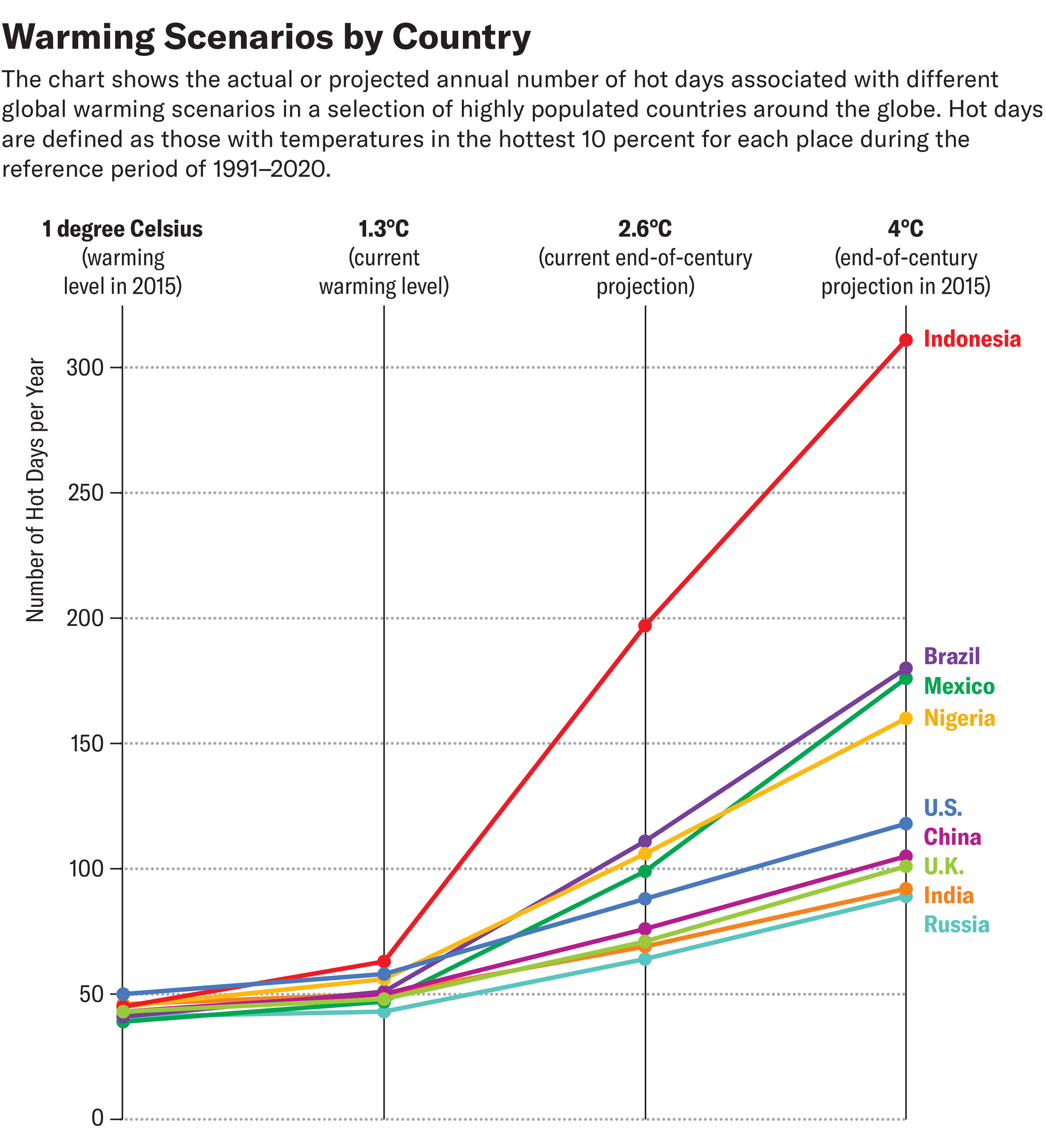
Amanda Montañez; Source: “Ten years of the Paris Agreement: the present and future of extreme heat”, Climate Central and World Weather Attribution (data)
But even the limited progress made under the Paris Agreement is having a discernible impact. Before the deal, the world was on track to reach four degrees Celsius of warming, which would have caused an average of 114 additional hottest days each year. (For some countries, like Indonesia, that number could skyrocket to more than 300 additional days.) We are now on track for warming of between 2.5 and 3 degrees Celsius, which would cut the number of additional extreme days in half. “Every fraction of a degree of warming – whether 1.4, 1.5 or 1.7°C – will make the difference between safety and suffering for millions of people,” Friederike Otto, a climate scientist at Imperial College London and co-author of the recent joint study, said in a press release.
The study also looked at some recent heat waves that likely killed tens of thousands of people and caused droughts and wildfires, further underscoring the difference that limiting warming to even 2.6 degrees Celsius can make. With global warming of four degrees Celsius, such heatwaves would be three to six degrees Celsius higher than today and five to 75 times more likely to occur. With 2.6 degrees Celsius warming, they would be 1.5 to three degrees Celsius warmer and three to 35 times more likely.
It is by no means certain that countries will meet their obligations, as President Donald Trump’s decision to withdraw the United States from the deal on his first day in office and his efforts to increase U.S. fossil fuel production have made clear. There are positive signs, however, such as the fact that emissions from China – currently the largest domestic source – have either remained stable or declined over the past 18 months. Solar and wind power generation has also more than tripled since 2015, and investments in clean energy have outpaced those in fossil fuels. And local and state officials across the United States are attending the meeting to signal that they still want to act to reduce the nation’s emissions.
The key question at COP30 will be whether the countries still participating will make concrete and additional commitments to reduce emissions beyond those already promised.
It’s time to defend science
If you enjoyed this article, I would like to ask for your support. Scientific American has been defending science and industry for 180 years, and we are currently experiencing perhaps the most critical moment in these two centuries of history.
I was a Scientific American subscriber since the age of 12, and it helped shape the way I see the world. SciAm always educates and delights me, and inspires a sense of respect for our vast and beautiful universe. I hope this is the case for you too.
If you subscribe to Scientific Americanyou help ensure our coverage centers on meaningful research and discoveries; that we have the resources to account for decisions that threaten laboratories across the United States; and that we support budding and working scientists at a time when the value of science itself too often goes unrecognized.
In exchange, you receive essential information, captivating podcasts, brilliant infographics, newsletters not to be missed, unmissable videos, stimulating games and the best writings and reports from the scientific world. You can even offer a subscription to someone.
There has never been a more important time for us to stand up and show why science matters. I hope you will support us in this mission.


