
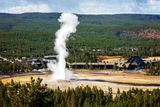
Yellowstone is infamous, having made it onto the small and prestigious list of “supervolcanoes.” This means it is one of just a handful of volcanoes that have produced an eruption of magnitude 8 at least once in their lifetimes. To make the cut, the eruption must result in the deposit of over 240 cubic miles (1,000 cubic kilometers) of volcanic material.
But while geologists can say at least three extremely large eruptions have occurred over the last 2.1 million years, the full number of eruptions is a much harder figure to calculate. As scientists at Yellowstone Volcano Observatory explain in Yellowstone Caldera Chronicles, some past eruptions could be camouflaged, having been partially (and sometimes completely) hidden by eruptions that have occurred more recently.
This may be frustrating from an intellectual standpoint, but it has practical implications too. Knowing when, where, and how past eruptions occurred helps geologists predict the likelihood of a future eruption.
Read More: Seismic Activity Shakes Up Microbes Deep Under Yellowstone Lake
What Do Geologists Know About Yellowstone Eruptions?
The geological record shows there have been at least three eruptions explosive enough to produce a large volcanic crater (or caldera) — one 2.1 million years ago, one 1.3 million years ago, and another 631,000 years ago. Together, these volcanic cycles created the Yellowstone Plateau volcanic field that we see today.
Smaller rhyolite lava flows occur more frequently. But while more common than the magnitude 8 supereruptions that capture popular imagination, these are still few and far between. The last known example took place around 70,000 years ago.
Still, it is not known exactly how many rhyolite eruptions have occurred in Yellowstone’s history. Researchers writing in another Yellowstone Caldera Chronicals have found evidence for “at least 28” within the Yellowstone caldera since the last big eruption (which triggered its formation) 631,000 years ago — but, as USGS geologists Mark Stelten and Nicole Thomas wrote, “this number is treated as a minimum because geologists know there may be more eruptions that have yet to be recognized.”
Known rhyolite eruptions occurred in two clusters: 580,000 to 250,000 years ago and 160,000 to 70,000 years ago, which were responsible for six eruptions (the Upper Basin Member rhyolites) and 22 eruptions (the Central Plateau rhyolites), respectively.
How Is Our Understanding Of Yellowstone’s History Improving?
While Yellowstone’s complex structure makes it incredibly challenging to untangle evidence of one eruption from another, technological advances are making it easier to read and improving scientists’ understanding of the volcano and its history. This includes techniques such as argon dating, which measures the decay of potassium into argon.
Increasingly, research is showing just how complex volcanic activity at Yellowstone really is. Instead of lasting hours or days, as many once thought, large explosions could occur over a period of weeks, months, and even decades — “rather than single large events, they may be composed of multiple smaller events,” wrote Colin Wilson, a New Zealand-based volcanologist, in a previous column of the Yellowstone Caldera Chronicles.
When it comes to what type of volcanic activity we might see in the future, the good news is that it is highly unlikely to be the destructive supereruption type. Far more likely is a hydrothermal explosion — a violent eruption of water, steam, and debris — which occurs every few years.
Read More: A Mysterious Ground Shift Returns to Yellowstone, and Advanced Tech Is Helping to Monitor It
Article Sources
Our writers at Discovermagazine.com use peer-reviewed studies and high-quality sources for our articles, and our editors review for scientific accuracy and editorial standards. Review the sources used below for this article:


:max_bytes(150000):strip_icc()/Health-GettyImages-2205082968-74479e1cd12d42ad97d5832a8d97a0ca.jpg?w=390&resize=390,220&ssl=1 "4 Nuts That Could Help Lower Blood Pressure Naturally")