Proposed Hope Scholarship changes to save WV money become most contentious issue at Capitol so far

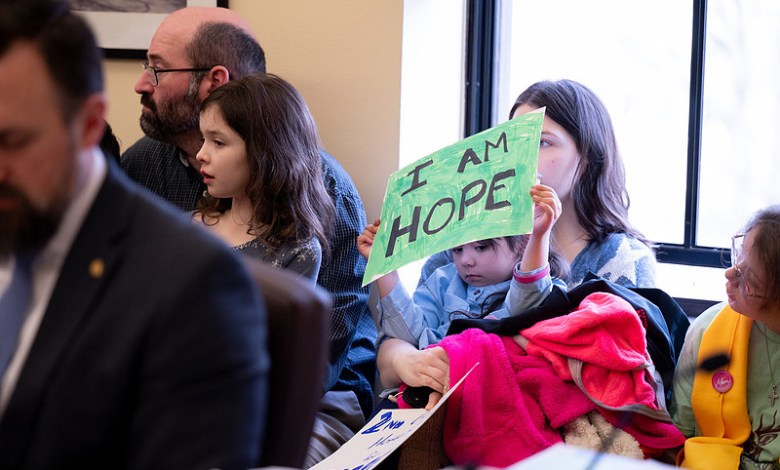
A family attends a House Finance Committee meeting in Charleston, West Virginia, February 19, 2026, to oppose proposed changes to the Hope Scholarship. (Photo by Perry Bennett/West Virginia Legislative Photography)
Dozens of homeschooling parents and their children and other “school choice” advocates lined the hallway in front of the House Finance Committee Friday morning.
A helium tank was placed on a chair so families could blow up balloons. Children held posters with phrases such as “Don’t take hope away from the Hope Scholarship.”
They had come out to oppose a bill that would place restrictions on how families can use the Hope Scholarship, West Virginia’s school voucher program.
“We came here today because of the proposed changes to the Hope Scholarship bill. They are really detrimental to our children and many other children with special needs who are across the state,” said Katie Switzer, who lives in Cabell County and homeschools her young children. She brought her children to the Capitol to tell lawmakers to leave the program as is.
THE Hope Scholarship gives West Virginia students approximately $5,200 to use for private school tuition, home school supplies, extracurricular activities and more.
Switzer used the funds to pay for speech therapy and dyslexia tutoring services for her children — the type of specialized help, she said, that her children could not receive at her local public schools.
“Having hope allows us to use a program that meets their needs,” she added. “We want our children to be confident in themselves. We want them to get a good education, and Hope helps us get that.”
Hope Scholarship opens to all West Virginia students for the first time next school yearincreasing its price to 230 million dollars compared to the current cost of $100 million this exercise.

Del. Vernon Criss, R-Wood
House Finance Chairman Vernon Criss, R-Wood, hopes put new restrictions How the money can be spent — such as banning its use in out-of-state schools and for tutoring services — could lower the price. He says the state can’t afford it a $230 million voucher program alongside other budget pressures, like Medicaid funding and a potential tax reduction.
“One of the things we’re trying to do here is align the things that we want to provide through Hope Scholarship, so that in the long run the program can survive,” Criss said Friday. “That’s one of the biggest problems we’re solving where we are right now.”
The measure is likely to face a fight in the House if it gets there, and over the past week it has become the most contentious issue of the legislative session. Some senators have already expressed their opposition to this measure, which has not yet been submitted to them. And Governor Patrick Morrisey said on his account that the program must be fully funded and that the state can afford it.
The House of Delegates, with a strong Republican component, has historically voted for “school choice” measures, including the Hope scholarship. Several House members are homeschool parents and advocates for the program.
The House Finance Committee was scheduled to consider Hope’s proposed changes on Friday, but it was pushed back until next week while lawmakers continue to refine the bill.

Del Clay Riley, R-Harrison
Del. Clay Riley, vice chairman of the House Finance Committee, said it’s common for agendas to be fluid during the process of debating the bill. The House committee process allows for several days of review of the bill.
“We can get feedback from the committee members. We can get feedback from the rest of our colleagues in the House. We can get feedback from all 1.8 million citizens of the state of West Virginia, and that’s really important,” said Riley, R-Harrison. “It is therefore not uncommon for agendas to be modified and adjusted as delegates receive feedback. »
At the end of the House Finance meeting, several parents in the audience raised their voices to lawmakers, saying they would return to see how lawmakers would vote on the future of the Hope Scholarship.
“We will come back and we will come with more families,” said a mother in the room.

Families lined the room before the House Finance Committee on Friday, Feb. 20, 2026, before lawmakers considered proposed changes to the Hope Scholarship. (Photo by Perry Bennett/West Virginia Legislative Photography)
New Restrictions Proposed for Hope Scholarship
The House bill proposing changes to the Hope Scholarship would now increase the voucher amount to $5,250, up from the $5,435.62 planned for next school year.
It would also allow funds to be dispersed four times a year, which Criss said is important for financial stability.
The House finance bill would also eliminate certain qualifying expenses, such as testing fees related to college admissions and after-school and summer programs.
The funds could also no longer be used to pay for tutoring services provided by a tutoring establishment or individual.
Jaimee Szynanski is the owner of Dynamic Dyslexia and Speech in Weirton, where she accepts the Hope Scholarship to helping children with tutoring, speech therapy and more.
“Public schools are not equipped to handle dyslexia. Children with dyslexia need at least two hours of one-on-one tutoring per week,” she said. “Through the Hope Scholarship, which is money that they would already give if they were in a public school, they can get that money, and so they can be literate and be functional in society.”
The bill would also require students using the Hope Scholarship to participate in statewide student growth assessments, similar to what is required in public schools. These tests could be administered online, according to the state Department of Education.
I hope the changes face a dubious future before the Senate and the governor
If the measure passes the House, it will also be challenged in the Senate. Notably, senators voted Friday morning in favor of $300 million in funding for the Hope Scholarship. in their budget bill.

Sen. Patricia Rucker, R-Jefferson
Sen. Patricia Rucker, R-Jefferson, held a news conference Thursday where she was joined by Senate Finance Chairman Jason Barrett, Sen. Jay Taylor, R-Taylor, and a handful of House members.
“These changes would radically alter the benefits of the entire scholarship and significantly reduce the ability of parents to make decisions that best meet their child’s needs,” she said.

Larry Pack, West Virginia State Treasurer
Rucker said the State Treasurer’s Office does an excellent job tracking the use of funds in its annual reports.
Larry Pack, State Treasurer urged Lawmakers to reconsider the proposed changes, saying it would “produce negative effects” for families using the program. Pack noted that the proposed changes come as the program less than two weeks away from universal expansion.
“We believe it is inappropriate, at this time, to push for such drastic departures and welcome further further discussions about the future of the program,” he wrote in a statement.
The House Finance Committee is expected to consider the Hope Scholarship bill as early as Monday.
“Each of these children deserves a chance, and politicians need to put aside their political views and give each of these children the best opportunity possible,” Switzer said.
SUPPORT: YOU MAKE OUR WORK POSSIBLE


