Astronomers share new insights about the early universe via the Webb Space Telescope

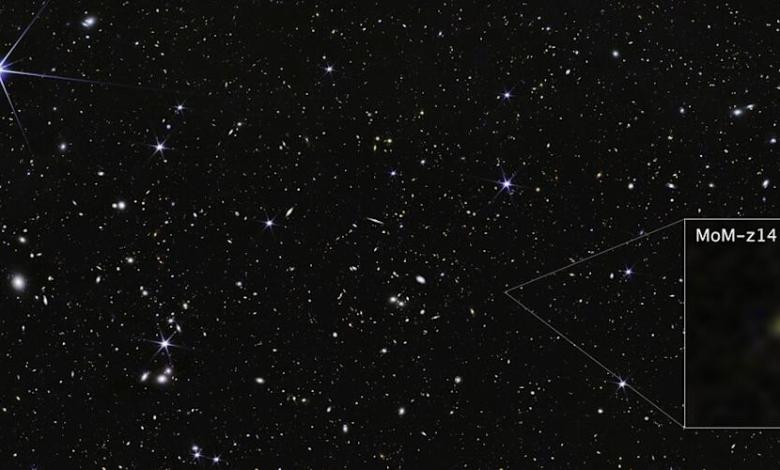
Researchers using the James Webb Space Telescope have discovered a galaxy offering new data on the early stages of the universe’s existence. The latest discovery shared by astronomers concerns a bright galaxy called MoM-z14. According to the team, this galaxy existed 280 million years after the Big Bang.
That seems like a long time, but in the context of the universe’s estimated existence of 13.8 billion years, it’s actually one of the closest examples astronomers have found to the occurrence of the Big Bang. As a result, MoM-z14 may offer insights and surprises into what the early stages of the universe entailed.
“With Webb, we are able to see further than humans have ever done before, and it’s nothing like we predicted, which is both challenging and exciting,” said lead author Rohan Naidu of the Massachusetts Institute of Technology. The findings about this galaxy were published in the Open Journal of Astrophysics.
Scientists were able to date MoM-z14 with Webb’s near-infrared spectrograph instrument, analyzing how light from the galaxy changed wavelength as it traveled to reach the telescope. One of the first questions raised by this brilliant galaxy concerns the presence of nitrogen. Some early galaxies, including MoM-z14, revealed higher concentrations of nitrogen than scientists had expected. Another topic of interest concerns reionization, or the process by which stars produce enough light or energy to permeate the dense fog of hydrogen that existed in the early universe.
“This is an incredibly exciting time, with Webb revealing the early Universe like never before and showing us how much there is yet to discover,” said Yijia Li, a graduate student at Pennsylvania State University and team member.


