At the Doorstep of Tomorrow


A day for Gaza
/
February 3, 2026
Faced with ever-narrowing possibilities, I return to my journal to try to dream, to imagine a future.
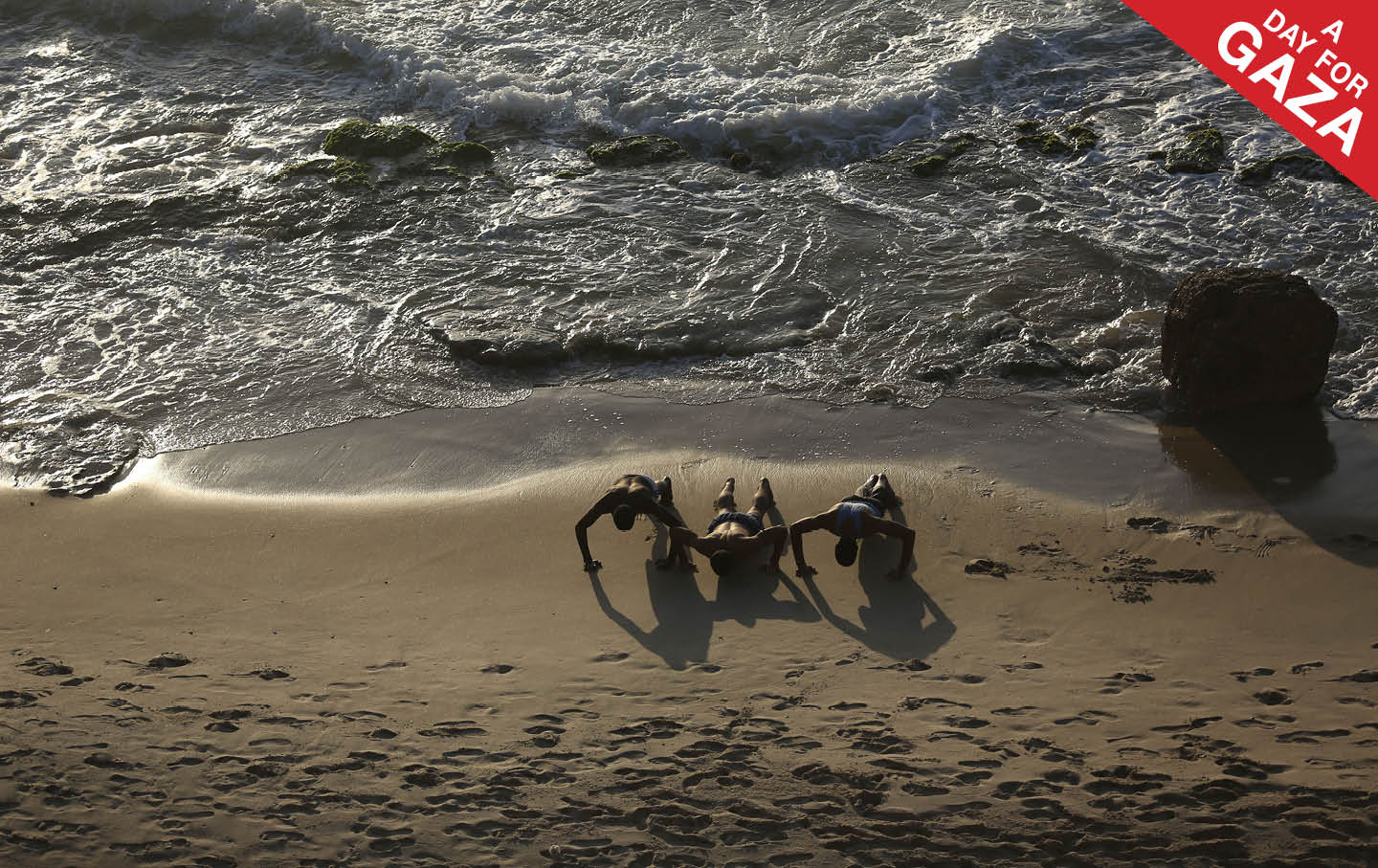
This journal entry was written shortly after a ceasefire was declared. I wrote this between the noise of bombings and shells, but also between dreams of studies and reunited families. This is not a story of individual survival, but an attempt to summarize a generation that experienced war in all its horrors and, at the same time, insists on dreaming.:
The war started the week of my 26th birthday. There was a lightness about that day, something born from what remained of our childhood. Sparkles like candy crackling in our mouths: colorful letters; laughter escapes from the voice notes; hearts adorning our text chats; an abundance of cake. But the days that followed stretched out like burnt matches; once the first one was lit, the flames consumed the rest. The war spared nothing on the calendar; Since then, I haven’t had another birthday.
I’m trying to put all this behind me. I try to extricate myself from these heavy details, to move forward. I want a future where the sky does not tend towards war planes. I want a future separate from what “The Strip” now means. A true and hopeful future where there is no Strip.
There is a dream that I came true. A wave breaks on the shores of Accre before heading towards Jaffa, and I suddenly find myself on a small motorboat. We sing first, then laugh. Soft sounds drown out the roar of the engine. My grandmother spoke of this place, the Bride of the Sea, a vast blue expanse which did not always overlook barbed wire enclosures.
I want a future where the sky does not tend towards war planes. I want a future separate from what “The Strip” now means. A true and hopeful future where there is no Strip.
We go down to the port and walk towards these old houses whose balconies swing along the seaside. A familiar smell spreads: a seller sells Kaa’ak. He greets me in our Gazan dialect, his voice full of familiar confidence, and I run my fingers along the sesame seeds. “Mati’la’qish“, he said, Don’t worry. It’s a scene too familiar to be cliché. It is an element ingrained in our minds, a heritage so omnipresent that we could never encounter it for the first time.
In this dream, I am at home at nightfall. I am constantly talkative, desperate to announce to my mother a happiness that cannot be contained. I doze off thinking about this miracle: having arrived at these two cities not through a search engine or an anthropological study, but having made the short journey that began in a port and ended, once again, in the embrace of Gaza. Two halves of the proverbial orange repaired according to the principle of return.
Then I gather my three sisters. Exile has scattered us far further than what appears on a map. These reunions are endless, as if time itself is finally atoning for every dinner table that wasn’t whole, every occasion for incomplete celebration, every moment we chased after their garbled voices on an international call. We’re sitting in one house, their bodies squashed on a couch made just for two. I sit on the floor surrounding the children: Eileen, Ahmad, Tamim, Elias. We whisper the names of the different fast foods we plan to order – just be careful my mother doesn’t overhear us. She who has always taken care to feed us only what is good for the body. I tell them the stories of those nations that passed through us and those dreams that passed through us, an assessment of the years that somehow managed to continue without them. I steal a piece of chocolate from each of the children and slip it into my pocket. Small testimonies that a family, however dispersed, can bring together again, can only come together in a city known through stories. We talk about it.
Current number
I’m reaching the end of today’s lines. I feel that this is not so much the story of a dream deferred but a test of my imagination, a measure of my ability to imagine a life despite all that has tried to uproot us.
From my window, I can see Gaza as it is today: tired, exhausted, bent in prayer and desperate for salvation. But there is still life; the capacity to dream, to hope, to resist. These journals are no comfort. They are trying to tell the world that I have a future, just as you can understand that I had a past. We come from a country that should be seen, not captured. A life that deserves more than rubble, as they take their turn in the war against us.
-
Submit a correction
-
Reprints and permissions
From Minneapolis to Venezuela, from Gaza to Washington, DC, we live in a time of staggering chaos, cruelty and violence.
Unlike other publications that reproduce the opinions of authoritarians, billionaires and corporations, The Nation publishes stories that hold the powerful accountable and center communities too often denied voice in national media – stories like the one you just read.
Every day, our journalism weeds out lies and distortions, contextualizes developments that are reshaping politics around the world, and advances progressive ideas that fuel our movements and incite change in the halls of power.
This independent journalism is only possible with the support of our readers. If you would like more urgent coverage like this, please donate to The Nation Today.


