This black hole “burps” with Death Star energy


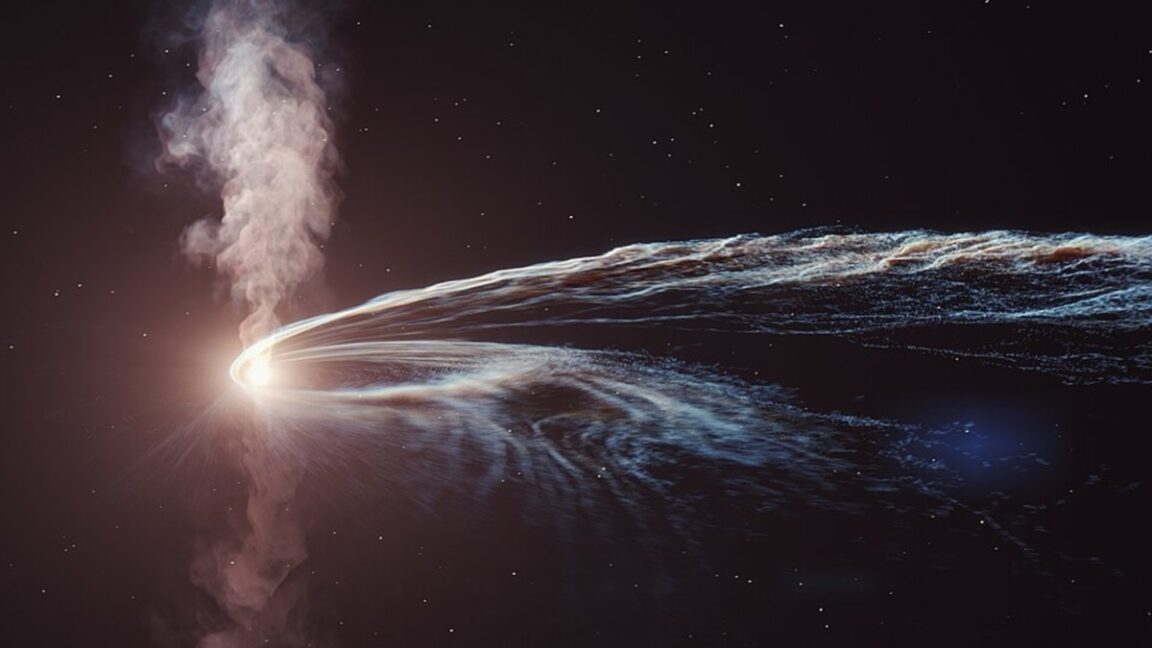
When AT2018hyz, aka “Jetty,” was first discovered, but radio telescopes did not detect any signatures of matter emission in the first few months. According to Cendes, this is true for about 80% of TDEs, so astronomers have moved on, preferring to use valuable telescope time on potentially more interesting objects. A few years later, radio data from the Very Large Array (VLA) showed Jetty lighting up the sky again, spewing out material at a whopping 1.4 millijansky speeds at 5 GHz.
Since then, this brightness has continued to increase. How big is the increase? Well, people have estimated the energy emitted by the fictional Death Star in the Star Wars saga, and Jetty McJetface’s emissions are a trillion times that, perhaps as much as 100 trillion times those of energy. As for why Jetty initially escaped detection, there appears to be a single jet emitting radiation in a direction that might not have been aimed at Earth. Astronomers should be able to confirm this once the energy peaks.
Cendes and his team are now scouring the sky for similar behavior in high-energy TDEs, because Jetty’s existence suggests that delayed outflow is more common than astronomers previously predicted. This is such an unprecedented phenomenon that astronomers have never really studied it before. After all, “If there’s an explosion, why expect there to be something years after the explosion when you haven’t seen anything before?” » said Cendès.
DOI: Astrophysical Journal, 2026. 10.3847/1538-4357/ae286d (About DOIs).


