Detained in immigration raids, Maga mom still has faith in Trump’s mass deportation plan


BBC News

 Arthur Sahakyan
If Arpineh Masihi could vote, she would have voted for Donald Trump. She is a fervent supporter of the American president – even now that she is locked up as an illegal immigrant.
“He does the right thing because many of these people do not deserve to be here,” said Arpineh to the BBC by phone from the Adelanto immigrants’ detention center In the Mojave desert in California.
“I will support him until my death. He makes America again large.”
Sixty miles (96 km) in his house in Diamond Bar, a rich suburban town in the east of the County of Los Angeles, a Trump flag flies on the courtyard before the family. The Maga hats decorate a shelf next to a family photo album, while the company birds of the family chosen in a cage.
It is an animated house, with three dogs and four young children, and the husband and mother of Arpineh are in the eyes and exhausted with concern, trying to put courageous faces.
“Our house is broken,” says Arthur Sahakyan, Arpineh’s husband.
‘We all make mistakes’
In many respects, Arpineh, 39, is an American success – an excellent example of how the country gives people the second, even the third chances. Arpineh’s mother has been flowing with tears when she talks about her daughter, who has lived in the United States since she was three years old.
She had a difficult reparation many years ago, in 2008, when she was found guilty of burglary and the big flight and was sentenced to two years in prison. An immigration judge revoked his green card, which is a common practice. But because she is an Iranian Armenian Christian, the judge allowed her to stay in the country instead of being expelled.
“We are Christians. She cannot go back, there is no way,” said Arthur while their 4 -year -old daughter embarks on and out of the room. He fears that her life is in danger if she was returned.
 Arthur Sahakyan
But since her prison release, Arpineh has rebuilt her life, creating a prosperous business and a family among hundreds of thousands of Iranian immigrants who call southern California.
West Los Angeles – Often called Tehrageles – has the largest population of Iranians outside Iran.
Some, like Arpineh, have been detained in recent weeks, swept away in immigration raids that have put the city on board. While the majority of people detained in Los Angeles come from Mexico, the daily updates of the Ministry of Internal Security show that immigrants from all over the world have been arrested.
Trump was elected partly because of his promise to “launch the biggest expulsion program for criminals in history” – a promise that Arpineh, her husband and mother say they all believe.
However, his family says that they have the faith that Arpineh will be released and believe that only the hardened and dangerous criminals will in fact be expelled.
“I don’t blame Trump, I blame Biden,” said Arthur. “It is its fact for open borders, but I believe in the system and all the good people will be released and those who are bad will be returned.”
While many detained persons do not have a criminal record, Aprineh is a condemned criminal, which makes her a main target for withdrawal.
Ice did not respond to a request for comments on the case of Arpineh.
Arthur says he does not know the details of the burglary. They spoke briefly before their marriage, then he forgot what he considered as a young indiscretion by his wife.
Instead, he focuses on his wife’s good dections in the past 17 years, volunteering with the local school district and bringing food to firefighters and the police.
“We all make mistakes,” he said.
“No matter what, we’re going to catch you”
So when Ice phoned Arpineh on June 30 when the family had breakfast, the couple thought it should be a joke.
But the application of immigration stopped at their home 30 minutes later.
Despite panels throughout the County of Los Angeles urging immigrants to “know your rights” and not to open the door to the agents of the application of immigration, the couple went out to speak with the officers.
Arpineh explained how a judge had allowed her to stay in the United States due to the situation in Iran, as long as she has not committed any other crime, and as long as she frequently verified immigration officials. Her latest recording took place in April, she showed them, presenting her documents.
Arthur even invited them to the house, which they refused, he said.
Immigration application agents said that his situation had changed and that they had a mandate for his arrest.
They allowed him to return inside and say goodbye to her children – aged 14, 11, 10 and 4 years. The police told her that if she did not come back outside, they would finally catch her.
“They told us, no matter what we are going to catch you – maybe if you drive in the street with your children – then we thought, what we had seen on the news: flash bombs, cornering cars,” said Arthur. They did not want to risk that it was violently detained, perhaps with their watching children.
“She came and kissed the goodbye children,” he recalls. “She came out like a champion and said,” Here I am “.”
Arthur asked immigration agents not to handcuff his wife. They said it was not possible, although they agreed to do it on the other side of the vehicle so that the couple’s children do not see.
“I knew my children looked up,” he said. “I didn’t want them to see their mom handcuffed.”
Arpineh was then taken to a federal building in downtown Los Angeles, a center used by ice to treat those arrested during the Raids in the region. The building has become the sometimes violent anti-glossy protest center that agitated Los Angeles for weeks.
She says that those detained in the building “have been treated as animals”.
Arpineh told the BBC that she had been held in an icy and brilliant room with 28 other women for three days. They survived on snacks and a bottle of water a day, she says, women snuggle up together for heat and sleep on the ground.
 Getty images
Waiting for suspended
Because Arpineh speaks three languages – Armenian, Spanish and English – she was able to communicate with many other women and says they have helped each other.
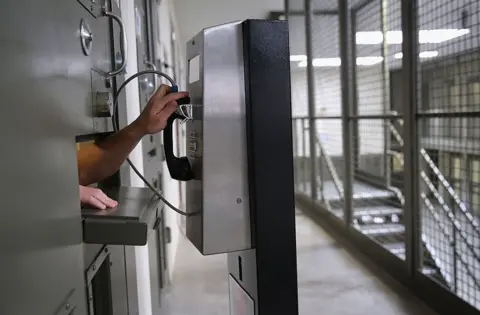
Three days later, it was transferred to Adelanto, the Center for the Detention of Ice Private in the desert northeast of Los Angeles, which has a reputation for severe and prison conditions.
But Arpineh says that it is much better than what they have faced in downtown Los Angeles, now having three meals a day, access to showers and a bed. Although she heard that it is difficult to obtain medical treatment if you need it, Arpineh is young and healthy.
“But it’s always very difficult,” she said.
She and her husband say they always trust the Trump administration and believe that she will be released.
“I am not deportable to any country,” said Arpineh to the BBC of the detention establishment.
But that did not prevent immigration officials in the past. In February, a group of Iranian Christians who had just crossed the border of Mexico was expelled – but towards Panama, not Iran.
Arpineh remains full of hope for a stay, but she notes that she also felt discouraged.
She says that she loves America and that she feels American, even if she does not have paperwork.
She calls on her husband to collect once per hour so that they can share updates on her legal affair, but so far, there is not much to share. Older children understand what’s going on, but their 4-year-old daughter continues to ask when mom comes home, he said.
The four children are American citizens, born and raised in California. The couple think that officials will take this into consideration when they decide the Arpineh fate.
“I have four citizens’ children. I have a business. I have a property. I have cars,” said Arpineh. “I haven’t hurt anything for so many years.”


