Astronomers just watched a star 1,540 times the size of our sun transform into a hypergiant. Will it go supernova?

When you purchase through links on our articles, Future and its syndication partners may earn a commission.

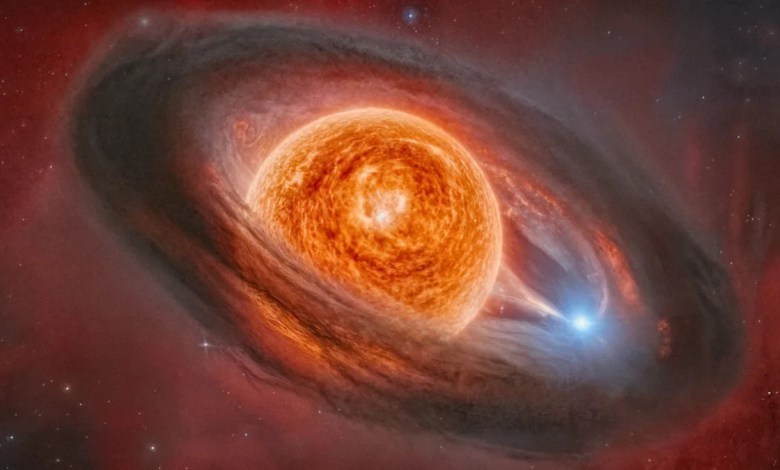
An illustration of the binary system of WOH G64 surrounded by a dense ring of dust. | Credit: Daniel Cea Martinez
Astronomers have seen one of the largest stars in our universe transform into a rare stellar body, and this spectacular metamorphosis could be the prequel to a powerful supernova explosion that will see this star give birth to a black hole.
The condemned star in question is WOH G64 (also known as IRAS 04553-6825), located in a satellite galaxy of Milky Way known as Large Magellanic Cloud (LMC), approximately 163,000 light years away. The star is about 1,540 times the size of the star. sunwith nearly 30 times the mass of our star and a staggering 282,000 times the luminosity. Discovered in the 1970s, the WOH G64 has always appeared as a red supergiant star surrounded by a ring, or torus, of dense dust.
However, in 2014, the appearance of this supergiant began to change. A team of astronomers, led by Gonzalo Muñoz-Sanchez of the Athens National Observatory, noticed a change in the star’s color accompanied by a corresponding increase in its surface temperature. Muñoz-Sanchez and his colleagues determined that this must represent the transformation of a red supergiant into a rare yellow hypergiant, which could also mean that astronomers are witnessing the “death” of a star in real time.
“The fate of stars with initial masses between 23 and 30 solar masses after they evolve into red supergiants is still uncertain. In this case, WOH G64 was the most extreme red supergiant known, with an estimated mass of around 28 solar masses,” Muñoz-Sanchez told Space.com. “It is still unclear whether such stars explode like supernovascollapse straight into black holesor evolve from the red supergiant phase to a yellow hypergiant stage before ending their life. “WOH G64 could be the solution to this question.”
The team’s results represent the first evidence that an extreme stellar object can change temperature and evolve from red to yellow in the space of a year – and do so smoothly and silently.
“This is particularly surprising because rapid changes in stars are usually associated with violent or abrupt processes,” Muñoz-Sanchez continued.
But that’s not all the team discovered about this immense star. Scientists also discovered that WOH G64 is not alone.
Live fast, die young… but not alone
At just 5 million years old, WOH G64 is cosmically young compared to other stars such as our middle-aged sun, 4.6 billion years old, so it may seem a little cosmically unfair that it is facing the end of its life. This is the case because massive stars like this “live fast and die young,” burning through their store of fuel needed for nuclear fusion more quickly than stars of modest size.
Although this short lifespan is true for all massive stars, the later stages of the lives of these stellar titans are not as certain. For example, not all red supergiants lose their outer layers when their cores contract to become yellow hypergiants.
“Yellow hypergiants are extremely rare because they represent a short-lived transition phase between the red supergiant stage and the eventual supernova explosion,” Muñoz-Sanchez said. “Therefore, only a small number of confirmed yellow hypergiants are currently known, representing only a few dozen objects.”
For this transformation into a yellow hypergiant to occur, a massive star needs a stellar wind strong enough to shed an outer envelope of previously lost stellar matter, a process that causes its temperature to rise. However, only the brightest red supergiants can cause outflows of matter powerful enough to trigger this transition phase that ultimately leads to the death of the star.

Artist’s impression of two sides of WOH G64: a red supergiant from its discovery until 2013 and a binary with a yellow hypergiant and a hot star from 2014. | Credit: Patryk Iwanek/OGLE
The team also discovered that the enormous star is actually part of a binary system, existing with a companion star. This complicates the potential cause of its transformation if the main star is greedily removing material from its companion.
“Binary interactions may also play a crucial role in the formation of yellow hypergiants,” Muñoz-Sanchez said. “If mass transfer or envelope stripping occurs in a binary system, the envelope of a red supergiant may be partially stripped, potentially leading to its evolution toward yellow temperatures.”
The researcher continued by explaining that in a binary scenario, which sees the evolution of the star caused by interactions with its companion, the binary system would have been embedded in a common envelope, a cocoon of gas surrounding the two stars that made it appear like a red supergiant. The partial ejection of this envelope would then reveal the two stars.
“Alternatively, even if the system is binary, the transition could have been caused by intrinsic stellar processes. In this case, the star could have undergone an extraordinary eruptive episode lasting more than 30 years and is now returning to a calm yellow state,” Muñoz-Sanchez added. “Both possibilities are extremely rare, and seeing either happen on a human scale is almost unprecedented.”
Thus, the team does not yet know whether its evolution is a consequence of interactions between WOH G64 and its binary stellar companion or whether the metamorphosis is intrinsic to the star itself.
“Recent observations suggest that some of the other extreme red supergiants may also be found in binary systems,” explained Muñoz-Sanchez. “Understanding whether the extreme properties of these stars come from their intrinsic nature or from binary interactions is crucial for studying populations of evolved massive stars, predicting their deaths and interpreting the supernovas they produce, phenomena which are still poorly understood.”
And understanding the binary nature of WOH G64 is not only the key to understanding one’s life; these details are also integral to his death.
The continuous exchange of mass between stars could lead to their collision and the merger of the two components. However, if interactions between stars are mild or non-existent, the main star would evolve into a core collapse, ultimately resulting in either a supernova explosion or a direct collapse into a black hole. “In astronomical terms, WOH G64 appears to be a very evolved system, and it is possible that its core will undergo collapse ‘soon.’ In this context, ‘soon’ corresponds to a time scale of a hundred to a few thousand years,” Muñoz-Sanchez said. “Such an event would be extraordinary, it remains highly unlikely that it will occur in our lifetime.
Of course, we’re not even sure if this star explodes in a supernova. »
An article on these results was published Monday February 23 in the journal Nature.


