‘CODE RED’ Explores AI’s Potential to Spot the Next Minnesota-Style Fraud Scheme, Saving Taxpayers Millions


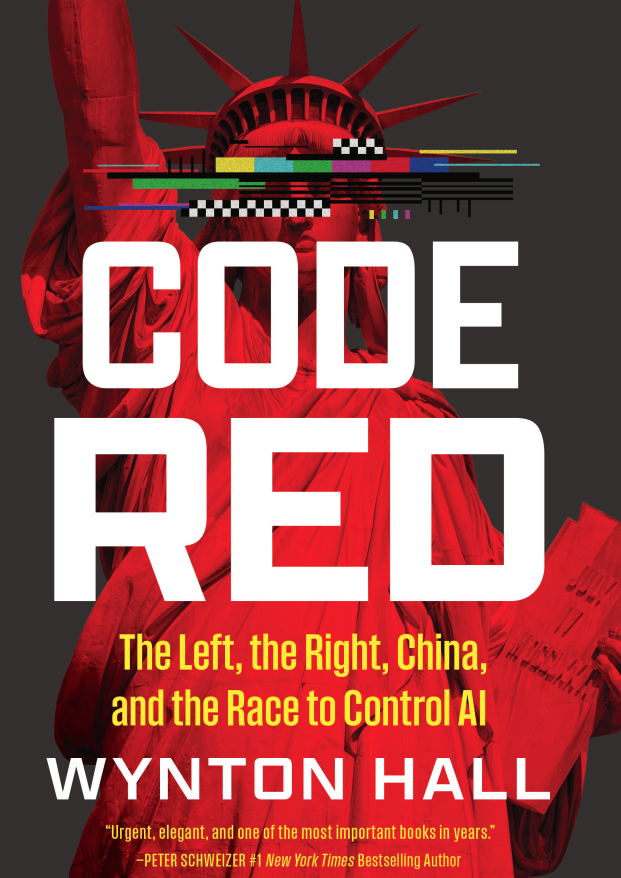
Author Wynton Hall argues in his new book Code Red: the left, the right, China and the race to control AI, publish tomorrow, that AI can support human efforts to detect mass thefts of government funds, like the infamous Minnesota fraud scheme, saving taxpayers millions of dollars.
“AI is uniquely suited to help uncover waste, detect fraud, and identify abuse within the federal bureaucracy precisely because it excels at analyzing massive data sets, performing billions of calculations in seconds, and recognizing complex patterns,” Hall writes in CODE RED. “Put simply, for the first time in a long time, conservatives can do more than just talk about limited government; they can use a transformational cost-cutting weapon to modernize and improve the efficiency of government. But where do we start?”
As Hall explains, AI can play a role in fraud detection, similar to the efforts of former DOGE leader Elon Musk, who assembled a “nerd squad” of young tech wunderkinds and seasoned engineers to sift through the government’s “trove of data” in what could be “the boldest conservative cost-cutting initiative ever attempted.”
One of these technology visionaries, Thomas Shedd, a former Tesla engineer, oversaw the General Services Administration’s (GSA) Technology Transformation Services (TTS), which includes hundreds of technologists. DOGE has led efforts to adopt an “AI-first” strategy, including the development of “AI Coding Agents” available to all federal agencies. These agents, trained to read government contract data sets, automate workflows and even help spot unnecessary government spending.
Hall writes:
The department plans to create a massive, secure database capable of performing procurement analytics that will identify redundant and redundant spending, as well as improve fraud detection. “Another [project] I’m trying to work on a centralized place for contracts so we can analyze them,” Shedd said. “It’s not new at all – it’s something that was in motion before we started. What’s different is potentially building this whole system in-house and building it very quickly. It goes to this [idea]“How do we understand how the government spends money? » » By developing these systems in-house, DOGE aims to ensure compliance with OPM guidelines for data privacy and responsible use of AI.
Breitbart News social media director quotes Dmitry Shevelenko, CEO of AI platform Perplexity, in CODE RED, which states that AI can “streamline government” and handle “80% of that initial work faster, where you get your hit list,” which would allow humans to make better decisions.
Abuse of federal aid became a focal point as federal prosecutors charged people in fraudulent programs run by Minnesota’s state Medicaid department. Many of the people charged with fraud in Minnesota are part of the state’s Somali community.
In CODE REDHall wrote that the Government Accountability Office (GAO) estimates that the federal government loses about a quarter to a half billion dollars annually to fraud. He noted that the GAO also found, since 2023, that federal agencies have reported about $2.8 trillion in estimated improper payments. The Small Business Administration (SBA) has awarded $312 million in coronavirus pandemic loans to children under 11 years old.
“In fairness, past government efforts using machine learning and data mining have produced results. Federal law enforcement has worked to combat fraud rings that have bilked taxpayers out of billions of dollars,” Hall asserted.
He continued:
In December 2024, at the request of the House Budget Committee, the nonpartisan Congressional Budget Office (CBO) released its first-ever report on AI. Among the CBO’s predictions were that AI could have the effect of “increasing the efficiency of government in collecting tax revenues and in distributing those revenues through transfer payments” and that “the successful use of AI to reduce fraud could lead to a decrease in irregular payments in the largest mandatory spending programs: Medicare, Medicaid, and Social Security.” 30 This would not be a small victory. Over the past decade, Medicaid improper payments and errors have amounted to an estimated $543 billion to $1.1 trillion.
Hall added in CODE RED“Similarly, the Office of Personnel Management (OPM) says that generative AI “has the potential to improve how the federal workforce delivers results to the public,” helping employees “improve their creativity, efficiency, and productivity.”
Wynton Hall CODE RED covers a wide range of AI topics, from its impact on elections and the economy to faith and family. Crucially, the book treats AI not as a terrible evil or a utopian good – but rather as a tool that must be harnessed properly to support American values.
Sen. Marsha Blackburn (R-TN), who was appointed one of TIMEThe 100 most influential people in the field of AI, hailed Code Red as a must read. She added: “Few people understand our conservative fight against big tech the way Hall does,” making him “uniquely qualified to examine how to best use the enormous potential of AI, while ensuring that it does not exploit children, creators and conservatives.” Michael Shellenberger, award-winning investigative journalist and founder of Public, calls Code Red “illuminating,” “alarming,” and describes the book as “an essential conversation starter for those hoping to overturn big tech’s autocratic plans before it’s too late.”


