Emperor Penguins Added to IUCN Red List — Their Population Could Drop 50 Percent by 2080


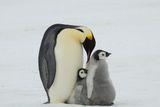
If you’re like me, you’ve watched Penguin Walk more times than you can count. The popular documentary follows emperor penguins on their annual journey inland to begin the breeding season. Sadly, these majestic creatures are officially listed as endangered – a change that scientists say reflects a rapidly worsening climate crisis in Antarctica.
Between 2009 and 2018, researchers estimated a loss of around 10% of the global population, which equates to more than 20,000 adult penguins. These dramatic population declines are directly linked to the loss of sea ice, with projections suggesting their numbers could be halved by the 2080s.
“Penguins are already among the most endangered birds on Earth,” Martin Harper, CEO of BirdLife International, said in a press release. “The emperor penguin’s move to endangered status is a stark warning: climate change is accelerating the extinction crisis before our eyes. Governments must act now to decarbonize our economies urgently.”
Why emperor penguins are now on the red list
The International Union for Conservation of Nature (IUCN) has reclassified emperor penguins from Near Threatened to Endangered, largely based on climate projections. Scientists used population models incorporating a range of future warming scenarios, and almost all predicted a sharp decline this century unless greenhouse gas emissions were drastically reduced.
The main driver of their extinction is the loss of Antarctic sea ice, which has reached an unprecedented level since 2016. According to NASA, the 2025 summer sea ice is tied for the second lowest minimum ever recorded in nearly five decades of satellite monitoring. Globally, Earth is now more than 1 million square kilometers short of sea ice compared to pre-2010 averages – an area roughly equivalent to the entire eastern United States.
“After careful consideration of the different possible threats, we concluded that human-induced climate change poses the most significant threat to emperor penguins. Early spring sea ice break-up is already affecting colonies around Antarctica, and further changes in sea ice will continue to affect their breeding, feeding and moulting habitat,” explained Philip Trathan, a member of the IUCN SSC Penguin Specialist Group.
Learn more: Antarctic penguins are breeding 13 days earlier than a decade ago – probably because of climate change
How sea ice keeps emperor penguins alive
Emperor penguins rely on so-called “fast ice” – a type of sea ice anchored to the coast of Antarctica or the ocean floor – for almost all stages of their life cycle, as noted by the Antarctic and Southern Ocean Coalition. They breed, raise chicks, and undergo their annual molting process on this stable ice shelf.
To successfully breed, emperor penguins need about nine months of consistent sea ice each year. If ice forms too late, breaks up too early, or covers too little area, entire breeding seasons can fail.
Evidence of emperor penguin breeding season failures
The failures of the breeding season mentioned by scientists are no longer just theoretical. According to the Antarctic and Southern Ocean Coalition, in Antarctica’s Weddell Sea, Halley Bay – once home to the second largest colony of emperor penguins – has experienced repeated breeding failures. Between 2015 and 2018, almost no chicks survived after sea ice broke up before they could develop waterproof feathers.
Similar events have been recorded elsewhere. In 2022, for the first time in satellite records, parts of the Bellingshausen Sea were completely ice-free during the summer. Colonies in the region experienced widespread chick mortality when unstable ice gave way beneath them.
Scientists stress that emperor penguins are not just a species in trouble. As a sentinel species, their plight acts as a wake-up call and reflects broader environmental changes already underway in Antarctica.
“Their decline underscores how quickly ecosystems are degrading and how the cumulative impacts of warming are accelerating food shortages, emerging diseases, and habitat loss. The result is a rapid increase in the risk of extinction for many species. The Red List is an essential tool, but it must be adequately resourced and bolstered by climate-informed science to identify risks and help reduce climate-driven extinctions,” concluded Kathleen Flower, vice president of biodiversity science at Conservation International.
Learn more: A saltier Southern Ocean could cause more ice melt in Antarctica
Article sources
Our Discovermagazine.com editors use peer-reviewed research and high-quality sources for our articles, and our editors review the articles for scientific accuracy and editorial standards. See the sources used below for this article:


