Viral image of runaway wolf in S. Korea is AI-generated

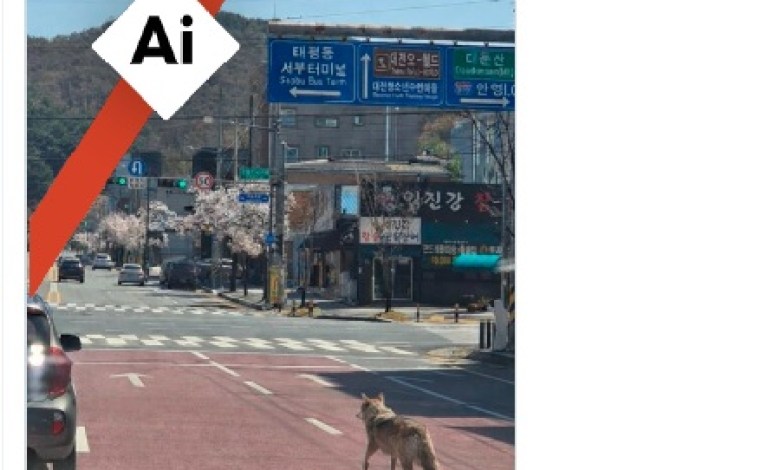
South Korea has deployed hundreds of officers, drones and thermal cameras to increasingly search for a wolf that escaped from a zoo on April 8, 2026. Hours after the escape, an image purporting to show the fugitive crossing an intersection in the city of Daejeon spread widely online, amplified by government agencies and media outlets. However, an AFP visual analysis revealed it was created using artificial intelligence (AI) tools, a conclusion supported by an independent, local expert. authorities.
“The b of 1 yearaby wolf from O-World,” reads the Korean-language X post shared on April 8.
“I hope no one gets hurt and the baby comes back safe and sound,” he continues, who has accumulated thousands of interactions.
The attached image appears to show a light brown wolf crossing a four-way intersection in Daejeon, a city about 150 kilometers (93 miles) south of Seoul.
Screenshot of a fake message captured on April 15, 2026, with a red X and an AI symbol added by AFP
The image quickly spread across platforms such as Threads, TikTok and X. South Korean authorities have launched a massive search for a male wolf named Neukgu who dug a tunnel out of an enclosure. at the O-World theme park zoo on on the morning of April 8 (archived link).
This prompted the closure of a nearby primary school the following day, as authorities deployed hundreds of firefighters, police and soldiers while using drones and thermal imaging cameras in the search (archived link).
Local media reported on April 14 that Neukgu had been spotted the previous evening but was not captured (archived link).
Korean media published the image of the purported sighting on April 8, and some of the country’s biggest newspapers and news agencies used it (archived here and here). AFP redistributed the photo before later removing it.
Daejeon City also shared the image on its official X account a few hours after Neukgu’s. disappearance.
“Search and capture operations are currently underway,” said the message, which urged residents to “take additional safety precautions.”
Screenshot of an X post captured on April 15, 2026, with a red X and an AI symbol added by AFP
City officials also sent an emergency text message alert saying, “The wolf that escaped from O-World this morning has been confirmed to have headed toward O-World. intersection” (archived link).
However, visual analyzes by AFP and an independent expert indicate that the image circulating is not authentic.
“The image appears to have been manipulated using AI technology,” Howard Kim, professor of AI convergence technology at Seoul Cyber University, said on April 14 (archived link).
The case “demonstrates how the widespread use of generative AI technology can pose an unanticipated threat to public safety response systems,” he said. added.
AI-generated image
Hive Moderation, an AI detection tool, assessed that the purported wolf image is “likely to contain AI-generated fakes or deepfakes.” content“.
Screenshot of Hive Moderation captured on April 15, 2026, with an AI symbol added by AFP
AFP geolocated the visual to a four-way intersection in south-central Daejeon using Naver Maps, a local navigation system. platform (archived link).
Street View images of the area from April 2025 match the fabricated images. pictureboth showing the same grilled eel restaurant in front of the crosswalk.
Screenshots of the image shared online (L) and Street View images from Naver Maps, with an added AI symbol and corresponding elements highlighted by AFP.
An AFP photographer took a new photo on April 11 of the four-way intersection, located about 2.3 kilometers from the zoo.
Several features differ from those observed in the AI-generated image, including:
-
The location of the arrows, and the length and position of the white dotted lines, on the red sidewalk
-
A blue line on the far right of the AFP photo, which appears white in the AI version
-
Landmarks in the AFP photo, such as power lines and a cross on a building, are faded in the circulating image.
Screenshot of the fabricated image (L) and an AFP photo taken by Jung Yeon-je, with an AI symbol added and corresponding elements highlighted by AFP
Kim pointed out other discrepancies, such as distorted text on street signs and unclear signage. The perspective of the buildings in the background also appears unnaturally compressed.
Such inconsistencies “are not characteristic of AI image editing tools built into smartphones, which simply insert objects into the real photo,” Kim said.
“These results suggest that the image was created using a generative AI system, or reconstructed from sources such as Street View images, rather than modified from an original. photograph“.
How does the picture propagated
A reverse image search on Google revealed versions of the fake visual initially spread across social platforms and other online spaces on April 8, including a community platform on Naver for mothers in Daejeon.
A spokesperson for The Daejeon fire headquarters told AFP on April 15 that authorities first received the image from an employee of the Geumgang Basin Environmental Bureau, an environmental agency based in Daejeon. ministry.
The employee shared the image on KakaoTalk, a Korean messaging platform, at 1:26 p.m. (04:26 GMT), just three minutes before the city sent its emergency SMS alert.
Contacted by AFP, the Geumgang Basin Environmental Bureau declined to comment.
A spokesperson for Daejeon Metropolitan City told AFP on April 13 that after receiving the information, “the priority was to send authorities to the scene and check the situation there.”
“Given the urgency of the situation, we had no basis at the time to determine whether the image was generated using AI,” they said, adding that such assumptions could have taken place. cause “further delays. »
Officials from the Daejeon city, fire department and police all confirmed to AFP between April 13 and 15 that the visual was likely a computer-generated image created using AI.
Read more AFP Fact Check articles on artificial intelligence here.


