A Polymarket trader made $300,000 of Biden’s pardons : NPR

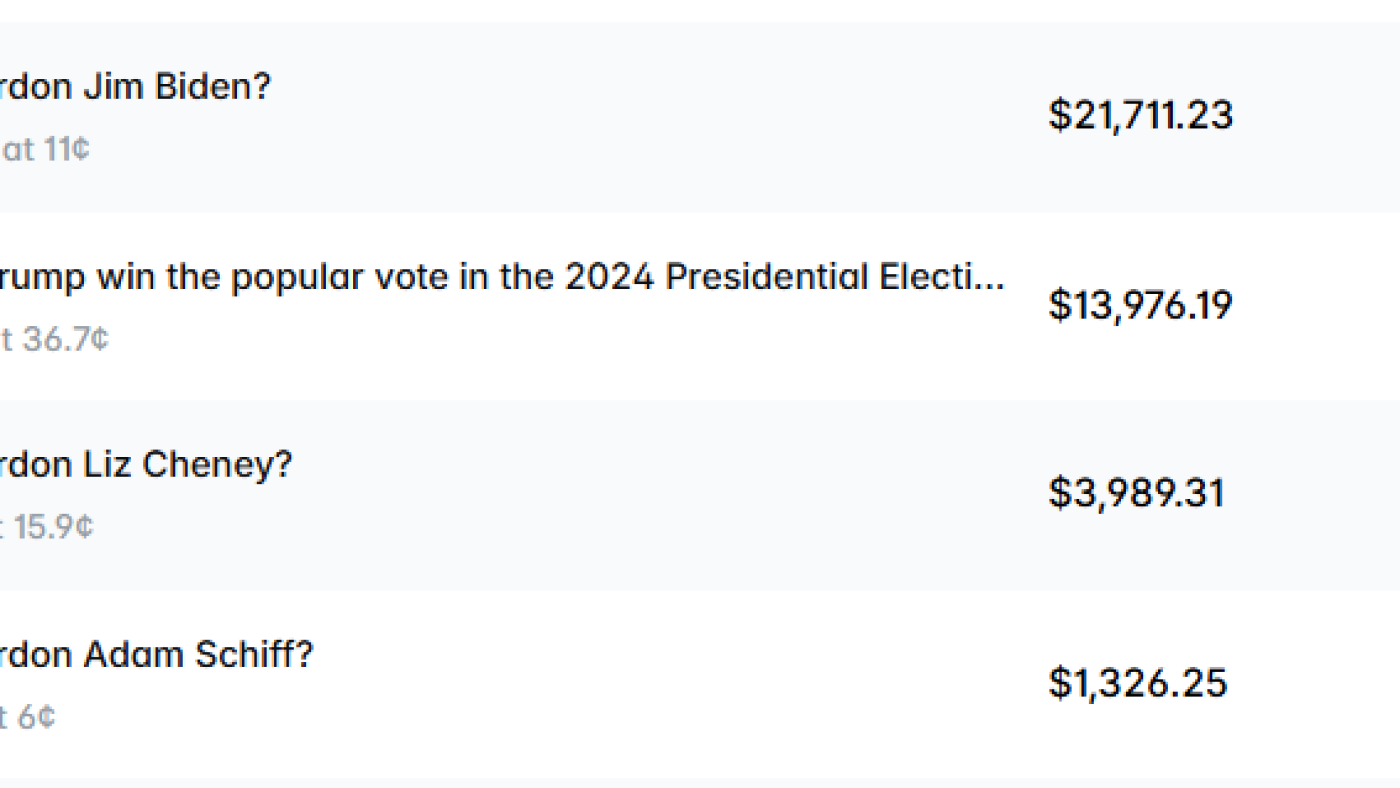

Some of the bets were executed by an anonymous trader who placed more than $300,000 on the likelihood of obtaining a pardon from former President Biden.
hide caption
toggle caption
During the final hours of President Biden’s term, a Polymarket trader made about $300,000 by correctly betting on Biden’s last-minute pardons, according to new data provided to NPR by an analytics firm that examines cryptocurrency trades.
As Biden issued a wave of pardons just hours before leaving the White House, the Polymarket trader bet big on four names, with the odds of those pardons happening quickly falling to near zero on the prediction market site.
The trader, whose identity is not publicly known, bet about $64,000 that Biden would issue a preemptive pardon to Jim Biden, the brother of the former president, former Rep. Liz Cheney, Sen. Adam Schiff, former Rep. Adam Kinzinger. – all prominent critics of President Trump. Although none of them were ever charged with crimes, all four were pardoned to protect them from possible prosecution during Trump’s second term.
A month earlier, the same punter made a timely bet on Polymarket that Biden’s son, Hunter, would receive a pardon on gun and tax charges.
Together, those five bets earned the trader $316,346 in profits, according to an analysis by Paris-based analytics firm Bubblemaps, which shared its findings exclusively with NPR.
“The chances of this happening by chance are virtually zero,” said Joshua Mitts of Columbia Law School, who advises the Justice Department on insider trading cases.
“The trader could have been a White House insider,” he said. “But the trader could have had the information without being an insider,” said Mitts, who published a paper last month estimating that $143 million in profits were won on Polymarket by bettors with inside information.
The Biden pardon-related trades show that individuals may have profited from classified government information before President Trump’s return to office, when prescient bets tied to federal policy and military strikes on sites like Polymarket began to come under scrutiny.
Polymarket did not return a request for comment.
Detectives Crypto Transactions Linked to Biden Pardons
To piece together suspicious transactions related to Biden’s pardons, Bubblemaps forensic investigators examined Polymarket’s transactions using pattern-matching artificial intelligence software. They found that two accounts had a perfect history of betting on Biden pardons.
“We looked at all the accounts trading on this single marketplace and their transactions with each other,” Nick Vaiman, founder of Bubblemap, told NPR in an interview. “And we found a connection between two accounts, which was a shared deposit wallet.”

This means that analysts determined that both accounts were sending Polymarket betting profits to the same cryptocurrency wallet on the Kraken site, a US-based crypto exchange.
“Exchanges like Kraken don’t offer information on individual accounts,” Vaiman said. “We tried desperately, but they don’t give up that information easily.”
Kraken has “know your customer” rules similar to a bank, requiring its customers to verify their identity before using the exchange. However, it remains difficult to publicly identify a customer based solely on a crypto wallet.
Federal prosecutors often find that crypto wallet holders engaging in insider trading do so through other people or shell companies, Mitts said. “If the government subpoenas and retrieves data showing that an entity made the transactions with no connection to the White House, that’s where the trail goes cold.”

Prediction markets, like Polymarket and its main rival, Kalshi, thrived during Trump’s second term.
Théo Marie-Courtois/AFP via Getty Images
hide caption
toggle caption
Théo Marie-Courtois/AFP via Getty Images
And even when a wallet on a cryptocurrency blockchain is connected to a person, a legal case of insider trading is far from over, Mitts added.
“If it’s a misappropriation of information, the problems for prosecutors start there,” he said. “Who was embezzling the money? Could you prove it? Could you prove the conditions under which they obtained the information?”
Biden’s pardon trades follow string of other alleged insider traders taking advantage
Prediction markets, like Polymarket and its main rival, Kalshi, thrived during Trump’s second term. The administration has embraced an industry once considered a pariah in Washington, fearing that markets are ripe for abuse and manipulation.

Investment firm Bernstein predicts that over the next four years, prediction markets could become a $1 trillion industry, and the Trump family is getting in on the action. Donald Trump Jr., the president’s son, is an advisor to both Kalshi and Polymarket.
As millions turn White House announcements and geopolitical episodes into money-making opportunities, a series of controversies have erupted over suspicions of insider trading.
Hours before Venezuelan leader Nicolás Maduro was overthrown by U.S. forces in January, a Polymarket trader placed a bet that netted $400,000. Similarly, an account trading under the username “Magamyman” made more than $500,000 after betting on Polymarket that Iranian Ayatollah Ali Khamenei would soon no longer rule Iran. Shortly after the bet was placed, an Israeli strike killed him.

Most recently, a group of new accounts on Polymarket raked in hundreds of thousands of dollars in profits betting that the United States and Iran would reach a ceasefire before the deal was revealed.
U.S. prosecutors have not announced any investigations or charges regarding possible insider trading. In Israel, authorities arrested several people in a case alleging that military reservists traded on Polymarket using classified military intelligence.
The largest U.S. prediction market, Kalshi, is regulated by the Commodity Futures Trading Commission, a status challenged in court by dozens of states.
The CFTC bans betting on markets linked to war, assassinations and terrorism, but has otherwise lightly supervised the industry, unlike the Biden administration, which banned most types of “event contracts” except those related to things that had obvious public value, such as the weather, oil futures and grain prices.

Polymarket has also been well received by the Trump administration.
Under Biden, the Federal Bureau of Investigation raided the home of Polymarket’s CEO and forced the site to shut down in the United States. It continues to operate primarily as an overseas exchange, with its largest site accessible to Americans only through a virtual private network. Unlike Kalshi, Polymarket uses cryptocurrency, making it easier for traders to remain anonymous.
But Trump’s law enforcers have taken a more hands-off approach to Polymarket’s most controversial deals, on everything from the situation in Gaza to the war to the next nuclear detonation.
“These markets are problematic,” said Nizan Packin, a law professor at Baruch College. “If we’re going to come up with this type of game about geopolitics and elections, we have to do it in a proper way, which means guardrails that we created after studying the consequences and the problems. This is not something that has been done,” said Packin, co-author of a new paper in the journal Science examine the risks of online prediction markets.
“Without clear regulation and clearer, stricter enforcement, the gray area widens and more questions should and will be asked,” she said.