New undersea cable cutter risks Internet’s backbone


China’s “demonstration of deep-sea cable-cutting technology” represented a “show of force”, said Wendy Chang, an analyst at the Mercator Institute for China Studies in Germany, when the technology was first discovered in 2025.
“Whether it is continuing to deny its involvement in shadowy operations involving tampered anchors or revealing equipment to cut fortified cables, China is sending mixed messages about its role in the world’s underwater infrastructure,” Chang said. “It wants to be a player in its construction and operation, but it also wants the world to know that it has the capacity to disrupt critical infrastructure if necessary. »
China is not alone in having the technological capacity to access and potentially cut submarine cables. During the Cold War, the U.S. Navy used a specially modified submarine and divers to covertly exploit Soviet naval communications passing through an undersea cable in the Sea of Okhotsk. The United States and Russia continue to operate nuclear submarines and surveillance ships equipped with robotic submersibles that can access undersea cables. Some of the latest incidents of accidental or suspected sabotage damage to submarine cables have even simply involved ships dragging their anchors across the seabed.
Dual-use ambiguity sparks sabotage concerns
Chinese researchers have insisted that cable-cutting technology is intended for civilian purposes involving “marine resource development.” But the South China Morning Post speculated that the tool could pose a threat to fiber optic cables connecting Pacific islands such as Guam, the US overseas territory that hosts several military bases.
Such a tool would also exacerbate Chinese military pressure on Taiwan’s self-governing democracy, which relies on 24 major cables for its global connectivity. Taiwan has faced a series of suspected submarine cable sabotage incidents involving Chinese ships as part of a broader pressure campaign by Chinese military ships and maritime militia, which have conducted several exercises in waters near Taiwan.
Chinese-flagged cargo ships have even damaged underwater data cables and gas pipelines in the Baltic Sea at least twice in October 2023 and November 2024, affecting European countries including Germany, Finland, Lithuania, Estonia and Sweden. Chinese authorities described these incidents as accidents.
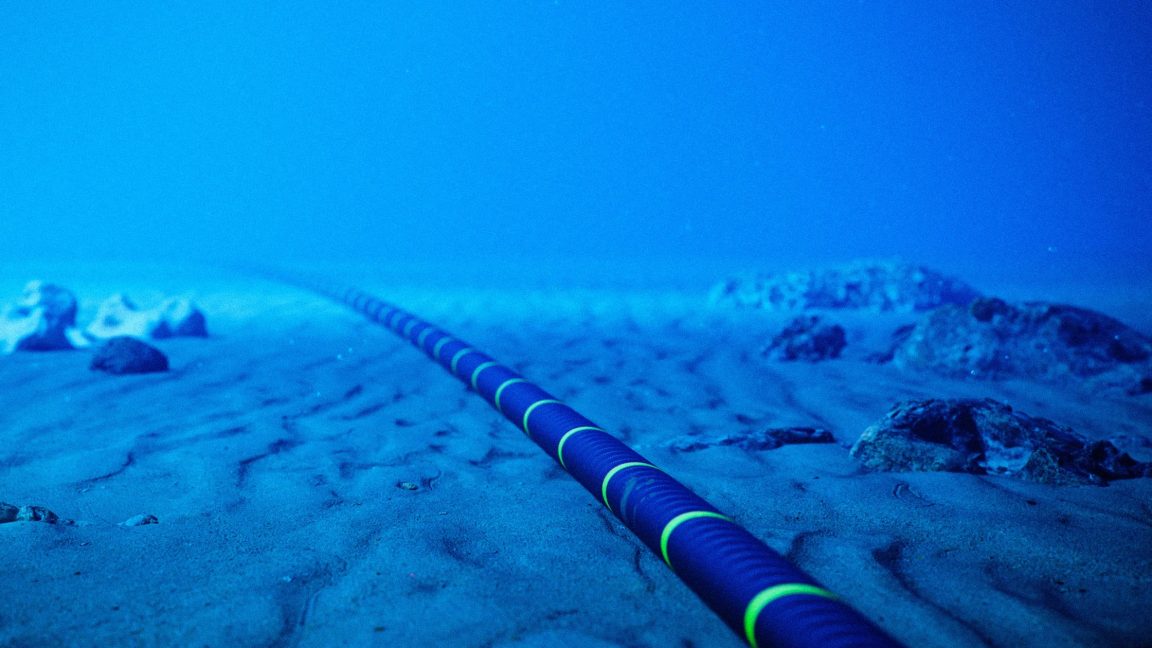
Given the wider number of alleged sabotage incidents, it’s not hard to imagine cause for concern about the dual-use capabilities of the new cable cutting tool. It is also a reminder of the growing vulnerability of the physical backbone of the Internet, made up of more than 1.5 million kilometers of undersea cables that stretch across oceans and connect continents.


