Santa Marta May Be a Game-Changing Moment for the Climate


Cover the climate now
/
April 30, 2026
At a crucial climate conference, a critical mass of countries begin planning to phase out fossil fuels.
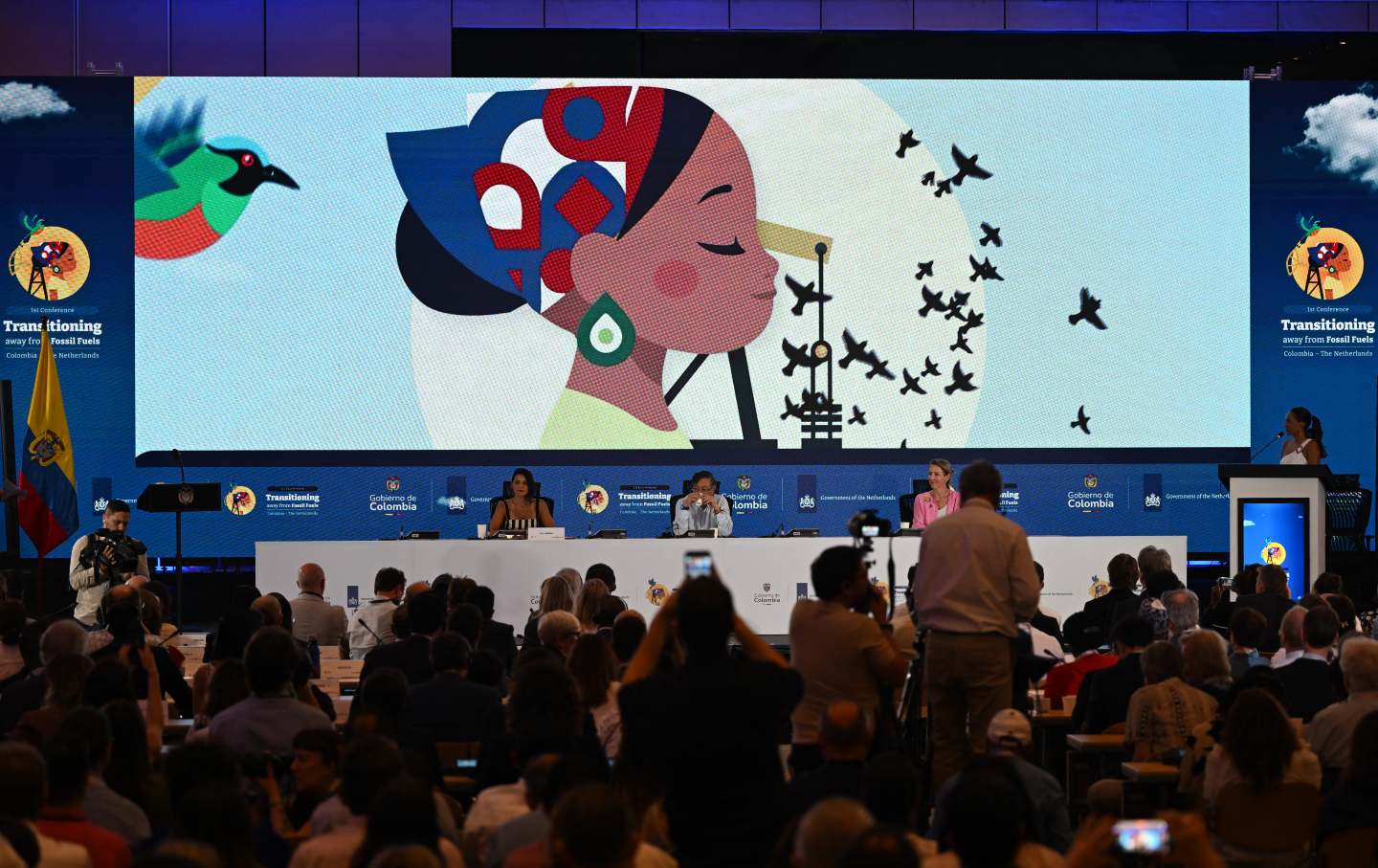
Colombian President Gustavo Petro (center), Colombian Environment Minister Irene Velez (left) and Dutch Minister of Climate and Green Growth Stientje van Veldhoven attend the International Conference on a Just Transition away from Fossil Fuels in Santa Marta, Colombia, April 28, 2026.
(Raul ARBOLEDA/Getty Images)
Sante Mr.arta, CColombia-“You are the light in a tunnel of darkness,” climate scientist Johan Rockstrom told delegates at the first conference on moving away from fossil fuels this week in Santa Marta, Colombia. After years of U.N. climate summits rarely mentioning the words “fossil fuels,” 57 countries representing a third of the global economy gathered in Santa Marta to discuss not whether, but how, to leave behind the main driver of climate change. This potentially historic development generated significant media interest: 146 journalists from 61 media outlets and 28 countries attended in person, countless others followed the live broadcast, and extensive media coverage was broadcast around the world, according to the governments of Colombia and the Netherlands, co-sponsors of the conference.
The rally received an unexpected boost when the head of the International Energy Agency said in an interview with The guardian that the war in Iran has irreparably destroyed fossil fuel markets. Interruptions in oil and gas supplies and resulting price spikes, Turkish economist Fatih Birol said, will forever turn countries away from fossil fuels and toward safer, renewable energy sources. “The damage is done,” added Birol, whose agency The New York Times described as “hugely influential” on the long-term plans of energy companies and investors around the world.
Irene Vélez Torres, Colombia’s environment minister, welcomed Birol’s comments. “It seems that many of us are realizing at the same time that fossil fuels cannot provide energy security, because fossil fuels are subject to scarcity, and scarcity can be manipulated,” she said in an interview with Covering Climate Now.
The conference is separate from the UN process, so the goal was not to negotiate a legal agreement but to learn from everyone – including businesses, indigenous peoples and other parts of civil society – about the best ways to free economies and societies from fossil fuels. Each country’s roadmap will be voluntary and specific to its own situation. “This conference is not about documents,” said Rachel Kyte, the UK’s special representative for climate. “It’s about finding other travelers and learning from them: what works and what doesn’t? »
For example, France has published what it calls “the first national road map” of a developed country to phase out fossil fuels. The plan calls for removing coal from the national power grid by 2027, and ending oil consumption by 2045 and gas by 2050. Chinese electric car giant BYD and Australian mining company Fortescue hosted a private sector roundtable aboard what Fortescue called the world’s first cargo ship powered entirely without fossil fuels. The company urged businesses and governments to pursue the goal of “real zero,” rather than the “net zero” goal that uses carbon offsets and allows emissions to continue. Asked about the 80 to 89 percent of people around the world who want stronger climate action, Ana Toni, the Brazilian diplomat who served as executive director of the UN COP30 climate summit, urged citizens to act “at the national level. Elections are coming and the consumer choices people make matter too.”
The conclusions of the Santa Marta conference aim to accelerate progress at COP31 next November, but its greater impact could come from the economic weight of the conference’s “coalition of the willing.” Joined in Santa Marta by California, the world’s fifth-largest economy, these countries account for 30 percent of global fossil fuel consumption. Removing this purchasing power from oil, gas and coal in coming years could accelerate Birol’s planned phase-out of fossil fuels.
Santa Marta could well be a watershed moment in climate history, and journalists have many stories to explore in the months to come. Will the moving speech expressed by governments in Santa Marta be followed by the policies they implement in their countries? Will other countries and subnational governments join their ranks? How will the large emitters who were not present – the United States, China and other fossil fuel-producing states and companies – react? A follow-up conference will take place in February 2027, hosted by the Pacific island nation Tuvalu and co-sponsored by Ireland. “This is not the end,” Vélez said in the final moments of the conference. “This is the start of a new global climate democracy.”
From the illegal war against Iran to the inhumane fuel blockade against Cuba, from AI weapons to crypto corruption, we live in a time of staggering chaos, cruelty and violence.
Unlike other publications that reproduce the opinions of authoritarians, billionaires and corporations, The nation publishes stories that hold the powerful accountable and center communities too often denied voice in national media – stories like the one you just read.
Every day, our journalism weeds out lies and distortions, contextualizes developments that are reshaping politics around the world, and advances progressive ideas that fuel our movements and incite change in the halls of power.
This independent journalism is only possible with the support of our readers. If you would like more urgent coverage like this, please donate to The nation Today.


