Why the Hawks still have promising future despite ugly end to season vs. Knicks


For seven seasons, the Atlanta Hawks have had to be one type of team. Trae Young doesn’t really open many stylistic doors. He never really defended, nor was he ever an off-ball player or catch-and-shoot threat. If you want to justify building around him, that means building an offense around him and running dozens of pick-and-rolls every game. It’s basic and it’s effective. Between 2021 and 2024, the Hawks have consistently ranked league average or better in half-court efficiency, and they have consistently been much better offensively with Young on the floor.
They also ranked 22nd, 25th, 29th and 30th in assists per game during this window. They never displayed above-average defense throughout the season with Young on the roster. In other words, the style was limiting. Young’s injury early in the season opened all the doors that were previously closed. They moved to ninth in passing and 10th in defense. They rebuilt their offensive identity around the transition. Only the Clippers were more effective in transition, and only the Pistons, Heat and Raptors spent a greater proportion of their possessions there. The reinvention of Atlanta has happened. The Hawks traded Young to Washington. They focused on this identity.
And it fizzled out in the playoffs.
What went wrong against the Knicks?
Through the first five games of their first-round loss to the Knicks, only the Pistons, Magic and Trail Blazers were less efficient offensively than the Hawks. In their loss in the season-ending Game 6 on Thursday, they were down 47 points at halftime and scored 36 points in the first 24 minutes. Atlanta went from averaging around 18 fast break points per game to 13 and, more shockingly, after averaging around 295 assists per game in the regular season, they fell to 257 in the playoffs. Only the Thunder and 76ers moved the ball less.
So what happened? A few things. The Knicks aren’t exactly an athletic contest opponent since they rarely turn the ball over. Their individual offensive rebounders are so good that they can crash the glass without compromising their transition defense. Only the Thunder, Raptors and Celtics allowed a lower percentage of opposing plays to come in transition. The Knicks were built to play the slower, more methodical game created by the playoffs. The Hawks, at least for now, were not.
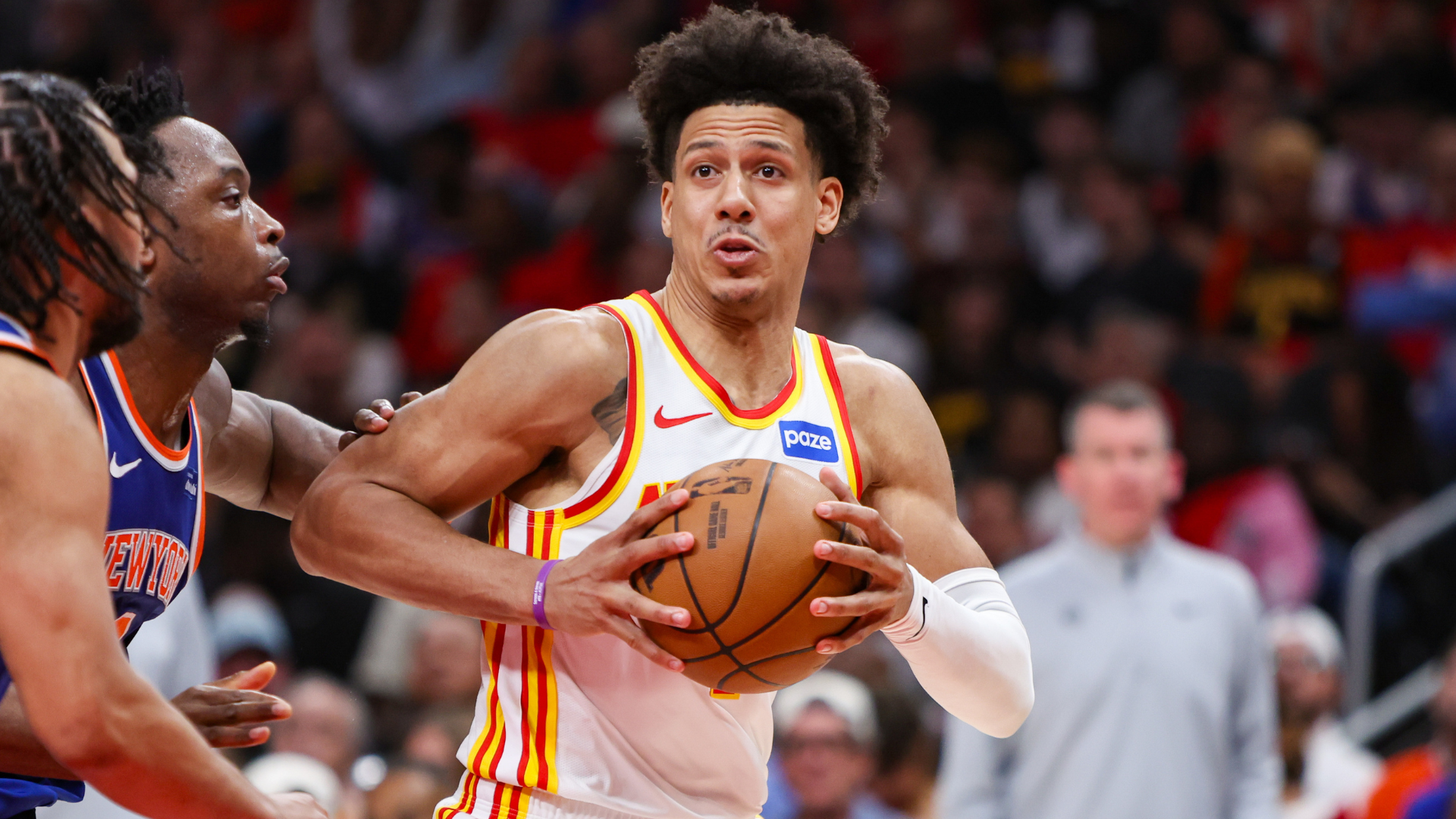
Atlanta spent much of this series playing 4-on-5 offensively. New York simply didn’t guard Dyson Daniels from the perimeter. Atlanta has built its offense to take this into account. Daniels functions, to some extent, as a center, serving as the primary pick-and-roll screener for the Hawks, while their current center, Onyeka Okongwu, shoots more 3s than most players his size. He’s simply not enough of a shooting threat to force the Knicks to compromise their rim defense.
The expectation going into this series was that New York’s best defender, OG Anunoby, would guard Hawks All-Star Jalen Johnson. He did quite a bit, but he also spent a lot of time on Okongwu so he could serve as a backup rim protector. Johnson, in his first playoff run in the rotation, was unable to generate any upside while guarded by the smaller Josh Hart, so the Hawks went from averaging around 52 paint points per game in the regular season to around 45 in the playoffs. Atlanta’s magnificent ball movement and speed came to a halt.
Atlanta’s offense only really worked in the simplest way: when CJ McCollum generated his own offense. The Hawks won Games 2 and 3 behind 55 points from McCollum, scored mostly at the expense of Jalen Brunson, against whom he shot 73.7% in the first five games of the series. Sometimes the playoffs are as simple as having a great individual shooter who can chase down the opposing team’s worst defender to generate points. New York’s great individual shooter is a 29-year-old on the cusp of making his third All-NBA team. Atlanta is a 34-year-old who has never appeared in an All-Star Game.
What do the Hawks need?
The Hawks have lessons to learn from all of this. For their playoff offense to work, they probably need a guard who can do what McCollum did early in the series, but more consistently. Young was that kind of guard. Does that mean they should have kept him? No, because he excluded them from all the other things that went well this season. The Hawks don’t need to abandon their ball movement or transition. They need to amp it up with a better goaltender than they currently have.
Fortunately, they have sufficient resources to try to achieve this. Johnson, Okongwu and Nickeil Alexander-Walker are all tied to deals so team-friendly that the Hawks have easy ways to limit cap space in the coming offseasons if they want to pursue him. For now, they will likely operate above the cap this offseason to keep McCollum and Jonathan Kuminga. The focus will likely be on the commercial market and, depending on the lottery, the project.
Atlanta infamously managed to relieve the Pelicans of their unprotected 2026 first-round pick in a trade during last year’s draft. This pick came with trade rights attached to the Bucks, meaning Atlanta has two bites at the upcoming lottery apple. If New Orleans or Milwaukee advance, the Hawks have a chance to become one of the star prospects in this class. What if they don’t? The back half of the top 10 is full of high-level guard prospects. In a perfect world, the Hawks draft Darryn Peterson. If they can’t, Keaton Wagler or Darius Acuff would suffice.
Ideally, the Hawks find their guard in June and are off to the races from there. If they don’t, it’s worth remembering that the Hawks have another Pelicans/Bucks pick coming in 2027, albeit an inferior one. The Hawks will get the lesser of these two picks, provided they both don’t land in the top four. Not the golden ticket that the 2026 pick was, but nonetheless a useful trade chip if the Hawks decide to go shopping for a veteran guard.
There are other questions that need to be answered here. Daniels is a big one. He shot 34% on three 3-point attempts per game last season. Not great, but pretty usable. He shot below 19% on less than half of the attempts this season. The Hawks don’t need Daniels to be an elite shooter. They need opponents to guard him. His pick, pass and transition attack adds tremendously to the Hawks’ offense when things are going well, and that’s before factoring in his role as Atlanta’s best defender. They just don’t have a team shot at this point to make up for it. Maximizing rim pressure on Johnson, especially in the half-court, relies on improving their spacing.
These problems are simply more solvable than those posed by the Young version of the team. There’s only so much you can go when you’re locked into a specific style. The Hawks landed on something more malleable this season, and it suits their other players quite well. They’ll need to complement these players with more talent and perhaps change how they use them, but considering how bleak things were in Atlanta just a few years ago, this is a pretty promising overall position the Hawks have created for themselves. They jettisoned their franchise player and still continued to trade blows with a Finals contender for six games. They will only get better with more time to build on this new philosophy.