Money, sex and a Buddhist monk: Head of China’s famed Shaolin Temple under investigation


Hong Kong
–
The famous Chinese Shaolin Temple announced on Sunday that its abbot was the subject of an investigation for an alleged diversion and “inappropriate relations” with women, reviving ten years against the controversial and high level monk.
Shi Yongxin, known as “CEO Monk” for its entrepreneurial efforts that have transformed the Buddhist monastery into a commercial empire, is suspected of criminal offenses, including the embezzlement and the embezzlement of project funds and temple assets, the temple authority said in a press release.
The 59 -year -old monk was also accused of having seriously violated Buddhist precepts by maintaining “inappropriate relations” with several women over an extended period and feeling at least one child, according to the press release.
We expected the Buddhist monks in China to make a vow of celibacy.
“(Shi) is currently under joint survey by several departments. More information will be returned to the public in due course,” added the press release.
CNN could not contact Shi.
Established more than 1,500 years ago in the forest mountains of Central China, the Temple of Shaolin is both a religious and cultural icon, renowned for its secular tradition of Zen Buddhism and Kung -Fu Shaolin – a distinct form of Chinese martial arts.
Shi, who became the abbot of the Shaolin Temple in 1999 and was a member of the Chinese rubber parliament for two decades, frequently appeared under media spotlights.
Known as the first Chinese abbot to hold a master of business administration, it has often been seen globetrotter with an iPhone in hand, meeting world leaders and titans of the industry-from the late Queen Elizabeth II of Great Britain, the South African President Nelson Mandela and Henry Kissinger at the CEO of Apple Tim Cook.
In February, Shi led a delegation of monks from the Shaolin Temple to the Vatican to meet Pope Francis.
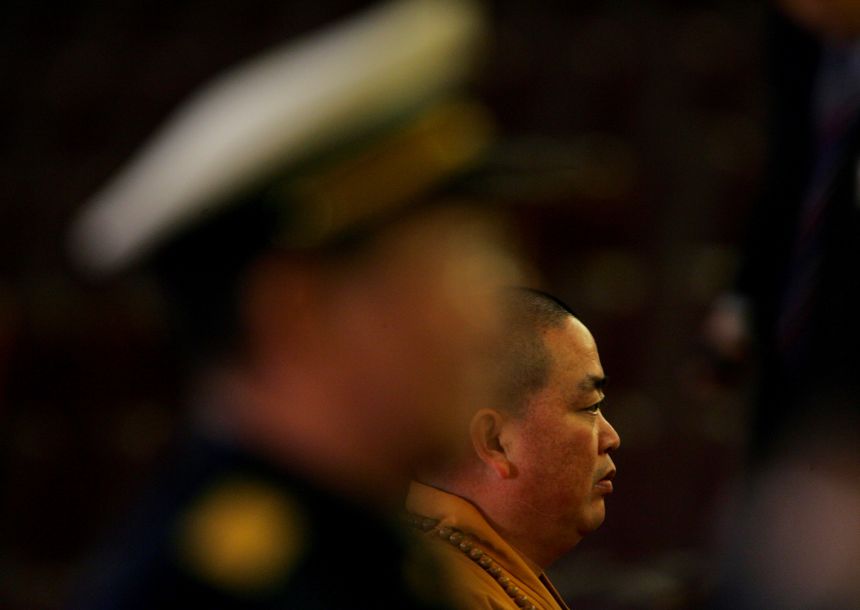
But the unflattering titles have darkened the Buddhist monk for years – including its acceptance of a car of 1 million yuan ($ 140,000) from the local government as a reward for the promotion of tourism in 2006.
Responding to a public outcry at the time, Shi told state media: “The monks are also citizens. We have fulfilled our functions and made the contribution to society, so it is true that we receive awards. ”
His emphasis put on the promotion of the Shaolin brand and transforming it into activities of several million dollars attracted a fierce criticism, in particular certain followers who considered excessive marketing as corrupting the spiritual integrity of the religious institution.
He organized Shaolin Kung Fu performances in the world, conceded the name of the temple to cartoons, films and video games, and has established a business empire that includes publication, traditional Chinese medicine, tourism and real estate development.
For its part, Shi defended its efforts to market the Shaolin brand and promote it worldwide.
After writing a check for $ 3 million in an Australian city in 2015 to build a Shaolin branch, Shi Yongxin told the Xinhua news agency led by the State: “If China I import Disney stations, why can’t other countries import the Shaolin monastery?”
“Cultural promotion is a very worthy company,” he said.
Later that year, an initiate of Shaolin Auto-identified published a series of explosive allegations on Chinese social media, representing Shi as a misappropriation of funds and a skill runner with illegitimate children.
The accuser included documents dating from the late 1980s showing that Shi was expelled from Shaolin after the theft and other accusations of his own master. Among the documents published online was a birth certificate for one of the abbot illegitimate children, as well as photos of the alleged mother and the child.
The allegations caused a denial of anger at the Shaolin Temple and an investigation by the country’s religious affairs authorities. Questioned by the Chinese BBC at the time on allegations, Shi said: “If there was a problem, he would have surfaced a long time ago.”
The authorities abandoned the case in 2017, citing insufficient evidence. Three years later, Shi was then re -elected as deputy chief of the Buddhist association of China – the state supervision organization on religion – a position he has occupied since 2002, according to the state media.
On Monday, the Buddhist association of China said in a statement that Shi had been stripped of its certificate of ordination – official proof of the qualification of a monk or the nun to enter monastic life.
“Shi Yongxin’s actions are extremely obvious, severely tarnishing the reputation of the Buddhist community and damaging the image of monastics,” said the association.
“The Buddhist association of China supports and firmly approves the decision to manage the case of Shi Yongxin in accordance with the law.”


