How businesses around the world responded



 Getty images
Business leaders around the world have woken up the reality of higher tasks on exports to the American market, after President Donald Trump’s new order on prices on Thursday evening.
In an executive decree, President Trump has imposed new prices on countries that have not concluded updated trade agreements with the United States. Earlier in the week, he described a new framework for agreements with the nations that have managed to negotiate revised conditions.
Trump’s decision has now reshaped US trade relations around the world with new rates on more than 90 countries.
Here is what some business leaders have told the BBC what it means for them.
Mexico
 Getty images
While the White House has raised prices on Canada from 25% to 35%, its other large North American trading partner, Mexico, has obtained a 90-day stay, temporarily stopping new functions.
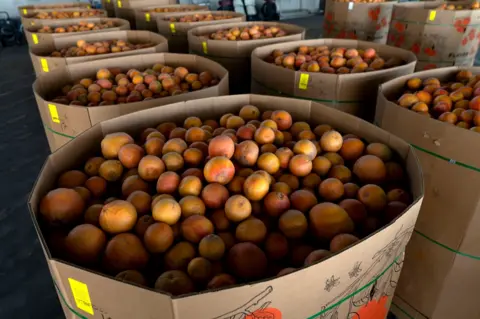
Jaime Chamberlain, president of the Société de Fruits et Vegetables Chamberlain distributing in Nugales, Arizona, said that his company imported millions of products from Mexico every year.
“We are in fact very lucky that Mexican negotiators and American negotiators have calmed down and stand with fresh heads,” he told BBC Radio 4. “The two countries really don’t want to be mistaken.
“And if it takes 90 more days to do things well, I think it’s worth it.”
But in the absence of an agreement, there is still a huge uncertainty about what could happen once this 90 -day extension is finished.
“I think that in the most extreme cases, many farmers would simply stop agriculture for the export market,” said Chamberlain. “It would be very difficult for importers of a file like me to continue to pay these tasks for a long time.”
Thailand
 BBC / Lulu Luo
Thailand, which initially looked at the possibility of a 36%levy, concluded an agreement to reduce prices to 19%.
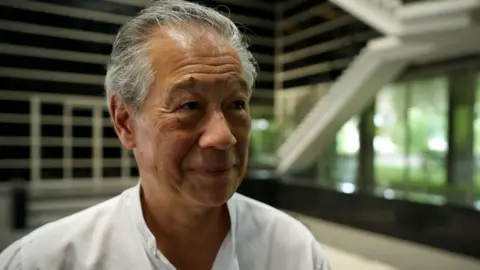
Richard Han, CEO of Hana Microelectronics – One of the largest contractual manufacturers in the country – recalled his shock during the initial announcement of Trump in April.
“I remember waking up in the morning. It was early enough, and the indicator standing on the lawn of the White House with his board. I thought:” Did I see that? 36%? How could it be? “” He said.
But he thinks that his company, which manufactures high -tech goods such as printed circuits, integrated circuits, RFID labels for prices, can survive as part of the new lower price agreement.
“If we all in this region ends with around 20%, our buyers will not look for alternative suppliers – it will be just a tax, like VAT [value-added tax]For us consumers, “said Han.
Italy
European leaders have concluded an agreement, holding prices for most of the goods at 15% after Trump first threatened a double rate.
But it is always a substantial increase in the first average rate of 4.8%.
According to the Italian Institute for International Political Studies, agricultural, pharmaceutical and automotive sectors are likely to be struck by the hardest part, the gross domestic product (GDP) of the projected country by 0.2%.
Cristiano finished of the Italian Confederation of Farmers said that the agreement with the United States felt more like “a surrender” than an agreement.
Several Italian commercial associations are now demanding compensation from the European Union to compensate for the losses provided.
Brazil
 Getty images
If the EU’s agreement has managed to blunt the worst effects of prices, Brazil has seen its fortune reverse.
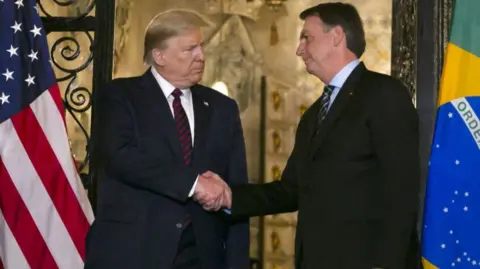
Trump initially announced a rate of 10%, but on Wednesday he increased this figure to 50%, accusing President Luiz Inacio Lula Da Silva of having unjustly attacked American technological companies and called the former president Jair Bolsonaro for having tried a coup a “witch hunt”.
However, the higher price is delivered with a few exemptions, for example for orange juice and commercial aircraft.
But other products are expected to face net price increases.
Cecafé, the Brazil Coffee Exporters Council, said the impact on Brazilian roasters and exporters would be “important” and warned American coffee drinkers to prepare price increases.
Brazilian producers and exporters work on emergency plans.
But Cecafé said it would not be easy to find other markets for the 8.1 m coffee currently exported to the United States. New markets open in Asia and the Middle East – but according to Cecafé, they will not be able to absorb all the American potential lack.
Swiss
Switzerland, once optimistic about the achievement of a modest rate of 10%, was rather affected by a rate of 39% – the highest in Europe.
Barely a few weeks ago, the president in Switzerland Karin Keller-Sutter hinted that an agreement on a rate of 10% could be possible.
Sudden hike has now shocked the country because prices could seriously affect companies that produce pharmaceuticals, jewelry and machine tools.
“With its unilateral prices increases on Swiss industrial products, the American government sends a clear protectionist signal,” said Swissmechanic, organization of the machine tool industry in a statement.
“The government must now act with clarity and confidence – and make a determined use of the existing opportunity window for negotiations with the United States.”
 Getty images
India
India was slapped with a 25% rate with an additional footnote – Trump threatened to impose an unpertified sanction on India’s trade relations with Russia.
India is currently among the largest Russian oil buyers, and Trump uses prices as a leverage to put pressure on Moscow during the war in Ukraine.
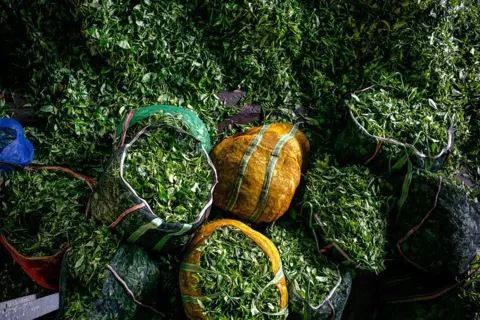
Aurobindo Nayak, who directs Ci Ltd, a large tea exporter in Kolkata, says that American consumers will finally pay the price.
He said to the BBC affairs report: “We will certainly bear the brunt. But I think people who will really be hit hard are the American consumers themselves.
“Choosing to impose tea in the United States will only make inflationary tea. Assam tea has a lot of character, it is appreciated by American consumers. Darjeeling tea is a specialized tea, it is cultivated anywhere else. Consumption in the United States is growing.”
 Getty images
Laos
One of the highest rate rates – 40% – was imposed in Laos in Southeast Asia.
“We are not very satisfied with the price … Laos is a very small country,” said Xaybanderth Rasphone, co-founder of the MKGT sports marketing agency, and vice-president of the Lao National Chamber of Commerce. “Laos exports to the United States only agricultural products, clothing, juice, etc.
RASPHONE told the BBC World Service Program Newsday that 60 companies operating in these sectors collectively using nearly 60,000 people could be affected.
“Indirect jobs could also be affected,” he said, noting that the global effect on the country’s economy could be substantial.
With Laura Gozzi reports in Rome, Jonathan Head in Bangkok, Ione Wells in São Paulo and Imogen Foulkes in Geneva


