Viking Silver Hoard Reveals How Silver Coins From the Middle East Ended Up in England


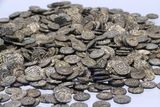
Most people are considering Vikings today as well -hardened marauders in combat, but this caricature does not represent the complete image of these Scandinavians of the sea. While the Vikings were certainly elite warriors who amassed the wealth by looting, they were also masterful merchants. Their commercial roads have extended throughout Europe and even reached Asia.
A new study, published in Archaeometry, revealed the international influence of Viking’s commerce on the basis of a 9th and 11th century silver artefact treasure that attach England to the Viking age in the Middle East. A significant quantity of money in Islamic silver in the treasure shows that the Vikings wealth were not only looted from raids, but also came from transactions outside their own domain.
The economy of viking ingots
When the Vikings began to invade England in the 9th century, they encountered an economic system very different from what they were used to. Vikings generally used weighted money as a currency; The silver they exchanged were valued according to their size and weight. The Anglo-Saxons already present in England, on the other hand, used parts of variables as money.
The Vikings were exposed to all kinds of cultural differences because they have established commercial networks and extended them to Russia and the Middle East. A great source of money in their economy of ingots was the Dirham, a coin in the Islamic world which was imported into mass quantities in northern Europe.
However, the Vikings did not use the coins exactly as expected. They would deliberately cut them into small pieces (called hacksilver, sign of an economy of ingots) or would shape them in ornaments.
Learn more: Vikings were not satisfied with raids and looting – they also had diplomacy and commercial networks
Content of the Bedale Treasury
The richness of the Vikings – silver coins and ingots with ornate jewelry – is kept in hordes that have been dugs across England. The new study is focused on the Bedale Treasury, found in 2012 near the small town of Bedale in North Yorkshire.
The treasure includes 29 silver ingots and several built -in rings, all dating from the end of the 9th or early 10th century. At the time, the Vikings had reigned over a region in northern England known as Jórvík (or Scandinavian York).
In the study, the researchers used a combination of analyzes of isotopes and trace elements to identify three sources of money in the treasure of Bedale: Western Europe, Islamic dirhams and mixed sources reflecting a mixture of the two. While most of the money came from the currency of Western Europe, nine of the ingots were geochemically accompanied by the money created in the Islamic Caliphate, around modern Iran and Iraq.
This money would have been transported to commercial roads that crossed Russia in Scandinavia, and he finally moved to his final destination in England.
“I love to think how Bedale – today, a northern market city of North Yorkshire – was, at the Viking age, at the heart of a much broader Viking Eurasian economy,” said study author, Jane Kershaw, professor of archeology at the University of Oxford, in a press release. “The Vikings do not only extract the richness of the local population, they also brought wealth with them when they attacked and settled.”
The Viking Complex Commerce Network
Researchers also found that Viking metallic in Scandinavia and England refined money using locally available lead. In a case, a large neck ring formed from several twisted rods would have been made in northern England from an oriental and Western silver mixture.
The study shows that the Vikings did not concern looting and looting. Although this is a notable part of their identity, they have also become an economic power by building such in -depth and interconnected commercial networks. This shows in the way they have acquired Silver Dirham from the Middle East and integrate it into their own system of ingots by cutting it, cast iron and overhaul.
Learn more: Viking skulls reveal that ancient people were robust, but not healthy
Article Sources
Our Discovermagazine.com writers use studies evaluated by high -quality peers and sources for our articles, and our publishers examine scientific precision and editorial standards. Review the sources used below for this article:


