AI Identifies Four Times More Quakes at Italy’s Campi Flegrei Than Traditional Methods


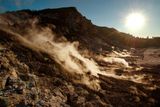
Researchers use artificial intelligence (AI) to exhibit hidden earthquakes and unknown flaw lines in the Italian Flegrei campi – identifying four times more earthquakes than traditional models.
“There are things to push, but the gain of information is so huge that there is really no return,” said co-author Greg Beroza, professor of geophysics at the Stanford Doerr School of Sustainability.
Campi Flegrei eruption
On September 29, 1538, the Campi Flegrei vents opened, releasing a torrent of ash, pumice stone and volcanic gases that swallowed up the surroundings, including the ancient Roman city of rod. It was the beginning of a weekly eruption, so powerful that it resulted in the formation of a completely new volcano – Monte Nuovo.
The event did not appear unexpectedly. There had been forefood signs: chains of small to moderate earthquakes occurring in rapid succession (also known as seismic swarms), a retirement coast (caused by a volcanic uprising) and an unusual activity emanating from the Volcano vents (called smokers). There were even reports of residents of the neighboring colony Pozzuoli of new terrains raising from the sea two decades before the eruption.
About five hundred years after the eruption, the ability of experts to monitor seismic activity has increased considerably. The same goes for the local population. More than half a million people live inside the caldera itself. Meanwhile, the city of Naples, which houses a million people, is only half an hour. In short, an eruption of the 1538 scale would be devastating.
This is particularly worrying because after centuries of inactivity, the volcano shows signs of disorders. There have been four gusts of increased activity since the 1950s. The most recent – still in progress – started in 2005. In recent years, activity has been even more intensified: thousands of earthquakes have been recorded each Months since August 2023. Five have been a magnitude four or more.
Now scientists writing in the journal Science used AI to improve the sensitivity of seismic surveillance systems. The automatic learning model aims to provide almost real information on the location and extent of the earthquake.
Learn more: What can we learn from the explosive past of Campi Flegrei?
Monitor an eruption with AI
The model was formed on a large database of earthquake and waveform data collected by analysts before applying them to the data recorded between January 2022 and March 2025.
Unlike traditional tools, AI has picked up incredibly subtle signals, which indicated tiny earthquake tremors one and smaller. When the seismological laboratory of the Institute of Geophysics and Volcanology (Ingv) in Italy had been manually located 12,083 earthquakes between 2022 and 2025, the model detected 54,319.
The model also identified two unknown faults before under Pozzuoli.
“We think that the length of the defects limits the maximum size of earthquakes,” said Beroza. “So to assess the danger, this is really critical information.”
Overall, the AI model provided volcanologists to supervise Campi Flegrei a much richer understanding of the fault system in which it works – which means that there is a change in seismic activity, it is more likely to be taken early, said Beroza. In terms of the possibility of an imminent eruption, there is no sign of magma moving towards the surface, which suggests that it is less likely in the short term.
Other seismic activity
As with all new technologies, there are elements to smooth. Researchers cannot exclude the possibility that certain earthquakes are false positives, for example. Beroza sees that it works in tandem with more traditional methods: “If you see something that seems abnormal, it is then that human experts enter and that they look at the data to confirm what they see is actually a real geophysical phenomenon.”
The AI model remains operational in Campi Flegrei and could be applied to other areas of high seismic activity, such as Santorini, Greece, to improve surveillance systems.
“There will be a lot of progress to have a clearer view of what is under us, in the same way as with the Spatial Webb Telescope, we can have a clearer view of the star systems,” said Beroza. “It is an exciting period of seismology.”
Learn more: Campi Flegrei had a massive eruption 40,000 years ago – Could a Supermassive volcano soon occur?
Article Sources
Our Discovermagazine.com writers use studies evaluated by high -quality peers and sources for our articles, and our publishers examine scientific precision and editorial standards. Review the sources used below for this article:


