A California lawyer returns home to Minneapolis to fight for civil rights

How to find the missing?
If you find them, how can you help them?
Oakland civil rights attorney James Cook has been on the ground in Minnesota for months finding answers to these questions as they come.
A talkative Minneapolis native who still lives part-time in the Twin Cities, Cook is one of a handful of lawyers who have dropped everything to help (for free) those caught up in the federal crackdown — protesters, immigrants and detained citizens — too many of whom have found themselves facing deportation, arrest or even disappearing, at least for a while.

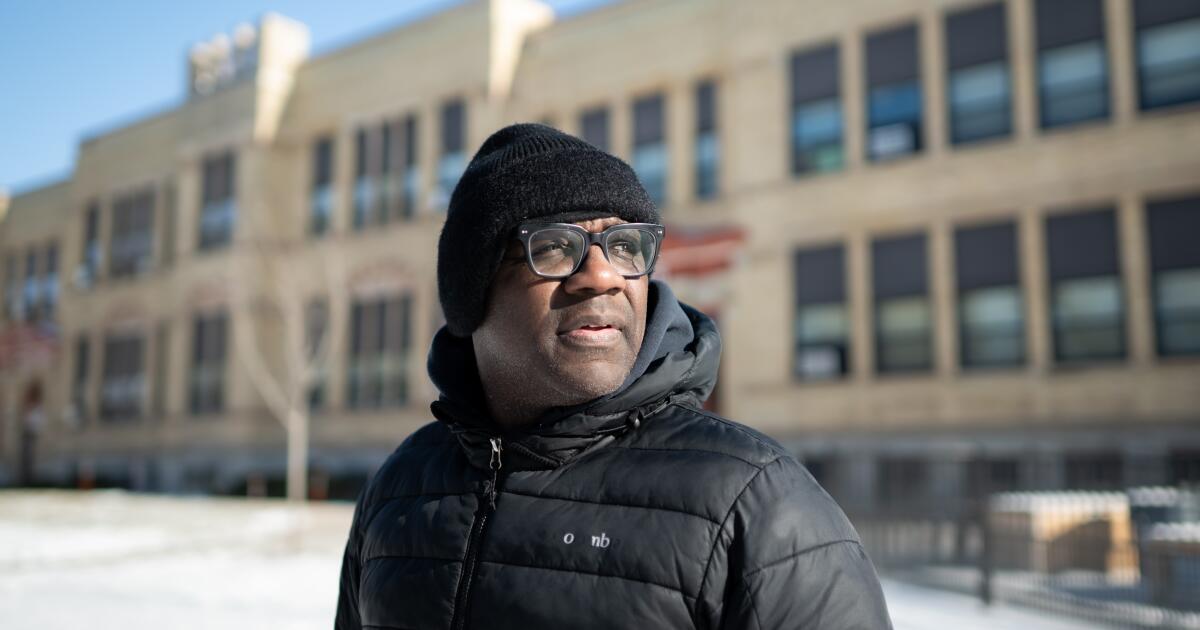
Civil rights attorney James Cook in the rearview mirror as he makes phone calls in his car in Minneapolis.
(Caroline Yang/For the Times)
“These are leaders who are on the ground and really helping people through this process,” Minnesota school board member Chauntyll Allen told me.
She was among protesters arrested at a local church, accused of conspiring to deprive others of their constitutional rights by Pam Bondi’s politicized Justice Department, which also arrested journalist Don Lemon on Friday for the same incident. Cook is one of the attorneys now representing Allen.
“It shows us that the judiciary, or part of the judiciary in our democracy, is prepared to step in and ensure that our democracy remains strong,” Allen said of Cook and others like him.
If it is the images of clashes in the streets that captivate the media and the public, it is lawyers like Cook who are behind the scenes waging an existential battle to preserve the rule of law in a place where it is becoming increasingly opaque, to say the least.
The legal work behind the detentions has been a largely neglected battleground that will likely rage years after ICE leaves the streets, leaving hundreds, if not thousands, of long, drawn-out trials in its wake.
Beyond the personal fates they will determine, the outcome of the civil litigation led by Cook and others will likely force transparency and accountability in this chaotic and troubled time.
It is a long and complex work, vital not only for people, but also for history.
Or, as Cook puts it, “I’ll be 10 years older when this is all resolved.”

Federal agents stand guard against a growing wall of protesters on Jan. 24 in Minneapolis, just hours after Alex Pretti was shot and killed by federal agents.
(Caroline Yang/For the Times)
Cook told me this on his way to the Bishop Henry Whipple Federal Building, where some inmates may be being held. It’s hard to know. A few years ago, when immigration enforcement in Minnesota intensified under Trump’s first term, activists tried to get the building’s name changed, arguing that Whipple, the state’s first Protestant Episcopal bishop, had been an advocate for the marginalized and didn’t want his name associated with what the federal government was doing.
It didn’t work, but the movement’s slogan, “What Would Whipple Do?” still has resonance in this city, where two American citizens, Alex Pretti and Renee Good, were fatally shot while protesting — incidents horrific enough that Bruce Springsteen wrote a song about them.
Cook is well aware that the guns carried by federal agents aren’t for show, even without the Boss’ new ballad. Just a few days ago, one of the first times he drove his battered truck up to the gate, Whipple’s federal guards pointed their guns at him.
“I’m like, ‘Hey, I’m going to take my keys out of the ignition and drop them on the ground. So please don’t shoot,'” he said.
They lowered their weapons, but Cook was afraid, a feeling that is not easy.
Long before his law degree, when he was a punk-rock-loving teenager in the 1980s, fresh out of Southwest High, the public school not far from Whipple, a former coach convinced him to abandon his college dreams and instead try to make the first Muay Thai kickboxing team in the Olympics.
The martial art ultimately did not become an official Olympic sport, but the experience launched Cook on a professional boxing and kickboxing career that took him to competitions around the world and taught him that fear is no reason to back down.
But “Father Time is undefeated,” Cook said. “I got older and started losing fights, and I was like, okay, it’s time to come back to life.”
This eventually led him to earn a law degree in San Francisco, where, after an internship as a public defender, he decided he wanted to become a trial lawyer and fight in court.

Civil rights attorney James Cook has been doing pro bono immigration work since the crackdown began in Minneapolis.
(Caroline Yang/For the Times)
He began soliciting John Burris, another Bay Area lawyer who is an icon of civil rights and police misconduct cases. Burris, known as the “godfather of police litigation,” was implicated in the Oakland Riders case in 2000, when officers were found to have withheld evidence. He has also represented Rodney King, the family of Oscar Grant and the family of Joseph Mann, among others.
But Burris, a boxing fan, didn’t return Cook’s calls until the young lawyer offered him free tickets to one of his fights, which he always did on the side.
“And then immediately, I got a call back,” Cook said.
Burris said Cook’s history as a fighter intrigued him, but “I told James, you can’t be a fighter and a lawyer. You can’t get hit in the head all the time.”
Cook did not follow this advice.
Still, Burris said, “It’s his perseverance that I admire, because the type of work we’re involved in requires dedicated people, who have a real commitment to the work, and he has demonstrated that kind of consistency and dedication.”
Cook has worked with Burris for more than 20 years now, but until recently, the maze of the immigration system wasn’t his area of expertise. It’s been a crash course for him, he said, in the often arcane laws that determine who can stay in America and who can’t.
It was also a crash course in what a civil rights emergency looks like. Along with his work tracking down locked-up immigrants, Cook spends a lot of time on the streets during protests, helping people understand their rights — and their limitations — and seeing firsthand what’s happening.
“If you ever wondered what you would have done in Germany, now is the time,” he said. “Now is the time to do something. People are being interned.”
In the hours after Pretti’s shooting, Cook was at the scene of the shooting, amid tear gas, offering legal help to anyone who needed it and testifying to conduct that will almost certainly face scrutiny one day, even if government leaders approve of it now.

Law enforcement officers throw tear gas canisters as they work to push back crowds and expand their perimeter in Minneapolis on January 24.
(Caroline Yang/For the Times)
“The way the police are chasing people, the protesters who were just protesting legally and being beaten, pepper sprayed and tear gassed — all of those are civil rights violations,” Burris said. “And so the law is the guardrails. So there have to be lawyers willing to protect those guardrails and act like centurions, as I call it.”
Cook tried to calm the protesters, he told me, and avoid confrontations. But people are crazy and determined. His biggest fear is summer – when hot weather could draw even bigger crowds if control measures are still in place. He fears that federal agents’ actions could turn into anger at local cops enforcing local laws, leading to even more chaos.
“I’ve always supported the cops as long as they do their job properly,” Cook said.
For now, he’s taking things one day at a time, one case at a time, one name at a time.

Protesters wave an inverted American flag as law enforcement throws tear gas in Minneapolis after Alex Pretti was killed by federal agents.
(Caroline Yang/For the Times)
On Tuesday, Cook walked through the Whipple armed checkpoint with a list of about seven people, people who were arrested by federal agents for one reason or another, or for reasons unknown, and who now cannot be located. They are not listed in the public online system meant to track detainees, and their family and friends have not heard from them.
If he’s lucky, Cook will get information on one or two that they are indeed inside, or perhaps in a detention center in Texas, where many have been sent. But there will be others whose location remains unknown. He will make calls, fill out forms and come back tomorrow. And the next day after that.
“That’s what we do,” he said. “I’m always in it for the long haul. I mean, you know, shoot, yeah, that’s kind of how it works.”


