A decade after Brazil’s deadly dam collapse, Indigenous peoples demand justice on the eve of COP30

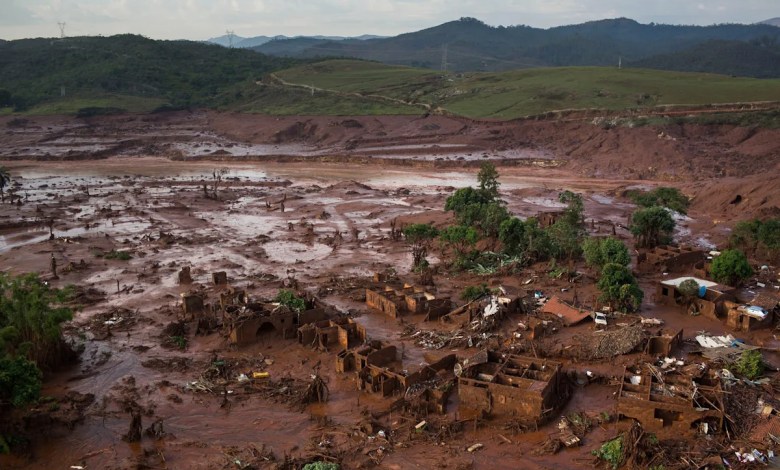
BOGOTA, Colombia (AP) — A week before what indigenous Krenak people now call “the death of the river,” they say they felt it coming. The birds stopped singing, the air grew heavy and an unusual silence settled over their village in Minas Gerais, a state in southeastern Brazil where forested hills give way to the winding Doce River.
Then, on November 5, 2015, the mud arrived.
A mining dam owned by Samarco – a joint venture between Brazilian company Vale and Anglo-Australian giant BHP Billiton – burst upstream near the town of Mariana, releasing a torrent of toxic iron ore waste. It buried the nearby community of Bento Rodrigues and raced down the Doce River valley, killing 19 people and contaminating waterways for nearly 600 kilometers (370 miles) before reaching the Atlantic Ocean.
For the Krenak people, who once depended on the river for food, rituals and daily life, the damage was not just environmental but spiritual.
“It was the saddest day for my people,” said Shirley Djukurnã Krenak, an indigenous leader whose community has lived for generations along the Doce River. “We felt the death of the river before it arrived. »
The Mariana disaster dumped an estimated 40 million tons of mining waste into the Doce basin, devastating one of Brazil’s oldest river systems, whose valley has shaped the landscape of Minas Gerais for millions of years.
Ten years later, reconstruction and repairs have dragged on due to legal disputes and the river remains contaminated with heavy metals. Local communities say little has changed, even as Brazil strives to define itself as a leader in global climate policy while hosting the United Nations’ COP30 climate summit — an event some are skeptical will bring change.
“For us, the fight is not just about speeches at the COP,” Krenak said. “It’s a matter of survival.”
A test for Brazil’s climate credibility
Brazilian President Luiz Inácio Lula da Silva now hopes to consolidate his reputation as a global environmental leader at COP30 in Belém, in the heart of the Amazon. Yet Mariana’s unresolved legacy and other recent policy measures reveal the distance between Brazil’s climate discourse and reality, according to Maurício Guetta, legal policy director at advocacy group Avaaz.
“It is contradictory for a country that wants to be a leader on climate issues to continue to approve laws that reduce the protection of nature and the rights of indigenous peoples,” he said, adding that indigenous territories are among the world’s most effective barriers against deforestation.
Indigenous MP Célia Xakriabá, who represents Minas Gerais, said the tragedy remains “a crime still in progress.”
“The Doce River is still sick. Fish are contaminated, people are sick and children are still asking when the river will be healed,” she said. “You can’t bring back 19 lives, or a healthy river. »
Xakriabá said the lack of justice for Mariana victims undermines Brazil’s credibility ahead of the summit.
“It’s difficult to talk about climate leadership when the state where this crime took place hasn’t even recovered,” she said. “A true environmental policy begins with justice for those who suffer its consequences. »
After the 2015 collapse, the state of Minas Gerais weakened its environmental licensing laws — a move that Guetta says directly contributed to the 2019 Brumadinho dam disaster, which killed 270 people.
In October 2024, the Brazilian government and the states of Minas Gerais and Espirito Santo signed a 132 billion reais ($23 billion) deal with Samarco, the mine operator, and its owners, Vale and BHP, to fund social and environmental repairs. The record deal, which will bring the total payment to 170 billion reais ($30 billion), includes aid to affected communities, but critics say deeper flaws in Brazil’s environmental governance remain.
“The Mariana disaster showed how fragile Brazil’s environmental control system is,” Guetta said. “Instead of learning from this, we have seen a process of deregulation.”
Brazil’s Congress approved a law in 2023 that restricts indigenous land claims and this year passed what activists call the “devastating bill,” which would relax environmental licensing nationwide. Environmentalists warn that both threats threaten to undermine the country’s own climate goals under the Paris Agreement, the 2015 global agreement to reduce greenhouse gas emissions and limit global warming.
Now Brazil’s Congress is also considering a national bill that would further relax oversight of mining and industrial projects and “virtually dismantle Brazil’s environmental licensing system,” Guetta said.
He added that Brazil’s environmental agencies remain underfunded and understaffed, even as mining and agribusiness expand deeper into fragile ecosystems.
Brazil’s Environment Ministry did not respond to a request for comment.
Skepticism towards the “Indigenous COP”
Krenak told the Associated Press that his community would not participate in COP30. She sees the climate summit as distant from the realities facing indigenous peoples and full of “greenwashing” and false promises.
“If all the previous COPs had worked, we would no longer be talking about crimes like this,” she said.
Instead, she said, real climate action starts with protecting rivers and forests – and recognizing indigenous territories.
Anthropologist Ana Magdalena Hurtado, who has spent decades working with indigenous communities in South America, said she shares this concern.
“What worries me is that this all looks very nice, but the people who will walk away feeling good are urban academics and policymakers, not those living in remote territories,” said Hurtado, a professor of anthropology and global health at Arizona State University.
She said dedicating space for indigenous voices at COP30 is a welcome step, but warned that inclusion without follow-up can do more harm than good.
As COP30 gets underway, many indigenous leaders share this skepticism but remain hopeful.
“I still believe change is possible,” Krenak said. “That one day our children will be able to drink a glass of water without fear of dying.”
___
Associated Press writer Melina Walling contributed to this report from Chicago.
___
Associated Press climate and environmental coverage receives financial support from several private foundations. AP is solely responsible for all content. Find AP’s standards for working with philanthropic organizations, a list of supporters, and funded coverage areas at AP.org.


