A fantastically techy car for the 1 percent

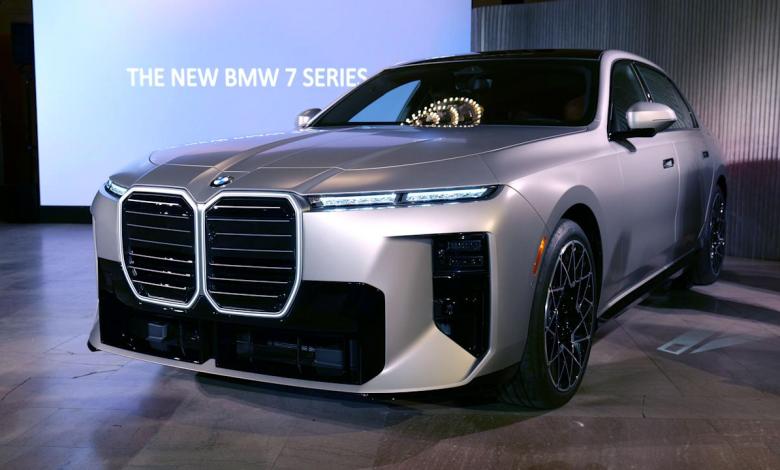
Large, sophisticated executive sedans are a dying breed, especially when it comes to electric vehicles. With the disappearance of the Tesla Model S and Mercedes EQ ranges, the choices are slim. Besides the upcoming S-Class, there’s the Lucid Air, Cadillac Celestiq, and maybe the Porsche Taycan, depending on how far you’re willing to stretch the definition. But as the market leader in luxury sedans, BMW isn’t giving up just yet. With the arrival of the new 7 Series, the company has created a car – with a full range of petrol, hybrid and fully electric options – that truly embraces modern gadgetry.
Preview
Because we’re electric vehicle enthusiasts here at Engadget, we’re primarily going to talk about the new i7, which is the battery-powered version of the new 7 Series. Unfortunately, due to building regulations at New York’s Grand Central Station, where BMW’s reveal took place, the company was only allowed to showcase a gasoline-powered car, so this story features photos of the 740. However, company representatives told me that there was no Most only minor cosmetic differences between the ICE and EV models (aside from the powertrains), so feel free to compare my photos with the official press images to see if you can spot any changes.

Between things like its grille and recessed door handles, the new 7 Series looks more like an electric vehicle than a gas-powered car. (Sam Rutherford for Engadget)
As for the i7 itself, it will be available in three main versions: the i750 xDrive, the i760 xDrive and the i7 M70 xDrive, the latter being the fastest and most powerful of the group. Pricing starts at $105,750 for the i750 and $126,250 for the i760, both available at launch later this year. The i7 M70 will arrive later, likely in 2027, with pricing yet to be determined.
Each model will come standard with dual-motor all-wheel drive, with the base i750 offering 455 horsepower or 544 hp on the i760, before going up to 680 hp on the i7 M70. Compared to the outgoing models, the new 2027 i7 also has a significantly larger power pack (112.4 kWh, compared to 105.7 kWh) made up of the new sixth-generation BMW battery cells. This helps support faster charging speeds of 250 kW (up from 195 kW), as well as a native NACS port and 400 volt architecture, which is enough to take the car from 10 to 80 percent in around 28 minutes. The improved batteries should also result in a longer range, with BMW saying the i760 will travel more than 350 miles on a single charge, based on internal measurements using EPA testing procedures.

On the new 2027 models, BMW has extended the 7 Series taillights to give the rear a more distinctive appearance. (Sam Rutherford for Engadget)
Finally, while we’re still waiting for the iX3 to make its official debut in the US market, the new 7 Series is also BMW’s first car for the US to feature the company’s Neue Klasse design language, which features a collection of significantly improved technology inside. We’ll talk more about that when we get inside.
Outside
One of the most interesting things about the new 7 Series is that it was designed to have essentially the same exterior regardless of each model’s powertrain. BMW says this not only makes it easier for customers to choose whether they want a gas, hybrid or electric car, but it also presents a more unified appearance within the family. That said, a number of features, like the recessed grille and door handles, make BMW’s latest luxury sedan feel more like an electric car than a traditional ICE vehicle. I even noticed that on the gasoline 740 exhibited by BMW, its exhaust outlets were pointed downwards and hidden behind the rear bumper of the car, which plays into the common identity of the different models. That said, on the M Sport models and the M Performance variant coming out next year, things like the tailpipes will be much more visible to help appease the type of enthusiasts who aren’t ready for the transition to electrification.
Up front, BMW has ditched the previous model’s stacked headlights in favor of a new ultra-slim design featuring 24 crystal LEDs that create a neat, jewel-like appearance. Meanwhile, the company’s iconic kidney grille has been given a totally futuristic update, with integrated lighting (including programmable welcome and goodbye designs) and active aerodynamics. At the rear, the 7 Series’ taillights have been extended almost the entire width of the vehicle, creating a more distinctive look.
Interior
For tech enthusiasts, the interior of the new 7 Series is a true marvel of engineering and gadgetry, highlighted by BMW’s Neue Klasse design language. Depending on how you count, there are between five and seven different displays. In the center, there’s the 17.9-inch main screen (which supports both Android Auto and CarPlay), as well as the company’s Surround Vision (which is actually a projector) which adds another slim screen across the entire bottom of the windshield. Panoramic Vision also provides a more traditional 3D HUD for things like turn-by-turn navigation while driving.
For the driver, BMW has also updated the i7’s steering wheel with what the company calls “timid technology.” This means the controls are only illuminated when a specific feature is available, while also providing haptic feedback for additional tactile response. And although I didn’t get to drive the car myself, BMW representatives told me that the car’s assisted driving technology had been updated to be more accommodating of small manual adjustments. On other cars, this might disable hands-free driving altogether or force you to struggle with a robot-controlled steering wheel.
For the first time on any of its vehicles, BMW is including a 14.6-inch passenger display that can be used to stream movies, music and more, completely independent of what’s displayed on the main screen. Next, two small panels are mounted on the doors for the rear passengers to control things like climate control settings and more. And with a Bowers and Wilkins sound system featuring 36 speakers and 4,000 watts of power, audio certainly hasn’t been neglected.
However, arguably the real centerpiece of the entire vehicle is the optional 31-inch 8K cinema screen, which BMW claims is the largest screen in any production car today. It’s mounted on a motorized chassis that lowers from the ceiling and it’s simply massive. Gadget lovers will appreciate that it comes with a built-in webcam, so you can use it for video calls. And when you’re not working, you can even pair accessories like Bluetooth controllers to the screen to play games. There are even woofers mounted under the rear seat to deliver what BMW says is a 4D sound experience.
My favorite part of this package is the full-size HDMI jack located next to the USB-C port on the back of the center console. This will allow you to plug in just about anything you want and enjoy it on this huge 31-inch screen. And like previous 7 Series models, the i7 still features BMW’s Executive Seat Mode, which raises the front passenger seat an additional 20cm while reclining the rear, providing a truly luxurious way to enjoy a car ride (there’s even a small built-in footrest). Another little thing that potential buyers will surely appreciate is that BMW also provides four years of data and access to its Digital Premium service as standard on every vehicle.
Initial thoughts

The luxury tour. (Sam Rutherford for Engadget)
With all these changes, BMW is calling this the new 7 Series, but it’s actually closer to a mid-cycle refresh after a total redesign in 2023. For people who can never have enough screen real estate, the i7 and its gas-powered siblings are practically overflowing with screens. Plus, I really like BMW’s attention to detail that allows users to pair peripherals like game controllers to in-car displays or plug in external devices via HDMI. As someone who likes the more futuristic, sleek exterior that we see on many electric vehicles, I think BMW has done a great job finding a middle ground that works for both gas and electric powertrains.
Even the i7’s base specs have had big problems, both in terms of range and charging speeds, although at some point BMW will need to upgrade its 400-volt architecture to something beefier. In many ways, the i7’s $105,750 starting price is its biggest hurdle, because for tech enthusiasts, it feels like BMW has all the bases covered and then some. On the bright side, if you can afford it, you can probably also afford to hire a driver every once in a while so you can take advantage of the 7 Series’ executive seat mode.