A midwife tells how his mom’s childbirth crisis inspired his career path : NPR


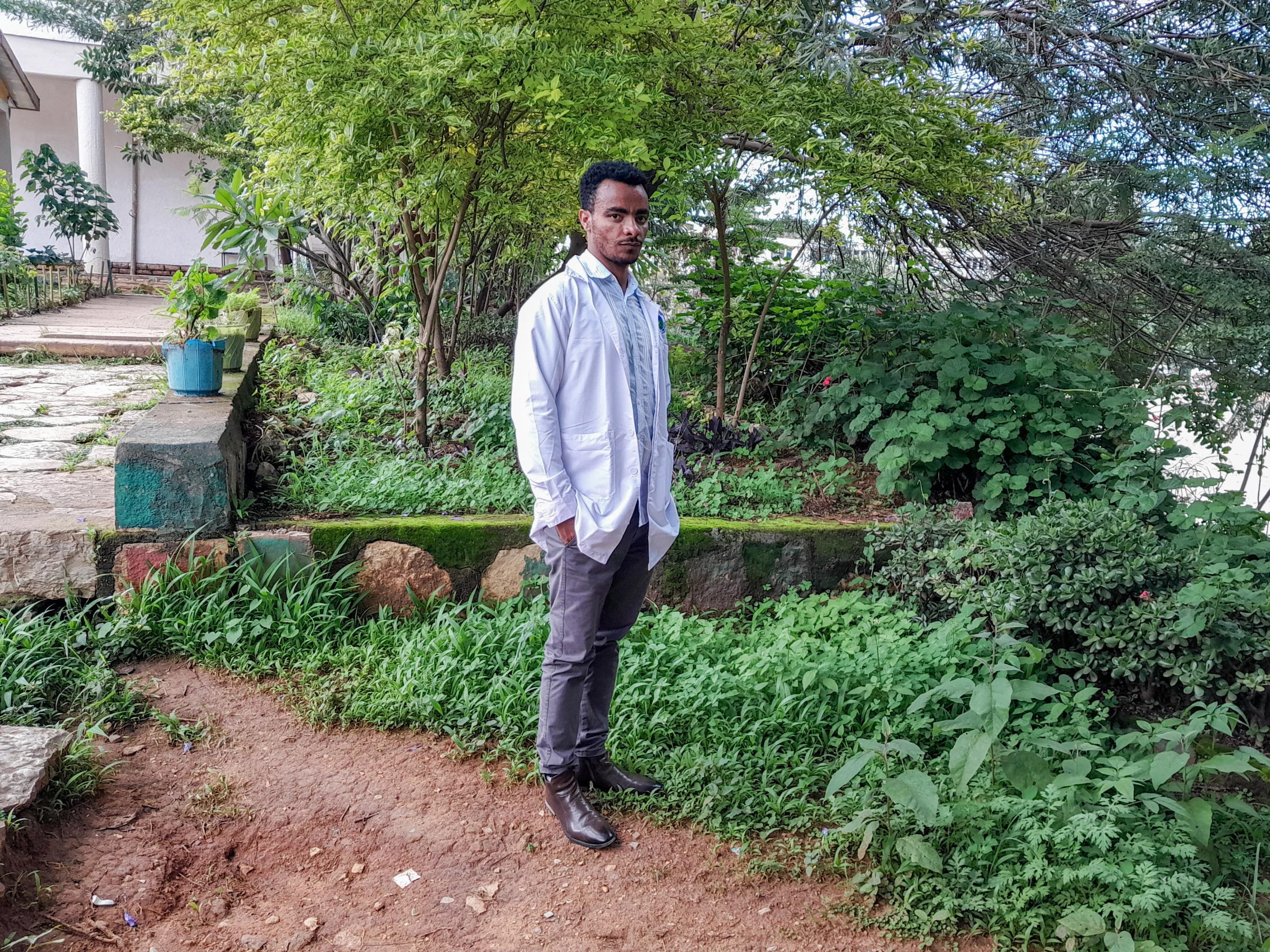
Dawit Tamru heads the midwifery school at a teaching hospital in Dire Dawa, Ethiopia. He was inspired to become a midwife when his mother experienced serious difficulties after giving birth to his younger sister – and midwives saved her life.
Ben de la Cruz/NPR
hide caption
toggle caption
Ben de la Cruz/NPR
Dawit Tamiru knew he wanted to become a midwife when he was just 10 years old.
It all started the day her mother, a street vendor in Ethiopia, gave birth to her younger sister. After the baby girl arrived, something was wrong: her mother had not delivered the placenta as usually happens after childbirth. He remembers that the traditional birth attendant, who Tamiru said had minimal training, informed his mother that she was possibly having twins and that they would have to wait to see if another baby would be born.
Tamiru remembers seeing her mother bleeding at home and her condition deteriorating.
“She was panting and having difficulty,” he recalls. “I was very young. I was very nervous. I didn’t know what to do. It was hard to wait and I just prayed.”
A cousin recommended that he take him to the hospital. Tamiru had to stay at home but was able to leave the next day to visit his mother.
“When I saw her the next morning, [she was] on. I couldn’t believe it. I just thanked my God and said, “Who did this?” Who saved my mother’s life? “
The hospital staff told him: The midwives.
“I was very inspired,” he says.
From that moment on, Tamiru had her sights set on becoming a midwife.
Today, he is an assistant professor of midwifery at Haramaya University and heads the midwifery school at Haramaya University Hiwot Fana Specialty Hospital.
He says he now understands that his mother could easily have bled to death if a hospital midwife had not put on elbow-length gloves and carefully removed the placenta.
Tamiru can think of countless times a midwife has saved the life of a mother or child. And he worries that there aren’t enough midwives for all the women giving birth. His concerns are supported by the numbers.
Published research in February 2026, there was a shortage of nearly a million midwives.
“Every region of the world needs more midwives,” explains Daniela Drandicwho is a co-author of the article and works at the International Confederation of Midwives. “Africa accounts for about 47% of the global shortage, but it is doing a very good job of closing that gap.”
A studypublished in the Lancet Global Health in 2020, predicted that if the number of midwives increased to reach universal coverage levels, 67% of maternal deaths could be avoided as well as 64% of neonatal deaths and 65% of stillbirths. This equates to more than 4 million lives saved each year. According to WHOOver the past decade, progress in reducing maternal and child deaths has largely stalled.
Geeta Lal, coordinator of the global midwifery program at the United Nations Population Fund, singled out Ethiopia as a country with high maternal mortality that has championed midwifery as a way to improve the situation. In 2008, the country had a little more 1,000 midwives and now Lal estimates that number exceeds 20,000.
“The progress has been enormous,” she says. “We have made progress and there is now a growing belief that these models of care work, but there is still a long way to go.”
Knowing what these numbers mean in personal terms is part of what motivated Tamiru to launch a local campaign in Ethiopia to raise awareness of the profession – as part of a global effort. “I placed large posters in high traffic areas, at the university gates, where thousands of students and teachers pass daily. I also spoke at schools, at community gatherings, in public spaces — wherever people were willing to listen,” he says. “I focused on the importance of maternal and newborn health and the essential role of midwives.”
May 5 is International Day of the Midwife. This year’s theme is “A Million More.”
NPR spoke with Tamiru about her life and work — as well as what it means to be a male midwife. Here are highlights from the conversation, edited for length and clarity.
Ever since you were a little boy and watched your mother struggle, the Ethiopian Ministry of Health has been working to increase the number of midwives. What changes have you noticed? And what else is needed?
I noticed the difference.
So, looking at the trends, especially in the last two decades, as the number of midwives has increased, it has become rarer to see maternal illnesses these days in our country. [urban] hospitals. The change seems obvious and visible, not only to the professional but also to everyone around them. It is increasingly rare to see mothers die during childbirth or from pregnancy-related complications.
But there is [also] a shortage and it is evident, especially in rural areas.
In the Ethiopian context, more than 80% of the country is rural. So, for many of these families, access to health services may be far away. Most of the time, after completing their training, midwifery students choose to work in the city. So I think the government should prioritize midwives and encourage them to work in rural and hard to reach areas.
Midwifery is a field often considered to be dominated by women. What do you think about this as a man?
This is a common misconception.
I think anyone, regardless of gender, could provide this service – anyone who is knowledgeable, knowledgeable and compassionate towards birthing women and newborns. I think the most important factor is passion.
However, for example, I have taught midwifery courses in neighboring countries – such as Somalia – and found that midwives are still expected to be women. This is simply not the case in our context, Ethiopia. For example, in the [midwifery] In the class I currently teach, 50% of the students are male and maybe 50% are female. It’s the same thing in all the sections I teach and, in my class [when I was a student]I think most of the students were men.
What is it like to be a midwife?
There is no mistreatment from spouses or relatives. We are seen as medical personnel. It’s common. It’s already part of the culture. This is nothing new.
At the start of 2025, the United States sharply reduced its foreign aid. Has this had an impact on your work and profession as a midwife in Ethiopia?
It was very disastrous. The USAID Cup [U.S. Agency for International Development] has had a considerable impact, particularly on maternal health and midwifery. Many projects were immediately canceled and some medications, formerly given to mothers, are now very difficult to obtain.
For example, for pregnant women who have Rh negative blood but whose baby has Rh positive blood, this can pose a problem. Especially after the first pregnancy – during the second pregnancy – this can be fatal for the fetus. So, to prevent these fetal deaths, there is a medication administered but this medication was supported by USAID.
Budget cuts force mothers to face pregnancy without any medication. This causes them to lose their babies. And this is common in my public hospital. We see babies dying during labor and delivery. It’s quite difficult to be honest.
[NPR reached out to the State Department for comment but did not receive a reply by the deadline.]What does your mother say about your career as a midwife?
When I first told her I would become someone like the person who saved your life, she was very proud and emotional at that moment. And I did it. It came true.
I believe that mothers are the pillar of the home, the pillar of the family and the pillar of the community. So every time I had the idea of studying something other than midwifery, [this belief] was in the back of my mind.
So, you have no doubts about your career choice?
I didn’t think twice about it.


