A shelter village provides a bridge to permanent housing : NPR

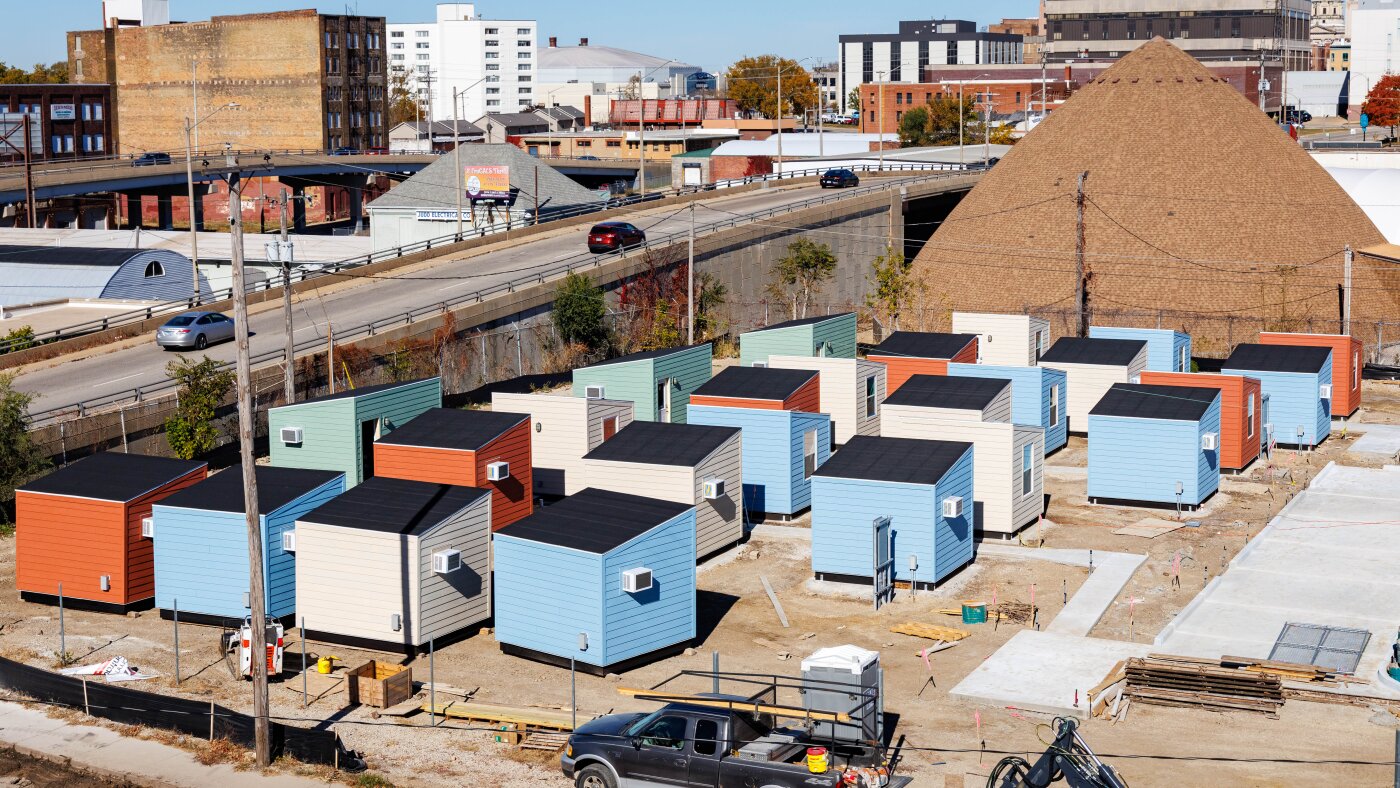

Tiny, colorful cabins make up Home Sweet Home Ministries’ shelter village, The Bridge, in Bloomington, Illinois. Construction began in summer 2025.
Emilie Bollinger
hide caption
toggle caption
Emilie Bollinger
A few months ago, in the dead of winter, Matthew Stone was living in a tent encampment in the woods of a central Illinois town.
“It was very horrible, a very horrible experience,” Stone said. “I was living in a tent with my dog. It was just a horrible experience, very cold this winter.”
Temperatures in central Illinois averaged 20 degrees Fahrenheit, with a low of minus 8 in January. But three days before temperatures dropped below freezing, the city of Bloomington opened its first shelter village. The Bridge is a small community of homes that provides homeless people with private spaces to sleep and store their belongings.
The housing shortage is escalating the homelessness crisis.
Bloomington is experiencing a housing shortage that has become disastrous in 2021 as more people have moved to the city in search of work at a new manufacturing company. There was not enough new housing to meet demand and homelessness increased.
Matt Burgess, CEO of Home Sweet Home Ministries, a local nonprofit, says it was a crisis that wasn’t visible to many city residents until 2023. That’s when people without permanent housing began living in a tent encampment in a downtown church parking lot.
“Hundreds of people passed through there every day,” Burgess said. “And that’s when the community started saying, ‘You know, it’s not right that we have people stuck outside.'”
In Illinois, weather conditions can be extreme, ranging from snowstorms and cold snaps to tornadoes and flash floods. These conditions can make life difficult, even deadly, for people living outdoors.
“We started saying very loudly, ‘It’s not acceptable that our neighbors have no legitimate choice but to try to survive in a tent in a parking lot,'” Burgess said.

A Home Sweet Home Ministries employee and a volunteer drag a tent to a dumpster in the parking lot of a church that was used as a homeless encampment.
Emilie Bollinger
hide caption
toggle caption
Emilie Bollinger
Despite this, the city closed the encampment and many people staying there continued to live outside, scattered throughout the community.
“We wanted to find a solution that has been proven to work in other communities across our country that maybe we could try here,” Burgess said.
An idea becomes a reality.
Burgess said Home Sweet Home Ministries was in an ideal position to offer an alternative because it had been serving people living on the margins of society in Bloomington for more than a hundred years.
Burgess came up with the idea for The Bridge after studying four communities that had built shelter villages to combat homelessness: Burlington, Vermont; Denver, Colo.; Missoula, Montana and Austin, Texas.

CEO of Home Sweet Home Ministry Matt Burgess came up with the idea for The Bridge after looking at how other cities were building refuge villages for people living outside.
Emilie Bollinger
hide caption
toggle caption
Emilie Bollinger
“I actually physically visited the refuge village in Missoula, Montana,” Burgess said. “They call it a ‘temporary safe outdoor space.’ And so, I got to see that in action, personally talk to the people who were running that program, as part of our development of The Bridge. »
Acquire a location
As Burgess collected ideas for building a possible refuge village, a major obstacle stood in his way: finding a place to set it up.
Accessibility was important. Residents needed to be in a prime location so they could easily bike to their appointments or take a bus. Zoning was also an issue.
“The biggest challenge has been dealing with community hesitancy about the project being too close to existing residential spaces,” Burgess said. “Of course, it’s the classic concern expressed by nearby neighbors: ‘What is it going to do to my property value to have a place like that right next door?'”
After Home Sweet Home Ministries decided to purchase land right across the street from their building. The owner of the land, the local transit company, was initially hesitant to make the sale.
Burgess said they held public forums to allay concerns and the zoning issues were ultimately resolved. Home Sweet Home Ministries was also able to reach an agreement with the transit company.
The bridge opened six months after the land was purchased.
Finally (temporary) accommodation
The Bridge is a fully enclosed campus with bathhouses and a community center. There are 48 small sleeping cabins that can accommodate 56 adults. The refuge village cost $2.7 million. Two-thirds of the funding came from private donations, while the remaining third came from a county grant.

There are 48 small cabins in The Bridge refuge village which can accommodate 56 adults.
Emilie Bollinger
hide caption
toggle caption
Emilie Bollinger
Unlike traditional shelters, there are few restrictions on who can live there. However, people convicted of sexual offenses are banned. Housing advocates in Bloomington said last year about 100 people were living outside. Burgess says the department’s street outreach team says they are finding fewer people in this situation.
Fifty-five people moved into the shelter in the first month.
Among them is Matthew Stone, who is staying in one of the sleeping cabins with his dog Tank.

Matthew Stone, one of The Bridge’s first residents, stands with his dog, Tank, inside the shelter village’s community center.
Emilie Bollinger
hide caption
toggle caption
Emilie Bollinger
“We put our bed on the back wall. We put our microwave and refrigerator behind the door. We put our wardrobe here that we can put all of our clothes in, and then we have our desk and our chair.”
Alarm clocks in each cabin help residents keep their appointments and stay on track, Stone said.
As he prepared to bike to a doctor’s appointment, Stone also praised the services offered by The Bridge.

Matthew Stone’s sleeping cabin has a bed, an alarm clock and a place for his belongings.
hide caption
toggle caption
CEO Burgess said by meeting people’s basic needs, Home Sweet Homes Ministries provides the bridge people need to leave homelessness behind.
One person who lived in the village has already moved into permanent housing.
Burgess said: “We’ve seen people’s attitudes change from fearfully asking, ‘What am I going to do tomorrow?’ » To ask the same question with hope: “What am I going to do tomorrow?” They’re the same words, a totally different type of question.”
Burgess says that means people who don’t have to worry about finding a safe space are looking forward to what they’ll be able to accomplish.


