A Supermassive Black Hole Shredded a Star — and Is Still Burping Out Its Bright Remains


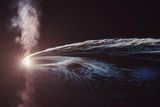
A supermassive black hole that tore apart a star years ago is now radiating energy that rivals a gamma-ray burst, potentially making it one of the most powerful single events ever detected in the universe. Instead of fading after its initial brightness, the system continued to brighten, defying expectations of how these cosmic catastrophes would unfold.
In a new study published in The Astrophysics JournalResearchers report that the object, known as AT2018hyz, has become about 50 times brighter in radio wavelengths since it was first detected. Emissions continue to increase and could peak around 2027.
“This is really unusual,” Yvette Cendes, head of research, said in a press release. “I would have a hard time imagining anything developing like this over such a long period of time.”
Learn more: Supermassive black hole flare launched wind and debris into space at 37,000 miles per second
Tidal disruption events near supermassive black holes
Events like this begin with what astronomers call a tidal disruption event. If a star passes within range of a supermassive black hole, gravitational forces stretch it unevenly, pulling harder on the near side than on the far side until the star is torn apart. The nickname “spaghettification” captures the visual: the star is drawn into elongated streams of gas.
Some of this stellar debris forms a swirling disk around the black hole, heating up as it falls inward and emitting light at multiple wavelengths. In most known cases, the emission peaks relatively quickly and declines within a few months.
This is why AT2018hyz didn’t stand out initially. When optical surveys identified it in 2018, it behaved like a typical disturbance. There was no indication that it would later produce an unusually strong and persistent radio signal. It was only years later that radio observations revealed that something much less ordinary was happening.
A black hole jet growing brighter in radio waves
The steady increase in radio brightness suggests that the black hole launched a jet, a narrow stream of high-energy particles shooting out from its vicinity. The jets form when powerful magnetic forces redirect some of the falling gas away from the black hole instead of letting it all disappear inside.
What sets this case apart is not just the presence of a jet, but also its timing. Instead of appearing immediately after the star’s destruction, the radio emission grew gradually stronger and continued to intensify for several years. Current models indicate that it could continue to increase before reaching a maximum around 2027.
One explanation is geometric. If the jet was not initially aimed at Earth, its signal might have been weak or undetectable at first. As it expands or changes orientation, more of its radiation could now enter our field of vision.
Data collected from radio facilities in New Mexico and South Africa show that the energy of the stream rivals that of gamma-ray bursts, among the brightest explosions known. In comparison, even the fictional Death Star from Star Wars would be considered insignificant next to this real-life cosmic event.
Rethinking long-term emissions from black holes
Prolonged brightening forces a reconsideration of how tidal disruption events evolve. They have often been classified as brief transients that fade quickly after their initial surge. AT2018hyz suggests that the most energetic phase could take place on a much longer time scale.
This possibility has practical implications. The duration of the telescope is limited and once a disturbance appears to fade, long-term monitoring is rare. If similar jets exist elsewhere, they may have gone unnoticed simply because sightings stopped too soon.
For now, AT2018hyz is still being monitored as its radio power increases. Whether this is an exception or part of a larger pattern, it suggests that the consequences of stellar destruction may play out over years and only become clear with sustained observation.
Learn more: The black hole wakes up like a cosmic volcano after 100 million years of sleep
Article sources
Our Discovermagazine.com editors use peer-reviewed research and high-quality sources for our articles, and our editors review the articles for scientific accuracy and editorial standards. See the sources used below for this article: