Age didn’t kill India’s beloved centenarian marathon runner. A speeding car did. : NPR

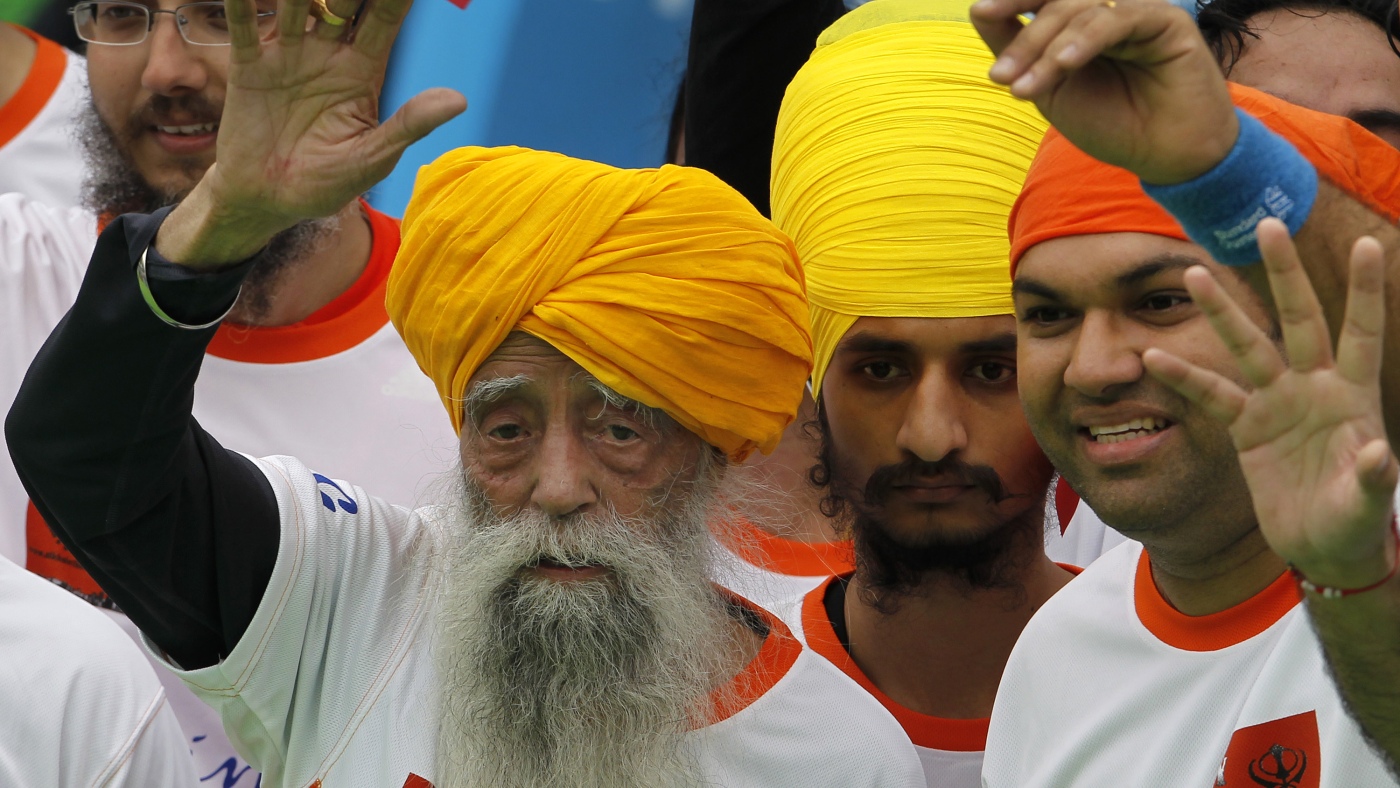

Runner of the Centennial Marathon Fauja Singh.
Vincent Yu / AP
hide
tilting legend
Vincent Yu / AP
In London in the winter of 1999, racing coach Harmandar Singh took a new student older than his father.
Fauja Singh was 89 years old, thin like a reed, and had an undressing beard that almost reached her chest. For their first training session on the marathon this morning in November, he appeared in a three -room costume.
“I had to somehow tell him that if he was running on the road with a costume in three pieces, it is possible that the police will say, what are you going to be?” said Harandar.
It turned out that the Sikh farmer from the Indian state of Punjab who had recently moved with one of his sons in the London district of Ilford,, flowed from his past.
“He had lost his daughter, his wife and his younger son in rapid succession in previous years,” said Harandar. “His family feared that he would fall into depression.”
The coach knew what it was. He too had lost someone a few months ago: his father.
For the next 14 years, said Harandar, Fauja Singh was the best student he had. The years of Fauja to his sprawling with rice and sugar cane from Jalandhar rural had made him difficult. Folklore had worked, even when his bulls were tired.
Fauja trained regularly, completely trusted her coach and could not speak of a mile from a kilometer. “I used this to my advantage,” said Harmandar. “When it remained several kilometers left, I told him that they were miles.”
From the year 2000, Singh completed nine complete marathons and several shorter. He traveled the world, from Hong Kong to New York, often walking on the track in his bright yellow turban. At the 2003 Toronto seafront marathon, it turned His personal record for five hours and forty minutes. Eight years later at the same event, he became The oldest person to finish a marathon. In doing so, he beat more than hundred Much younger runners in the 26.2 mile event.
Fauja was then 100 years old, according to her passport. However, he never made the records – because he had no birth certificate to prove his age. Little of colonial India British on the 20th century had one.

The Centennial Marathon runner Fauja Singh, then 101 years old, at the center, takes place in a 10 -kilometer race, held as part of the annual marathon of Hong Kong, in Hong Kong in 2013.
Kin Cheung / AP
hide
tilting legend
Kin Cheung / AP
The media liked Fauja anyway. He rarely refused interviews, often with his coach or a family member translating Punjabi. The sports brand Adidas presented it in their advertising campaign “Impossible is Nothing”. A children’s writer published A book on him. A bureaucrate that has become an author wrote a biography of the “Turban Tornado”.
Back in his family home in India – a three -story farm in Beas Pind Village, Punjab – Medals, Trophies and Certificates have stacked. Fauja’s family has proudly shown them on wooden shelves and cabinets, transforming their lounge into a sports renowned hall.
Fauja retired marathons in 2013 and returned to India around 2022. Residents often invited him to sporting events. “He would go as a guest but said to the organizers, I also want a medal,” recalls his granddaughter Japoneet Kaur. “At home, he climbed the sofa and hanging it with a nail.”
In the afternoon of July 14, 2025, Fauja was released to check her rice fields in the neighboring village when he was struck by a SUV. He is lying in a heap on the animated highway for several minutes until Balbir Singh, a friend of his passing son, notices it. “The doctors said he could have been saved if we had reached earlier,” said Balbir. “But he had lost too much blood.”
His death at 114 made the headlines around the world. Indian Prime Minister said The news paint him. His racing club in London said They built a Fauja Singh clubhouse on its training route. A group of Indian sculptors began sculpture A life -size statue of him.
But this has also highlighted the deadly roads of India where more than 150,000 people are killed each year in accidents. Last year, Indian Minister of Road Nitin Gadkari admitted In Parliament, the number of deaths continues to rise each year. “When I’m going to attend international conferences where there is a discussion on road accidents, I try to hide my face,” he said.

Japneet Kaur, Fauja Singh’s granddaughter and a budding marathon runner, is in front of her many prices.
Omkar Khandekar / NPR
hide
tilting legend
Omkar Khandekar / NPR
Police arrested a 26 -year -old man in a neighboring dasupur village for the offense of flight. Amrit Singh Dhillon had done his best to avoid detention after the collision, local media quoted The police say. He took his off -road car to escape the video surveillance cameras, covered him from his garage, went to a bicycle “and went around with casualness”.
The alacrity of the police action surprised the Fauja family. “The crimes occur because the culprits think they can run away,” said Fauja’s nephew, Parmeet Singh. “If the police still act quickly, people would not be as negligent on the roads.”
The aunt of Amrit Singh Dhillon, too, did not seem to expect the arrest. When NPR visited her residence in the village of Dasupur, she was not willing to be interviewed or to share her name. But she said: “The media took the problem because he [Fauja] was a celebrity. Otherwise, accidents occur all the time. “”
Why are the roads of India so dangerous?
The local traffic police chief, Manjit Singh, has a theory: “Young people are watching foreign films today and try to imitate waterfalls.” But pedestrians, he says, are not better.
Fauja Singh was killed on a highly frequented highway. His granddaughter Japan, says that he generally crosses the median of traffic to go to his fields in the village on the other side. Many people in the two villages do the same; The closest pedestrian crossing is more than half a long time. The day NPR visited the place, we saw a father jump the median with two children on his bike.
“The mentality of Indian pedestrians is, let’s take a shortcut,” said the Manjit Singh officer.
But Rohit BalujaDirector of the Indian Institute of Road Traffic Education, says there is a reason why people take such risks.
Road construction has booming Under the decade rule of the Indian Prime Minister Narendra Modi. Many of these roads, says Baluja, have crossed cities and villages, but lack warning panels or pedestrian paves. When there is an accident, he says, the authorities generally blame drivers or pedestrians. “Even a single engineer or a road authority is reserved for failures.”
The Baluja Institute conducts research and training in traffic management. “When we investigate accidents and have made around 8,000 cases of this type, we find that almost 30 to 33% are due to failures of road engineering and traffic.”
He shows the place where Fauja Singh has died: “There are approach roads to two villages in front of the other. But there is no rumble on the highway in the middle, no sign saying that there is a junction to come. We build roads for vehicles. We do not consider vulnerable road users.”
Fauja Singh’s body had failed him before his last day. He did not take any medication, ate three times a day and gapped on the mangoes growing in his backyard. The age had leaned his back and had narrowed him to his bones. He always walked everywhere, often without walking stick.
Fauja had no formal education. A few days before his death, his granddaughter taught him the English alphabet. In turn, Fauja taught him – a budding marathoner – towers of his job. “Only the other day, he showed me how to warm up,” recalls Japneet, 16. “I told him that he should be our EP teacher.”
If not for the accident, his biographer Khushwant Singh said Fauja Singh could have lived for many years. “I had asked him once he was afraid of dying,” he recalls.
“Fauja said: ‘I am afraid. Because now I fully live my life. ‘”


