Alzheimer’s finger-prick blood test could transform diagnosis, experts say


Fergus WalshMedical writer

 BBC
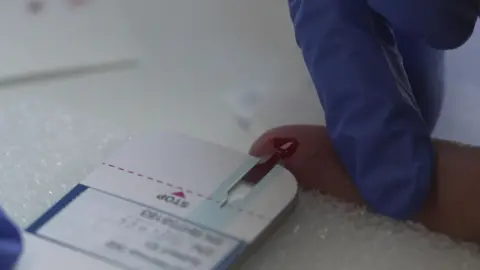
BBCAn international trial is examining whether a finger-prick blood test could be used to help diagnose Alzheimer’s disease.
The study, involving 1,000 volunteers aged over 60 in the UK, US and Canada, will aim to detect biomarkers associated with the disease.
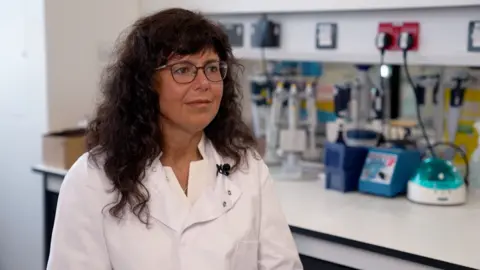
Dr Michael Sandberg, a GP from London, was encouraged to take part in the study after witnessing the slow decline of his mother with Alzheimer’s disease. He tested negative and said it was “a huge relief.”
The Bio-Hermes-002 study is led by medical research charity LifeArc and the Global Alzheimer’s Platform Foundation, with support from the UK Dementia Research Institute.
Dr Giovanna Lalli, Director of Strategy and Operations at LifeArc, said: “We are studying the presence of three proteins that have been linked to Alzheimer’s disease, called blood biomarkers.
“By analyzing the concentration and levels of these proteins, it could tell us whether a person is at risk of developing Alzheimer’s disease.”
Studies have shown that unwanted proteins called amyloid and tau can build up in the brains of individuals over the age of 15 before they begin to show symptoms of Alzheimer’s disease, the most common form of dementia.
All volunteers will undergo the current gold standard tests for Alzheimer’s disease, which involve a specialized brain PET scan using a radioactive tracer, or a lumbar puncture to collect a sample of spinal fluid.
Such tests are expensive, time-consuming and invasive and only two in 100 patients with Alzheimer’s disease are offered them. The hope, then, is that the finger prick test could help revolutionize the way the disease is identified.
Professor Fiona Carragher, head of policy and research at the Alzheimer’s Society, said that with tests not currently widely available in the UK, “getting an accurate diagnosis takes far too long”.
She added: “With new treatments on the horizon, early and accurate diagnosis must be a priority for the NHS. That’s why we’re funding work to bring blood tests for dementia to the NHS, so everyone who would benefit from a diagnosis can get one quickly and accurately.

Sandberg, a trial participant, told the BBC: “My mother did very well in a trial and that encouraged me to take part.
“I believe knowledge is power and I’m really excited that you can screen people at risk for dementia without expensive scanners or needles.”
When Sandberg received his results, the brain scan and finger prick test were negative. He said: “It’s a huge relief to know what my mother went through.”
Of course, this is just one set of results. Scientists will need to analyze the results of the 1,000 volunteers participating in the trial before knowing how useful the finger-prick blood test is in detecting the risk of Alzheimer’s disease.
Dr Emer MacSweeney, neuroradiologist at ReCognition Health, is recruiting some UK volunteers.
She said: “If successful, it will provide an accurate and ubiquitous test that can detect the presence of abnormal amyloid protein in the brain without complicated and expensive investigations.”
The use of blood biomarkers to identify the risk of Alzheimer’s disease is a rapidly developing area of research.
Last year, U.S. regulators approved a blood test to diagnose Alzheimer’s disease. This involves a traditional blood test using a needle and syringe.
Another study is underway in the United Kingdom to determine whether the use of blood tests improves both diagnosis and treatment in real-world settings.
A key advantage of the finger prick test would be that it could be carried out by individuals at home and the sample could be sent to a laboratory for analysis, as it does not require refrigeration.
It is hoped that blood tests could eventually be used as a screening tool for dementia in older people.
To date, the study has recruited 883 of 1,000 participants, and more than 360 of them have completed all tests.
This includes a mix of cognitively normal and mildly impaired people and some with early-stage Alzheimer’s disease.
At least 25% of volunteers will come from underrepresented groups. The trial is expected to end in 2028.

Get our flagship newsletter with all the headlines you need to start your day. Register here.


