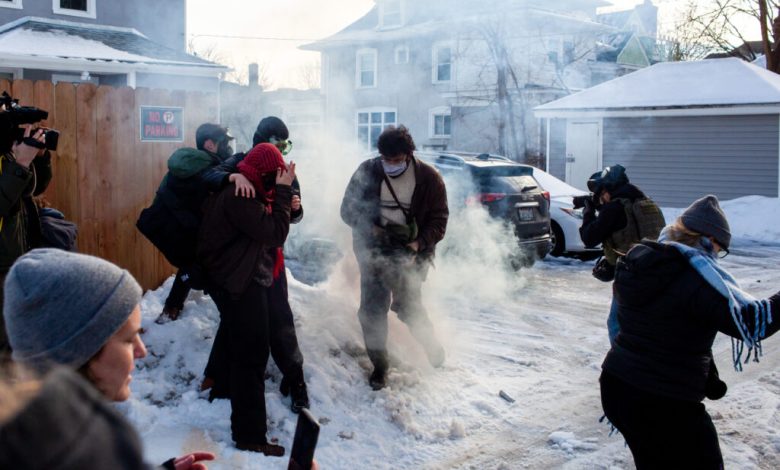
Federal agents fill an alley with tear gas in order to drive out of the alley as demonstrators gather after ICE officers shot and killed Renee Good through her car window Wednesday, Jan. 7, 2026 near Portland Avenue and 34th Street. (Photo by Nicole Neri/Minnesota Reformer)
Katie Henley, a Minneapolis resident and self-described “mom of two, wife, neighbor and dedicated employee in local government,” said federal immigration agents led her and a fellow observer last month to her house, which was then under construction. The feds photographed the home and the workers there, then surrounded her vehicle and took her photo.
One of the agents was holding a gun so big he needed two hands to carry it, she said.
The experience left Henley “truly worried about the unknowns of how what happened will affect me in the future…I fear retaliation by my own government for engaging in lawful observation,” she said, including — she feared — by TSA employees ahead of an upcoming family vacation.
Henley spoke at a news conference organized by the ACLU of Minnesota to discuss the aggressive tactics that lie at the heart of Tincher v. Noem, a case brought by the ACLU as Operation Metro Surge ramped up in December. The group filed an amended complaint on Feb. 13 adding five new plaintiffs, including the country’s largest labor union representing journalists and media professionals and an independent news outlet that has documented Operation Metro Surge for weeks.
That amended complaint features sworn declarations from more than 80 people, including a man who says he was hog-tied and pepper-sprayed at close range by federal agents, and a woman who says agents called her by name, told her they would “take you home,” and then followed her in their vehicles. Rather than lead them home, she waited for “several hours” in a restaurant.
“These declarations come from baristas, veterans, former police officers, nurses, writers, retirees, parents…in other words, people. People who have been followed home by federal agents, shot with rubber bullets, sprayed with chemical irritants and arrested simply for exercising their constitutional rights,” said Alicia Granse, an attorney for the ACLU of Minnesota.
Another observer, Maggie Wood, said an agent sprayed her “directly in the face” as she tried to get the name of a community member being detained nearby. She said the seemingly random detentions of ordinary people based on appearance or accent, and senior Trump administration officials’ demonization of the two Minneapolis residents killed by federal agents in January, had left her “heartbroken and angry.”
“These are Minnesotans…these aren’t the worst of the worst. They are just people entitled to their rights and to look out for their neighbors,” Wood said.
Last month, a federal appeals court stayed a lower court ruling curbing federal agents’ tactics — including using tear gas on peaceful protesters — while Tincher v. Noem played out. The appeals court said the government was likely to prevail on the merits.
Teresa Nelson, legal director for the ACLU of Minnesota, said Thursday her team continues to seek permanent guardrails on federal law enforcement activity in the Twin Cities.
Meanwhile, a Minnesota judge could decide in the coming weeks whether to bar federal agents from stopping or detaining people without judicial warrants or reasonable suspicion of wrongdoing, an ACLU attorney said Thursday.
At a hearing Wednesday, Judge Eric C. Tostrud — a first-term appointee of President Trump — gave attorneys for the U.S. Department of Homeland Security and other federal agencies until Monday to provide more information about the status of Operation Metro Surge, the 10-week law enforcement operation that senior administration officials have said is now winding down.
Kate Huddleston, an attorney with the ACLU, told reporters that Tostrud did not say when he would rule but indicated he would do so “on an expedited basis.”
The ACLU and attorneys with three private law firms sued DHS in January on behalf of three Minnesota residents who say they were racially profiled and unlawfully detained by federal agents even after showing proof of legal status. The case is named for Mubashir Khalif Hussen, a 20-year-old U.S. citizen and resident of Minneapolis’ Cedar-Riverside neighborhood and whose arrest and hours-long detention drew national attention in the opening weeks of Operation Metro Surge.
The plaintiff roster in Hussen v. Noem has since expanded to include more than two dozen people, most of whom are U.S. citizens or permanent legal residents. Reports of arbitrary detentions of U.S. citizens and permanent residents, often on the apparent basis of race, ethnicity or linguistic background, increased across the country following a favorable U.S. Supreme Court ruling in September. Some legal experts mockingly refer to the detentions as “Kavanaugh stops,” after the Supreme Court justice who penned the decision and said — erroneously, it turned out — that they are “typically brief.”
Huddleston cited stories of witnesses who said they were initially reluctant to testify due to pending citizenship applications or concerns about their family members’ well-being, adding that there are likely many more who haven’t yet come forward.
“People with other immigration statuses and pending asylum applications are also being arrested without probable cause, unlawfully,” she said.


