An Underwater Volcanic Eruption Brewing in the Bismarck Sea May Cause a New Island to Rise


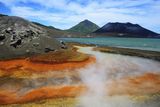
A new island could soon pop up in Oceania thanks to an ongoing underwater volcanic eruption near Papua New Guinea. In early May 2026, unusual activity in the Bismarck Sea, located north of Papua New Guinea, hinted at volcanic activity brewing beneath the surface; NASA satellites spotted steamy plumes rising from the sea, and the surrounding water had grown oddly discolored.
An image released by the NASA Earth Observatory on May 21, 2026, has revealed the unrest behind the eruption in the Bismarck Sea. Volcanologists don’t yet know which volcanic feature is erupting or how long the current eruption will last, but they will be closely monitoring the area to see if an island forms at the eruption site.
“We’re now eagerly waiting to see if a new island is about to be born — something that we’ve only rarely been able to observe with satellites as it happens,” said Jim Garvin, the chief scientist at NASA’s Goddard Space Flight Center, in a statement.
Read More: Some Volcanoes Don’t Explode When Erupting — A Hidden Force Helps Pressure to Escape
An Underwater Eruption in the Bismarck Sea
The first sign of a submarine volcanic eruption in the Bismarck Sea came on May 8, 2026, when seismometers detected a small swarm of earthquakes. A day later, NASA’s Aqua and Terra satellites captured images of white, steam-rich volcanic plumes rising into the atmosphere. A separate NASA satellite, called PACE (Plankton, Aerosol, Cloud, ocean Ecosystem), found that water at the site had turned green and had become increasingly disturbed.
Data from other satellites continued to reveal increased activity at the site; the Suomi NPP, a weather satellite jointly operated by NASA and NOAA, detected thermal anomalies covering around 2.7 square miles, shedding light on the depth of the eruption.
“There must be a lot of hot material near the surface to generate so many thermal anomalies,” said Simon Carn, a volcanologist at Michigan Tech, in the statement. “This suggests a fairly shallow eruption vent — much shallower than what’s implied by the existing bathymetry, which shows water depths of several hundred meters or more.”
More recently, rafts of pumice (a porous volcanic rock) have appeared at the eruption site, forming long bands in the surface currents. When a submarine volcano erupts, it often ejects pumice, which is light enough to float to the surface.
An Unknown Explosive Future
Scientists aren’t exactly sure if the current eruption will last for days or years. And because the area lacks high-resolution maps, they haven’t been able to confirm key details pertaining to the eruption, such as the original depth of the currently active vent or when it last erupted.
So far, the eruption has been less explosive than other recent submarine eruptions; it will likely continue this course, as it’s believed to be associated with a volcanic ridge near a spreading center. According to the Woods Hole Oceanographic Institution, spreading centers are where tectonic plates move away from one another, allowing magma to rise and fill the gaps. Volcanoes that stem from these areas aren’t as explosive as those that occur along subduction zones where tectonic plates collide.
There’s still a chance, however, that the current eruption could escalate if seawater were to enter the shallow magma chamber that has risen within the growing underwater structure, according to NASA.
Awaiting a New Island
Eruptions at submarine volcanoes sometimes form new islands, although they don’t always stick around for long. Those that are formed from easily erodible material may only last for months or a few years, according to a 2020 Scientific Reports study. Others, like the famous volcanic island Surtsey, which appeared off the coast of Iceland in 1963, last much longer.
If a permanent island does emerge at the current eruption site in the Bismarck Sea, researchers would have a chance to follow the island’s evolution as “island-nauts” by studying how the landform responds to animal colonization and various environmental conditions.
“This new eruption could present an even better opportunity for ‘island-naut’ exploration as we prepare to return to the moon with women and men via Artemis IV,” said Garvin.
Read More: Around 12,900 Years Ago, a Cluster of Volcanic Eruptions May Have Triggered a Sudden Ice Age
Article Sources
Our writers at Discovermagazine.com use peer-reviewed studies and high-quality sources for our articles, and our editors review for scientific accuracy and editorial standards. Review the sources used below for this article: