Ancestors of Asian Forest Tortoises Evolved in Europe, New Fossil Discovery Suggests


Paleontologists from the Institute of Paleobiology of the Polish Academy of Sciences and the Autonomous University of Barcelona have described a new species of the turtle genus. Manouria based on fossilized remains found in the Czech Republic.
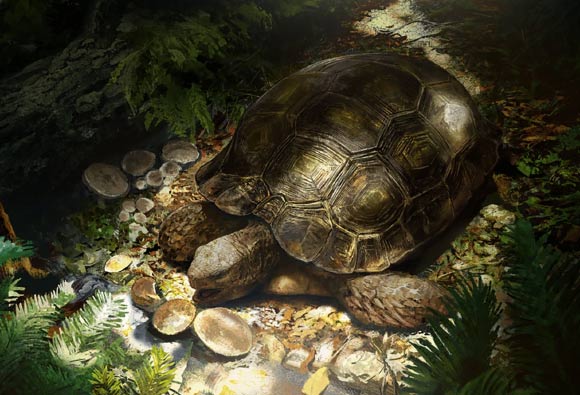
Restoration of life Manouria morla. Image credit: Rudolf Hima.
Manouria morla lived in the swamps of what is now the Czech Republic in the early Miocene, between 20 and 17 million years ago.
The species is the oldest member of the Manouria lineage, which today inhabits only Southeast Asia and includes four extinct and two living species: the Asian forest tortoise (Manouria emys) and the impressed turtle (Manouria impresses).
“Land turtles (Testudinidae) are a clade of turtles that are highly specialized in terrestrial environments, living mainly in semi-arid conditions,” said Dr. Milan Chroust, a paleontologist at the Institute of Paleobiology of the Polish Academy of Sciences, and colleagues.
“Members of the Testudinidae clade measuring more than 35 to 75 cm (14 to 30 inches) in total carapace length are classified as medium to large turtles, while species larger than 75 cm are considered giant-sized.”
“The living species of the Testudinidae are simply divided into three different main groups: the basal species Gopherus And Manouria (recovered either in the form of basal genera or in the form of consecutive branches), as well as the Geochelona clade and the testudona clade, the latter two constituting the subfamily Testudininae.
The fossilized remains of Manouria morla Parts of the carapace and plastron as well as numerous indeterminate shell fragments were discovered at the fossil site Ahníkov I in the Most Basin in Bohemia.
The estimated length of the turtle’s shell is approximately 50 cm (20 inches).
“The locality of Ahníkov I had been known for decades as a marshy area with swollen rivers and shallow lakes,” the paleontologists said.
“Thanks to the high number of juvenile crocodylians, and perhaps the presence of choristoderes, wetland habitat near the coastline has also been identified.”
“However, based on findings of the kind Manouriaa moist broadleaf evergreen forest near water, with a wet season and a drier cool season, similar to that of the existing Kaeng Krachan National Park in Thailand, may be involved.
The discovery of Manouria morla extends the paleobiogeographic distribution of the genus Manouria much further west, from Asia to the heart of Europe.
“According to our results, it seems that the gender Manouria originated in Europe just before the Middle Miocene climatic optimum and subsequently spread to Asia, where it persists to the present,” the researchers said.
The results were published on October 3, 2025 in the Swiss Journal of Paleontology.
_____
Mr. Chroust and others. 2025. Manouria morla sp. nov., the Elder: a large turtle from the Lower Miocene of the Ahníkov Marshes, Czechia. Switzerland J Paleontole 144, 63; doi: 10.1186/s13358-025-00400-6


