Ancient Bite Marks Suggest Tyrannosaurs Were Not Just Hunters


New research by paleontologists at Aarhus University overturns the image of tyrannosaurs as pure apex predators. An analysis of 16 precisely mapped bite marks on a 75-million-year-old tyrannosaur bone reveals that smaller tyrannosaurs reclaimed their own species.
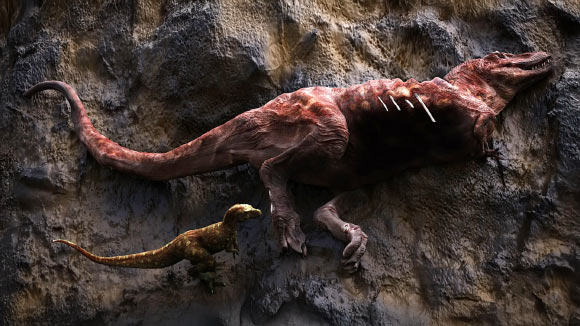
Visualization of a small tyrannosaurus feeding on the carcass of a larger tyrannosaurus. Image credit: Yu Xin, Shen Li and Liang Junwei, Aarhus Universitet.
“Tyrannosaurs were the dominant land predators of the Northern Hemisphere during the Late Cretaceous,” said first author Josephine Nielsen, a master’s student at Aarhus University, and colleagues.
“Known species from the Campanian of the northwest interior of North America include DaspletosaurusAnd Gorgosaurus.”
“Tyrannosaurids were megapredatory carnivores, with strongly built skulls, well adapted to withstand extreme biting forces and high stress.”
“A bite capable of processing bones, even from prey much larger than themselves, as evidenced by coprolites containing bone fragments.”
“Although such remains do not in themselves constitute direct evidence of bite force, debate remains over the feeding strategies of tyrannosaurs and how they might have interacted.”
Using 3D scanning, Nielsen and his co-authors identified 16 bite marks on a fossilized metatarsal (foot bone) belonging to a giant tyrannosaurus.
“I analyzed the depth, angle and location of the marks in a 3D virtual environment and I can prove that these bite marks did not occur by chance,” Nielsen said.
“These are precise impressions from the teeth of a smaller tyrannosaur that fed on a much larger relative.”
The study provides insight into the fact that nothing was wasted during the age of dinosaurs and these animals were also scavengers.
The hard bones from the feet were likely eaten late in the decomposition process, after most of the meat had already disappeared.
“The bone shows no signs of healing after the smaller dinosaur bit it,” Nielsen said.
“As the marks are located on the foot, where there is very little meat, this suggests that the dinosaur was ‘cleaning’ and eating the last remains of an old carcass.”
The authors did not have the original bone in their hands; instead, they worked with a digital representation and a 3D printed version.
The metatarsal is 10 cm long and comes from a tyrannosaurus which, when alive, measured 10 to 12 m and weighed several tons.
The bone was discovered by an amateur fossil hunter in Montana’s Judith River Formation, an eroded landscape that serves as a geologic record of a 75-million-year-old ecosystem teeming with dinosaur fossils.
“What makes this study special is not only the knowledge of how the food chain worked in dinosaurs millions of years ago, but also the technique used to read the details.”
“By creating a digital version, I was able to zoom in on very small details.”
The results appear in the newspaper Changing Earth.
_____
Josephine Nielsen and others. 2026. Investigation of size-asymmetric feeding in tyrannosaurids using tooth marks on a metatarsal from the Judith River Formation, Montana, USA. Changing Earth 4:100107; doi:10.1016/j.eve.2026.100107


