Ancient Roman ‘machine-gun’ damage discovered on Pompeii walls


April 20, 2026
2 min reading
 Add us on GoogleAdd SciAm
Ancient machine gun damage discovered on Pompeii walls
Recently discovered damage to the walls of Pompeii shows patterns that may have been created by an ancient “machine gun” called a “machine gun.” polyboles

A view of the northern fortification wall towards the so-called X Tower.
In 89 BCE, Pompeii was under siege. An invading army of tens of thousands of soldiers led by Lucius Cornelius Sulla, an influential commander and later dictator of Rome, stormed the city walls with slings and catapults. The siege, a success for Sulla, subjugated the rebellious city under the rule of the Roman Republic.
The recently discovered damage to Pompeii’s fortification walls likely resulted from that fateful siege – and some of it could come from a deeply mysterious ancient “machine gun,” researchers reported recently in Heritage.
Excavations and surveys carried out since 2024 have revealed several groups of grooves in the northern fortification walls of Pompeii which were perfectly preserved by the eruption of Mount Vesuvius in 79 CE. The marks, which are sandwiched between towers once used to spot armies and to allow archers and other artillery throwers to repel enemy incursions, are arranged in a way that suggests they may have been left by a repeating dart thrower called a polyboles.
On supporting science journalism
If you enjoy this article, please consider supporting our award-winning journalism by subscription. By purchasing a subscription, you are helping to ensure the future of impactful stories about the discoveries and ideas shaping our world today.
“It was an anti-personnel weapon used to hit archers emerging from the ramparts above and the postern below,” says the study’s lead author, Adriana Rossi, an engineer at the Luigi Vanvitelli University of Campania in Italy. The machine “had been described in detail but had never before been discovered in any archaeological find or physical evidence.”

Renderings of what the polybolos might have looked like.
Philo of Byzantium, an ancient Greek engineer, was the first to describe the machine in the third century BCE in his work. Belopéeiquein which he criticized it as impractical. “This would be the kind of machine that was probably considered a novelty or a proof of concept,” says historian Michael Taylor, a military expert on the Roman Republic at the University at Albany, who was not involved in the research.
Like other Roman catapults, the polyboles was equipped with a “twisting mechanism” likely made of fibers, hair, or thin rope that allowed it to throw iron-tipped darts at high speeds, Taylor says. “Basically, it looks like a giant crossbow.” But unlike your standard Roman catapult, it was equipped with “something like a bicycle chain” that allowed it to recharge automatically. And according to Philo Belopéeiqueit would leave a distinct fan-shaped pattern if pulled across the walls.
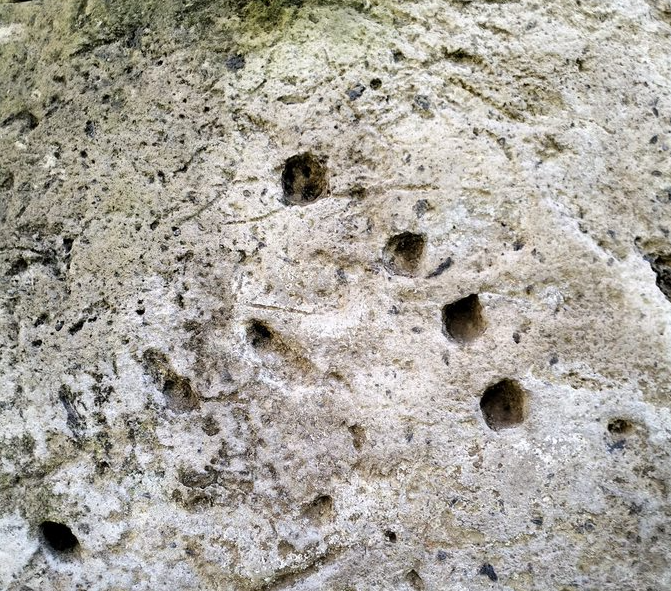
Close-up of damage to one of Pompeii’s fortification walls showing a pattern that could indicate it was created by a repeating weapon.
Using mathematical and three-dimensional modeling, researchers examined the damage on the walls of Pompeii and ultimately discovered that the angles and grooves did not correspond to typical slingshots or catapult shots. The arrangement of the marks seemed to match the fan-shaped throw of a repeating weapon.
Taylor finds one group particularly compelling: it looks like “what you’d sometimes see with a burst of machine gun fire.” He suspects, however, that the damage could have been caused by firing a regular catapult and adjusting its aim rather than by an automatic weapon. But, he says, the study’s hypothesis is “intriguing” and “if anyone were to come up with a custom repeating catapult, it would be Sulla. He seems to have a personal interest in very specialized catapults beyond the kind of standard hardware that would have been used by the Romans.”
It’s time to defend science
If you enjoyed this article, I would like to ask for your support. Scientific American has been defending science and industry for 180 years, and we are currently experiencing perhaps the most critical moment in these two centuries of history.
I was a Scientific American subscriber since the age of 12, and it helped shape the way I see the world. SciAm always educates and delights me, and inspires a sense of respect for our vast and magnificent universe. I hope this is the case for you too.
If you subscribe to Scientific Americanyou help ensure our coverage centers on meaningful research and discoveries; that we have the resources to account for decisions that threaten laboratories across the United States; and that we support budding and working scientists at a time when the value of science itself too often goes unrecognized.
In exchange, you receive essential information, captivating podcasts, brilliant infographics, newsletters not to be missed, unmissable videos, stimulating games and the best writings and reports from the scientific world. You can even offer a subscription to someone.
There has never been a more important time for us to stand up and show why science matters. I hope you will support us in this mission.


