Ancient Tooth Proteins Reveal Possible Link Between Homo erectus, Denisovans, and Modern Humans


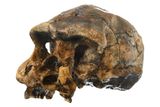
Studying the proteins from the ancient tooth enamel and bones of Homo erectus can give researchers a glimpse into the past and help them better understand the human evolutionary journey. Unfortunately, the analytic technique required for this — paleoproteomics — can be harsh and invasive on these ancient remains.
Worse yet, H. erectus remains are few and far between, and this lack of molecular evidence has left science without valuable information, such as their population diversity, genetic characteristics, and possible connection to modern humans.
However, a new study published in Nature may have found a way to reduce the invasive impacts of paleoproteomics and may have uncovered genetic links between H. erectus and Denisovans, with a potential connection to modern humans.
Most Complete H. Erectus Fossil Remains
According to the Smithsonian National Museum of Natural History, H. erectus is likely the oldest-known early human with modern human-like body proportions. It’s estimated that they lived between 1.89 million and 110,000 years ago. They were also the first species assigned to the genus Homo to likely leave Africa, according to the study, a key factor in early human evolution.
The most complete H. erectus fossil skeleton known to science comes from the ‘Turkana Boy,’ which is missing several bones, including almost all of the hand and foot bones. The remains date back to about 1.6 million years ago, and an analysis of Turkana Boy’s teeth indicates that the individual had a growth rate similar to that of a great ape.
Read More: Homo Erectus Crossed an Ancient Land Bridge to Roam Southeast Asia 140,000 Years Ago
A New Way of Analyzing H. erectus Fossils
The few remains of H. erectus are precious and hold high cultural significance, according to a press release on the study. Because of the irreplaceable nature of these fossils, little molecular research has been performed on them until now.
A multi-institutional research team, led by Qiaomei Fu from the Institute of Vertebrate Paleontology and Paleoanthropology (IVPP) of the Chinese Academy of Sciences, has used a ‘micro-destructive’ approach to collect samples from six H. erectus teeth.
This approach uses acid etching to recover molecular information without altering the tooth’s morphology or the enamel’s appearance. Acid etching has been used in the past on fossilized teeth, including in a 2017 PNAS study, where the method helped determine the sex of human remains.
Revealing Two Mutations
According to the study, the six H. erectus teeth were uncovered at the Zhoukoudian, Hexian, and Sunjiadong sites in China. Five of the teeth belonged to males, while the other belonged to a female. They all date to the Middle Pleistocene, about 400,000 years ago.
From the acid etching, the team identified two mutations that suggest a genetic link between H. erectus from East Asia and the Denisovans — another species linked to modern humans.
The first mutation, AMBN-A253G, was previously unknown to science. The team identified this mutation as a potential marker associated with this population of H. erectus and suggests that the species found at the three archaeological sites may have belonged to the same evolutionary population.
The second mutation identified, the AMBN-M273V variant, has historically been associated with the Denisovans; however, these findings indicate that it was also shared with this H. erectus population. The researchers suggest that this variant may have been introduced to the Denisovans through interbreeding and was then later passed on to modern human populations in Oceania and Southeast Asia.
These findings could pinpoint a connection between H. erectus from East Asia and the Denisovans, and also offer a possible genetic link to some modern-day humans.
Read More: Mosquitoes May Have Been Feeding on Homo erectus 1.8 Million Years Ago
Article Sources
Our writers at Discovermagazine.com use peer-reviewed studies and high-quality sources for our articles, and our editors review for scientific accuracy and editorial standards. Review the sources used below for this article:


