Archeologists Just Found a 2,000-Year-Old Battle Trumpet That May Be Linked to Queen Boudica


January 8, 2026
1 min reading
 Add us on GoogleAdd SciAm
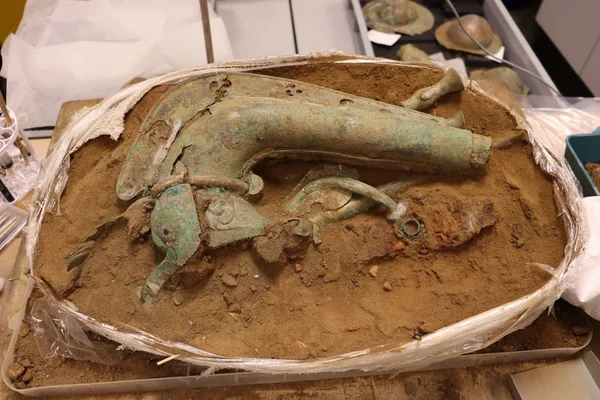
Archaeologists have discovered a 2,000-year-old battle trumpet that could be linked to Queen Boudica
This recently discovered Iron Age instrument may have been played during the Celtic resistance against the Roman Empire.
© Norfolk Museum Service
It was supposed to be a routine search. But archaeologists who were called in last year to inspect a site before construction began on a residential property in West Norfolk, England, made a truly remarkable discovery: a battle trumpet approximately 2,000 years old.
The Iron Age instrument, known as a carnyx, may have once been used by Celtic tribes in their war against the invading Roman Empire, and perhaps even by the forces of the warrior queen Boudica.
Boudica led the Iceni tribe which once occupied parts of present-day Norfolk and is most famous for fighting an ultimately unsuccessful battle against the Romans around 60 or 61 CE. Archaeologists place the age of the trumpet around the same time as that of the queen.
On supporting science journalism
If you enjoy this article, please consider supporting our award-winning journalism by subscription. By purchasing a subscription, you are helping to ensure the future of impactful stories about the discoveries and ideas shaping our world today.
The carnyx is one of only three of its species native to Britain and “one of the most complete found in Europe”, according to a release from Historic England. It was found alongside a collection of other metal objects, including five shield bosses and a bronze boar’s head which was probably used as a military standard.

© Norfolk Museum Service
“I’ve been doing archeology for over 40 years and I’ve never seen anything like this,” said Mark Hinman, CEO of Pre-Construct Archaeology, which originally found the objects, at Tutor. He described the discovery as “a once-in-a-lifetime discovery.”
“We are absolutely in the heart of the Iceni. Whether they were the ones who buried the treasure or not, we just don’t know,” Hinman said. Yet the artifacts are “of such quality” that “any important person from the Iceni and other groups would have known of these objects.”
It’s time to defend science
If you enjoyed this article, I would like to ask for your support. Scientific American has been defending science and industry for 180 years, and we are currently experiencing perhaps the most critical moment in these two centuries of history.
I was a Scientific American subscriber since the age of 12, and it helped shape the way I see the world. SciAm always educates and delights me, and inspires a sense of respect for our vast and magnificent universe. I hope this is the case for you too.
If you subscribe to Scientific Americanyou help ensure our coverage centers on meaningful research and discoveries; that we have the resources to account for decisions that threaten laboratories across the United States; and that we support budding and working scientists at a time when the value of science itself too often goes unrecognized.
In exchange, you receive essential information, captivating podcasts, brilliant infographics, newsletters not to be missed, unmissable videos, stimulating games and the best writings and reports from the scientific world. You can even offer a subscription to someone.
There has never been a more important time for us to stand up and show why science matters. I hope you will support us in this mission.