Artemis II astronauts welcomed home to Houston after historic moonshot

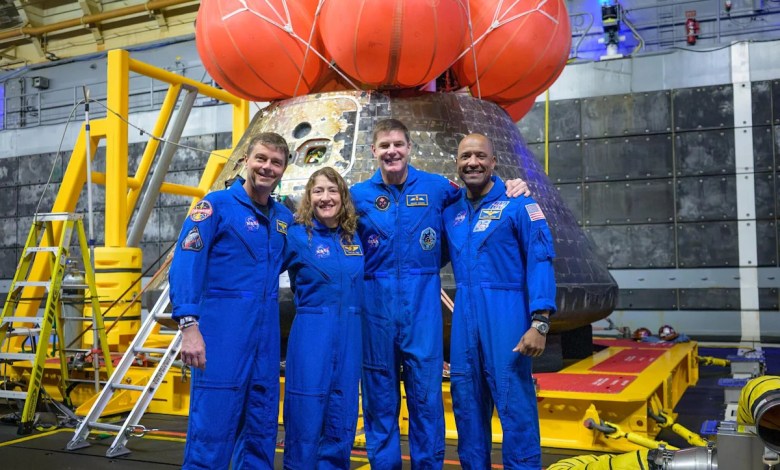
The four astronauts of Artemis II, freshly back from a historic trip around the Moon, returned Saturday to NASA’s Johnson Space Center in Houston to the cheers and applause of their family members and hundreds of space center employees who gathered to welcome them home.
Artemis II Commander Reid Wiseman, Victor Glover, Christina Koch and Canadian astronaut Jeremy Hansen ditched in the Pacific Ocean southwest of San Diego Friday evening to enclose a nine-day mission, the first piloted flight to the Moon and back since the end of the Apollo program half a century ago.

Artemis II astronauts greeting well-wishers gathered in a hangar near the Johnson Space Center in Houston to welcome the crew home. From left to right: Canadian astronaut Jeremy Hansen, Christina Koch, Victor Glover and Commander Reid Wiseman. /Credit: Miles Doran/CBS News
After medical exams and phone calls to family and friends, all four boarded a NASA plane and returned to Ellington Field, a few miles from the space center. A noisy crowd awaited them in a nearby hangar, among which were the crew’s families.
“After a brief 53-year intermission, the show continues and NASA gets back to sending astronauts to the Moon and returning them safely home,” NASA Administrator Jared Isaacman told the cheering crowd.
Turning to the astronauts, he said, “Thank you for showing us the Moon again. Thank you for showing us planet Earth again, and thank you for contributing to the greatest adventure in human history. Welcome home, Artemis II.”
Wiseman stood up and after joking with his teammates, said, “I have absolutely no idea what to say. Twenty-four hours ago the Earth was… out the window and we were traveling at Mach 39 (times the speed of sound), and here we are back in Ellington, home.
Speaking with clear emotion, he said: “Before you go, it’s like it’s the greatest dream on Earth. And when you’re there, you just want to be with your families and your friends. It’s a special thing to be a human, and it’s a special thing to be on planet Earth.”
Glover, a deeply spiritual man who carried a Bible with him to the moon, said that when the mission began, he wanted to thank God in public.
“And I want to thank God again,” he said Saturday. “For even greater than my challenge of trying to describe what we experienced, the gratitude of seeing what we saw, doing what we did, and being with who I was, is too great to just be in one body.”
Koch was also moved by the experience of seeing the Earth, suspended in the deep black of space, from the vantage point of the Moon, a quarter of a million miles away.
“When we saw little Earth, people asked our crew what impressions we had,” she told the crowd. “And honestly, what struck me wasn’t necessarily just the Earth, it was all the darkness around it. The Earth was just this lifeboat hanging undisturbed in the universe.
“I know I haven’t learned everything this trip has taught me yet. But there is one new thing I know, and that is planet Earth, you are a crew.”

The Artemis II astronauts pose in front of their Orion crew capsule after it was recovered during a water landing in the Pacific Ocean Friday and transported to a Navy amphibious ship for the journey back to shore. From left to right: Commander Reid Wiseman, Christina Koch, Canadian astronaut Jeremy Hansen and pilot Victor Glover. / Credit: NASA/Bill Ingalls
Attached to an Orion crew capsule they named “Integrity”, the astronauts took off from the Kennedy Space Center on April 1 atop a Space Launch System rocket. They were the first to travel into space aboard the world’s most powerful operational rocket and the first to fly in an Orion capsule.
After spending a full day in Earth orbit checking the Orion spacecraft’s life support and other systems, they fired the capsule’s service module engine to blast away from Earth for a four-day flight to the Moon.
It was NASA’s first piloted moonshot since the last Apollo moon landing mission in 1972, and the first of what NASA envisions will be a steady stream of flights while building a base near the lunar south pole.
The Artemis II mission had more modest goals, simply circling the Moon on a free return trajectory to Earth, giving Wiseman and his crewmates an unprecedented opportunity to observe nearly a quarter of the Moon’s far side while it was illuminated by the sun.
They were also able to enjoy a spectacular solar eclipse as the moon moved in front of the sun from the crew’s perspective, creating a ghostly glow around the darkened moon, an ethereal sight that left the crew in awe.
“It continues to be unreal,” Glover said in Houston. “The sun has passed behind the moon, and the corona is still visible, and it’s bright, and it creates a halo almost around the entire moon… The Earth is so bright there and the moon is just hanging in front of us, this black orb in front of us. We can see the stars and the planets behind it.”
The Orion capsule entered the Moon’s gravitational sphere of influence early last Monday and flew around the far side of the Moon about 14 hours later, passing about 4,000 miles from the lunar surface on a close approach.
Moments later, they set a new record for the maximum distance ever traveled from planet Earth – 252,756 miles – about 4,100 miles more than a record set in 1970 by the crew of the ill-fated Apollo 13 mission during its emergency return to Earth.
The astronauts took thousands of photos during their historic passage around the Moon, filmed video and recorded their personal observations to give researchers information based on the color sensitivity of the human eye.
“Your mission paves the way for America’s return to the lunar surface very soon,” President Trump told the astronauts by radio. “We’re going to do everything. We’ll plant our flag again, and this time we won’t just leave footprints. We’ll establish a permanent presence on the Moon and move toward Mars. It will be very exciting.”

The Artemis II Orion capsule carrying Commander Reid Wiseman, Victor Glover, Christina Koch and Canadian astronaut Jeremy Hansen descends toward a target splashdown 13 minutes after entering the atmosphere at more than 24,000 mph. / Credit: NASA/Bill Ingalls
Before launch, the science team helped identify a few relatively new craters that had not yet been named. The crew proposed the name of their spaceship for one of them.
“And the second one, particularly meaningful for this team, happened several years ago, we … lost a loved one,” Hansen said. “And there’s a feature in a really neat place on the Moon. And it’s on the near-side/far-side boundary… And at certain points in the Moon’s transit around the Earth, we’ll be able to see it. So we lost a loved one, her name was Carroll, Reid’s wife, Katey and Ellie’s mother… It’s a bright spot on the Moon. And we’d like to name him Carroll.”
“Integrity and Carroll Crater,” Canadian astronaut Jenni Gibbons responded from mission control. “Loud and clear. Thank you.”
At the welcome ceremony Saturday, Hansen spoke last, saying the mission showed him that a successful crew has three essential ingredients. The first is gratitude for the opportunity and the support of the thousands of people who made the flight possible. The second was to share the joy of the experience.
Then he called Wiseman, Glover and Koch in for a group hug, adding, “The last one is love.”
“What you saw was a group of people who loved to contribute and get joy out of it,” Hansen said. “And what we heard was that this was something special that you could witness. And the reason I gathered them here with me is because I would suggest to you that when you look here, you’re not looking at us. We’re a mirror reflecting you. And if you like what you see, then just look a little deeper. It’s you.”
See the text messages a man sent to his friend after his wife disappeared in the Bahamas
Risk on the road | Sunday in 60 minutes
Inflation soars as Iran war impacts US economy


