Artemis II Crew Returned to Earth Safely — What’s Next for NASA’s Moon Exploration Program?


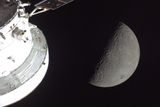
With the Artemis II mission having safely returned to Earth, NASA already has its sights set on the next steps of its Moon exploration program. The many tests conducted by the crew of Artemis II have paved the way forward for the upcoming Artemis missions — Artemis III, IV, and V.
Now that humans have journeyed around the Moon for the first time in over 50 years, the Artemis program will prepare to practice the docking capabilities of Orion, the partially reusable spacecraft that carried the Artemis II crew for 10 days in space.
In 2028, a crewed landing will make history on the Moon’s surface, an endeavor that hasn’t been done since 1972. So while Artemis II has already sparked worldwide fascination, the mission is building up to something even greater. Here’s a look at the timeline of NASA’s Artemis program in the coming years.
Preparing for the Future of Artemis
The four crew members of Artemis II — NASA astronauts Reid Wiseman, Victor Glover, and Christina Koch, and Canadian Space Agency (CSA) astronaut Jeremy Hansen — are now reunited with their families and will continue to undergo medical evaluations.
While in space for their 10-day mission in April 2026, the crew performed a variety of tests to make sure Orion can sustain humans in deep space, according to NASA. They also conducted several experiments to help NASA scientists explore the effects of spaceflight on human health.
The A Virtual Astronaut Tissue Analog Response (AVATAR) investigation, for example, involved organ chips — USB thumb drive-sized devices that carry cells — that joined the crew on their journey; now back on Earth, experts are studying these chips for their responses to microgravity and radiation.
Read More: Artemis II Crew Breaks Record for Farthest Human Spaceflight While Gazing Upon the Moon’s Far Side
A Lunar Practice Run
The next mission of the Artemis program, Artemis III, is slated to launch in 2027. It was originally meant to be a lunar landing, but in February 2026, NASA announced a change of plans; Artemis III instead changed to a crewed launch into low-Earth orbit, allowing Orion to test procedures for meeting and docking with one or both of two commercial lunar landers currently being built (one by SpaceX and the other by Blue Origin).
No announcements about the Artemis III crew have been made yet, but the selected astronauts will have an opportunity to try out new spacesuits developed by the Houston-based space infrastructure developer Axiom Space.
The Axiom Extravehicular Mobility Unit (AxEMU), according to NASA, is designed to give astronauts increased flexibility and improved mobility for moonwalking, helping them collect samples and perform other scientific tasks.
Building a Base on the Moon
With the changes to the Artemis program, Artemis IV will now be its first lunar landing mission, scheduled for an early 2028 launch. Four astronauts will fly to the Moon on Orion, which will dock with either the SpaceEx or Blue Origin lunar lander in the Moon’s orbit. Two crew members will then be transported down to the Moon’s surface, near the lunar south pole. There, they will collect samples and perform experiments for approximately a week before returning to Orion for the journey home.
A second lunar landing will take place with the Artemis V mission, scheduled to launch in late 2028. Similar to Artemis IV, two astronauts on the crew will travel down to the lunar south pole for research. Initial construction on a Moon base is also expected to begin during the mission.
NASA intends to send a mission to the Moon every year following Artemis V, meaning there could likely be an Artemis VI, VII, and onward.
In March 2026, NASA announced a three-phase plan for the Moon base; it will first focus on increased frequency of lunar missions involving rovers, scientific instruments, and technology demonstrations. Missions will then begin to deliver infrastructure to the Moon, aiming to transition from periodic expeditions to a permanent base.
Read More: Artemis II Catches Glimpse of the Moon’s Grand Canyon, a Basin That Looks Like a Giant Bullseye
Article Sources
Our writers at Discovermagazine.com use peer-reviewed studies and high-quality sources for our articles, and our editors review for scientific accuracy and editorial standards. Review the sources used below for this article:


