Artemis moon mission breaks record for distance from Earth

By Joey Roulette
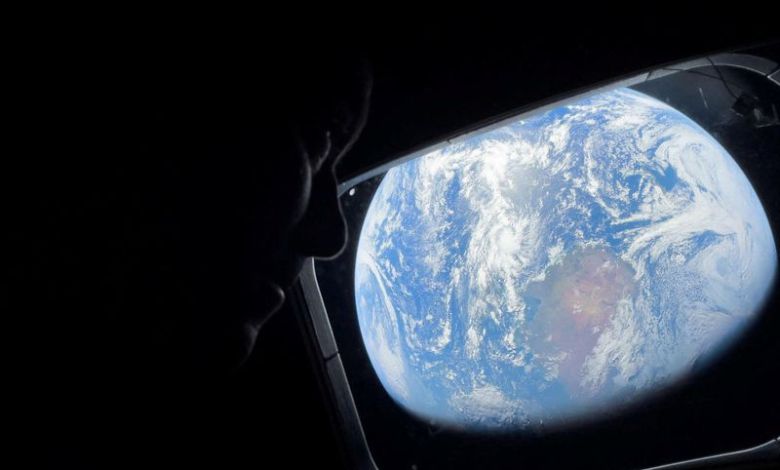
HOUSTON, Texas, April 6 (Reuters) – The four astronauts of NASA’s Artemis II mission reached the furthest point a human being has ever reached from Earth on Monday, navigating a path “in the Moon’s gravitational sphere of influence that will soon take them to the far side of the Moon, in the shadows.”
The Artemis II crew, flying in its Orion capsule since its launch from Florida last week, woke up around 10:50 a.m. ET for their sixth day of flight to a recorded message from the late Apollo 8 and 13 astronaut Jim Lovell.
“Welcome to my old neighborhood,” said Lovell, who died last year at age 97. “It’s a historic day and I know how busy you’ll be, but don’t forget to enjoy the view… good luck and good luck.”
NASA astronauts Reid Wiseman, Victor Glover and Christina Koch and Canadian astronaut Jeremy Hansen were scheduled to reach their maximum distance from Earth of about 252,760 miles later Monday, 4,105 miles (6,606 km) further than the record held by Lovell and his Apollo 13 crew for 56 years.
Next, they will sail around the far side of the Moon, observing it from about 4,000 miles above its dark surface as it eclipses what will appear to be a basketball-sized Earth in the distant background.
The milestone marks a culmination of the nearly 10-day Artemis II mission, the first crewed test flight of NASA’s Artemis program.
The multibillion-dollar series of missions aims to return astronauts to the surface of the Moon by 2028 before China, and establish a long-term U.S. presence there over the next decade, building a lunar base that would serve as a testing ground for possible future missions to Mars.
The lunar flyby will plunge the crew into darkness and brief communications blackouts as the moon blocks them from NASA’s Deep Space Network, a global network of massive radio communications antennas that the agency uses to talk to the crew.
The flyby will last about six hours, during which astronauts will use professional cameras to take detailed photos of the moon through Orion’s window, showing a rare and scientifically valuable view of sunlight filtering around its edges.
The crew will also have the chance to photograph a rare moment in which their home planet, dwarfed by its record distance in space, sets and rises with the lunar horizon as it sways, a celestial remix of a moonrise as seen from Earth.
A team of dozens of lunar scientists positioned in the Science Evaluation Room at NASA’s Johnson Space Center in Houston will take notes while the astronauts, who have studied an array of lunar phenomena as part of their mission training, describe their vision in real time.
(Reporting by Joey Roulette; editing by Don Durfee, Aurora Ellis and Bill Berkrot)



:max_bytes(150000):strip_icc()/Health-GettyImages-2235985527-1cc914bb4e0c4e9b8659859c7a378628.jpg?w=390&resize=390,220&ssl=1 "How Long Does Canned Food Last?")