Astronomers Detect Water Activity in Interstellar Object 3I/ATLAS


Using the Ultraviolet/Optical Telescope aboard NASA’s Neil Gehrels Swift Observatory, astronomers detected hydroxyl (OH) gas – a chemical fingerprint of water – from the interstellar object 3I/ATLAS.
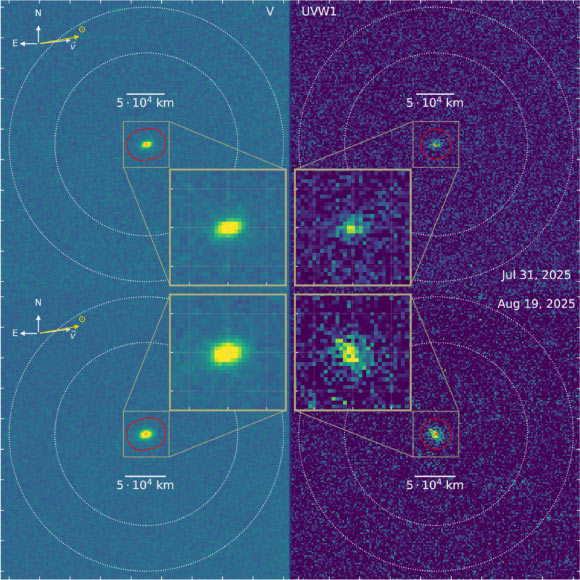
Stacked images of interstellar comet 3I/ATLAS acquired with the Ultraviolet/Optical Telescope aboard NASA’s Neil Gehrels Swift Observatory: the first were obtained on July 31 and August 1, 2025 (visit 1, upper half of the figure) and the second on August 19, 2025 (visit 2, lower half of the figure). Image credit: Xing and others., doi: 10.3847/2041-8213/ae08ab.
The discovery of the third interstellar object, 3I/ATLAS, on July 1, 2025, launched a vast characterization campaign across the world.
Following lessons learned from previous interstellar objects 1I/’Oumuamua and 2I/Borisov, observation campaigns were launched to rapidly capture its initial luminosity, morphology, light curves, color, and optical and near-infrared spectrum.
Given the apparent brightness and early extension of the coma, gas production was assumed and searched for, but was not found.
Characterizing the early activity of interstellar objects is essential to understanding their chemical and physical evolution during solar approach, as this represents perhaps the first time they are significantly heated during their very long dynamic lifetime.
“The detection of water represents a major advance in understanding how interstellar comets evolve,” said Dennis Bodewits, an astronomer at Auburn University, and colleagues.
“In the solar system’s comets, water is the standard by which scientists measure their overall activity and track how sunlight causes the release of other gases.”
“It is the chemical reference on which any comparison of volatile ices in the nucleus of a comet is based.”
“Finding the same signal in an interstellar object means that, for the first time, we can begin to place 3I/ATLAS on the same scale used to study comets native to the Solar System – a step toward comparing the chemistry of planetary systems across our Milky Way. »
“What makes 3I/ATLAS remarkable is where this aquatic activity occurs.”
Swift detected the hydroxyl when the comet was nearly three times farther from the Sun than Earth — well beyond the region where water ice on a comet’s surface can easily sublimate — and measured a rate of water loss of about 40 kg per second. At these distances, most comets in the solar system remain silent.
The strong ultraviolet signal from 3I/ATLAS suggests something else is at work: perhaps sunlight is heating small icy grains released from the core, allowing them to vaporize and fuel the surrounding gas cloud.
Such widespread water sources have only been observed in a handful of distant comets and indicate complex ice layers that preserve clues about how these objects formed.
Each interstellar comet discovered so far has revealed a different facet of planetary chemistry beyond our Sun.
Together, they demonstrate that the building blocks of comets – and the volatile ices that shape them – can vary significantly from one star system to another.
These differences suggest how diverse planet-forming environments can be and how processes such as temperature, radiation and composition shape the materials that ultimately give rise to planets and, potentially, life.
Capturing that whisper of ultraviolet light from 3I/ATLAS was a technical triumph in itself.
Swift carries a modest 30 cm telescope, but in orbit above Earth’s atmosphere it can see ultraviolet wavelengths that are almost completely absorbed before reaching the ground.
Freed from sky glare and air interference, Swift’s ultraviolet/optical telescope achieves the sensitivity of a 4m-class ground-based telescope for these wavelengths.
Its rapid targeting capability allowed astronomers to observe the comet within weeks of its discovery, well before it became too faint or too close to the Sun to study from space.
“When we detect water – or even its faint ultraviolet, OH, echo – from an interstellar comet, we are reading a note from another planetary system,” Professor Bodewits said.
“This tells us that the ingredients of the chemistry of life are not unique to ours.”
“So far, every interstellar comet has been a surprise,” added Dr. Zexi Xing, a postdoctoral researcher at Auburn University.
“‘Oumuamua was dry, Borisov was high in carbon monoxide, and now ATLAS is dropping water at a distance where we didn’t expect it.”
“Each one rewrites what we thought we knew about how planets and comets form around stars.”
An article describing the results was published September 30 in the Astrophysical journal letters.
_____
Zexi Xing and others. 2025. Water production rate of the interstellar object 3I/ATLAS. ApJL 991, L50; doi: 10.3847/2041-8213/ae08ab