Europe’s Vega C rocket launches advanced Korean Earth-observation satellite to orbit (video)

When you purchase through links on our articles, Future and its syndication partners may earn a commission.

Credit: Arianespace
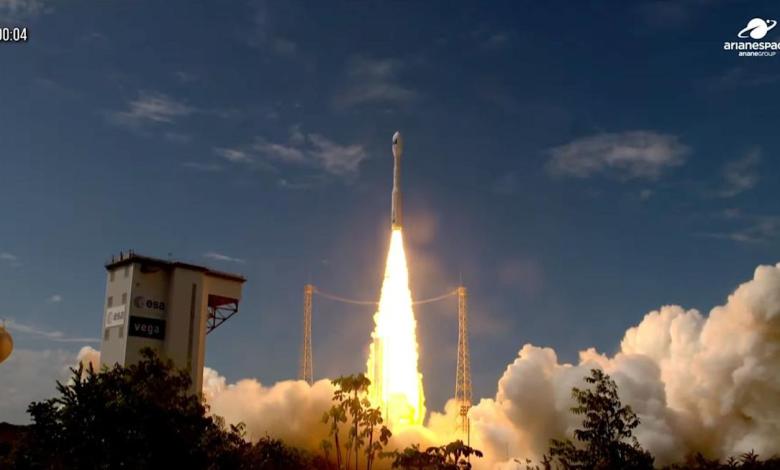
Europe’s Vega C rocket was launched for the sixth time today (December 1), sending a powerful Earth observation satellite into orbit.
South Korea’s KOMPSAT-7 spacecraft took off from The European spaceport in Kourou, French Guiana, at the top of a Vega C rocket today at 12:21 p.m. EST (5:21 p.m. GMT; 2:21 p.m. Kourou time).
THE rocket deployed KOMPSAT-7 as planned approximately 44 minutes after liftoff, into a sun-synchronous orbit (SSO) 358 miles (576 kilometers) above Earth.

An Arianespace Vega C rocket launches South Korea’s KOMPSAT-7 Earth observation satellite from Kourou, French Guiana, on December 1, 2025. | Credit: Arianespace
SSO spacecraft circle the Earth’s poles and fly over the same part of the planet at the same solar time every day. This ensures consistent lighting conditions at each of these points, making SSOs popular destinations for Earth observation missions.
The 3,990-pound (1,810-kilogram) KOMPSAT-7 was built by the Korea Aerospace Research Institute. It is the successor to KOMPSAT-3A, launched for Earth orbit in March 2015.
The new satellite will be “one of the most advanced ultra-high resolution optical satellites in the world”, according to the press kit provided by the French company Arianespace, which operates the Vega C.
“It is designed to support detailed observation of the Korean Peninsula and to meet the growing domestic demand for high-quality products. satellite images”, adds the press kit, which you can find here.
KOMPSAT-7 also offers “optical data transmission technology — a first for a Korean satellite — to enable real-time processing of large-volume Earth observation images via electro-optical modules and onboard storage/processing systems,” Arianespace wrote.
Today’s mission, which Arianespace called VV28, was the sixth of the four-story, 35-meter-tall Vega C, developed by the European Space Agency.
Five of the six launches of the medium-range rocket were successful. The only failure occurred on the Vega C’s second missionwhich took off in December 2022.
Editor’s note: This story was updated at 12:30 p.m. ET on December 1 with news of the successful liftoff, then again at 1:10 p.m. ET with news of the satellite deployment.


