Astronomers Discover Exotic Red Supergiant Star


Designated Stephenson 2 DFK 52, the newly discovered red supergiant lies in the solid stellar cluster RSGC2.
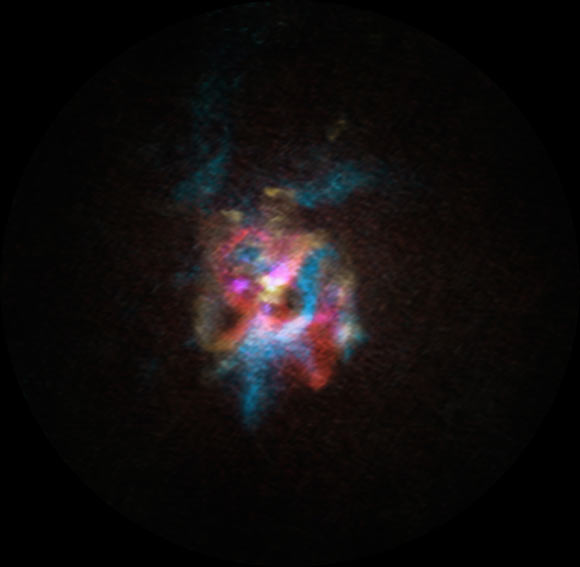
This image shows the red supergiantest star Stephenson 2 DFK 52 and its circumsellary environment. Image credit: Alma / ESO / NAOJ / NRAO / SIEBERT and al.
RSGC2 is a group of at least 26 red Supergiants located at the base of the SCUTUM-CRUX-CRUX spiral arm at a distance of 5,800 parsecs (18,917 light years).
Also known as Stephenson 2, the cluster is a site for a recent stars training activity in the region where the arm cuts galactic bulcting.
Astronomers at the Chalmers University of Technology, Mark Siebert and his colleagues, observed the RSGC2 stars with the large table of the ATACAMA millimeter / Submillimiter (Alma).
“What we see about this photo of Stephenson 2 DFK 52 is actually a red supergiant star expeling a cloud of gas and dust as he approaches the end of his life,” they said.
“These nebulae are common around supergiant stars; However, this particular cloud has an unexpected and considerable mystery for astronomers. ”
“This is the largest cloud of ejected materials to have been found around a supergiant star, a huge 1.4-light-diameter.”
“Stephenson 2 DFK 52 is rather similar to Betelgeuse, another famous red supergiant, so they expected to see a similar cloud around him.”
“However, if Stephenson 2 DFK 52 was as close to us as Betelgeuse, the cocoon around would be as wide in the sky as the third of a full moon.”
The new Alma observations allow astronomers to measure the amount of material surrounds the star and how fast it moves.
“The pieces that are directed towards us are highlighted in blue, and the sections that move away, in red,” they said.
“The data shows that about 4,000 years ago, the star crossed an episode of extreme mass loss, then slowed down at his current rate, more similar to that of Betelgeuse.”
According to the team, Stephenson 2 DFK 52 has a mass between 10 and 15 solar masses, and he has already lost 5 to 10% of his mass.
“It is always a mystery as to the way the star managed to expel so much material in such a short time,” said the researchers.
“Could this be a strange interaction with a complementary star?” Why is the form of the cloud so unusually complex? Are there more supergailters like this? ”
“Decipher why Stephenson 2 DFK 52 has already lost so much equipment will help astronomers understand how it will meet: an explosion of supernova in the coming million years.”
The team’s article will be published in the journal Astronomy and astrophysics.
_____
Mark A. Siebert and al. 2025. Stephenson 2 DFK 52: Discovery of an exotic red supergiant in the Massive Stellar Cluster RSGC2. A&Ain press; Arxiv: 2507.11609


