Astronomers Find Hidden Structures in Early Universe


Using spectral data from McDonald Observatory’s Hobby-Eberly Telescope, astronomers have produced the most detailed 3D map to date of faint cosmic structures from 9 to 11 billion years ago, revealing galaxies and intergalactic gas once invisible to telescopes.
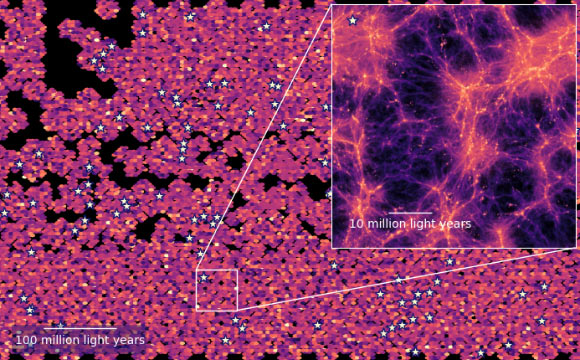
Section of the line intensity map created by plotting the distribution and concentration of excited hydrogen (via the Lyman alpha wavelength) in the Universe around 10 billion years ago. The stars mark where HETDEX found galaxies. The inset simulates the structure present in this map once it is enlarged and the background noise is removed from the data. Image credit: Maja Lujan Niemeyer / Max Planck Institute for Astrophysics / HETDEX / Chris Byrohl / Stanford University.
“Observing the early Universe gives us insight into how galaxies evolved into their current forms and the role that intergalactic gases played in this process,” said Dr. Maja Lujan Niemeyer, astronomer at the Max-Planck-Institut für Astrophysik and Ludwig-Maximilians-Universität München and member of the Hobby-Eberly Telescope Dark Energy Experiment (HETDEX).
“But because they are distant, many objects at this time are faint and difficult to observe.”
“Using a technique called Line Intensity Mapping, the new map highlights these objects, adding shape and nuance to this formative era of our Universe.”
Although line intensity mapping is not a new technique, this is the first time it has been used to map Lyman alpha emissions in such a large dataset and with such precision.
Using the Hobby-Eberly Telescope, the HETDEX project is mapping the position of more than a million bright galaxies in its quest to understand dark energy.
The project is unique in that it collects so much data – more than 600 million spectra – for such a vast swath of sky, measuring more than 2,000 full Moons.
“However, we only use a small fraction of all the data we collect, about 5%,” said HETDEX principal investigator Dr. Karl Gebhardt, an astronomer at the University of Texas at Austin.
“There is enormous potential in using the remaining data for further research.”
“HETDEX observes everything in one part of the sky, but only a tiny amount of this data is linked to galaxies bright enough for the project to use,” said Dr Lujan Niemeyer.
“But these galaxies are just the tip of the iceberg. There is a whole sea of light in the seemingly empty areas between them.”
To create its map, astronomers used supercomputers at the Texas Advanced Computing Center to sift through about half a petabyte of HETDEX data.
It then used the locations of bright galaxies already identified by HETDEX to calculate the locations of nearby fainter galaxies and bright gas.
Thanks to gravity’s propensity to bunch matter together, wherever there is a bright galaxy, other objects are sure to be nearby.
“We can therefore use the location of known galaxies as an indicator to identify the distance of fainter objects,” said Dr. Eiichiro Komatsu, HETDEX scientist and astronomer at the Max-Planck-Institut für Astrophysik.
“The resulting map further highlights the regions around the bright galaxies and adds detail to the extents in between.”
“We have computer simulations of this period. But they are only simulations, not the real Universe.”
“We now have a basis that can allow us to know whether some of the astrophysical data underlying these simulations is correct.”
The results were published on March 3, 2026 in the Astrophysics Journal.
_____
Maja Lujan Niemeyer and others. 2026. Lyα intensity mapping in HETDEX: Galaxy-Lyα intensity cross-power spectrum. ApJ 999, 177; doi: 10.3847/1538-4357/ae3a98


